OpenAI launches Images 2.6 with GIF output and two API models
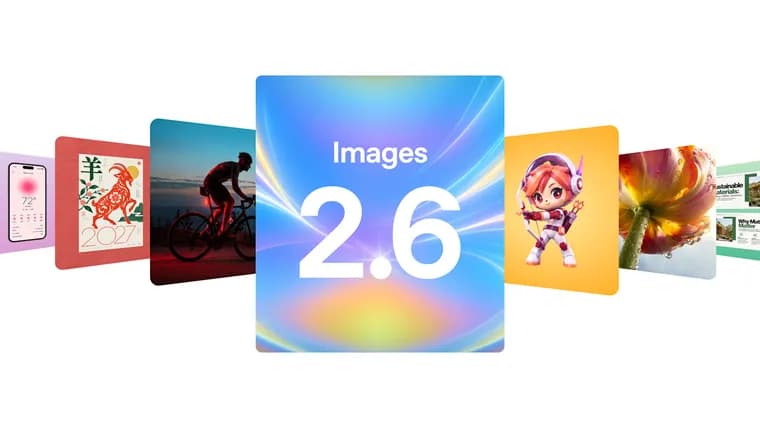
OpenAI has introduced Images 2.6 in ChatGPT, Codex and the API. The update has two aims: let people add motion to images with GIFs, and make polished visuals faster to produce and easier to refine, keeping characters, products and brand details consistent across edits.
OpenAI says people now create 4 billion images per week across ChatGPT, Codex and the API, which it puts at more than half a billion images per day on average. Images 2.6 generates images 50% faster than before; the announcement does not name the previous version used as the baseline.
In the API, developers get two models. GPT-Image-2.6 Flare is the fast one: with quality set to low it can generate images in as little as six seconds. OpenAI also says Flare improves layout quality for posters, product imagery and other professional visuals. GPT-Image-2.6 Sunburst is meant for work that needs more detail and precision. OpenAI says it brings higher-quality generation and even greater consistency across edits when quality is set to medium or high.
GIFs are the headline feature for users. OpenAI suggests marketers and creators can animate a brand mascot or character for a campaign, turn a product shot into a loop, make reactions and memes for social media, or build animated storyboards to explore character movement before video production. Even a simple sketch can become an animated character for videos, games and more. The one named customer is Town, a startup building an AI work assistant, which used Images 2.6 in the API to explore how animated characters could bring more personality to everyday interactions at work.
Developers also get more control. Image markup, already available in ChatGPT, comes to the API so teams can pinpoint exactly where to make specific changes. SVG exports make designs ready to use across websites, apps and print. A new complexity parameter lets developers adjust how much planning the model does to meet a request, with lower settings suited to quick edits. Image quality controls visual detail and fidelity, while complexity guides how much goes into the scene. OpenAI recommends low complexity for most editing tasks, paired with whatever image quality the workflow requires, and suggests trying medium or high complexity for scenes with many elements or constraints.
Images 2.6 is available globally today in ChatGPT and Codex across all subscription tiers, on desktop, mobile and web. Both Sunburst and Flare are available in the API, with pricing linked from the announcement. OpenAI points to a system card for its safety evaluations and safeguards.
Key facts
- Images 2.6 is available in ChatGPT, Codex and the API, and adds GIF generation for animating mascots, product shots, reactions and storyboards.
- OpenAI says Images 2.6 generates images 50% faster than before; Flare can produce an image in as little as six seconds at low quality.
- The API offers two models: GPT-Image-2.6 Flare (speed, poster and product layouts) and GPT-Image-2.6 Sunburst (higher quality and edit consistency at medium or high quality).
- API additions: image markup, SVG export for web, apps and print, and a new complexity parameter that sets how much planning the model does.
- OpenAI reports 4 billion images created per week across ChatGPT, Codex and the API, more than half a billion per day on average.
Why it matters
Image generation here moves from still pictures toward motion, and the API side moves toward work that gets edited and reused. GIFs let a mascot or product shot become a short loop without a separate video step, and SVG export gives designers a vector format for websites, apps and print. OpenAI also frames the launch against heavy usage: 4 billion images per week across ChatGPT, Codex and the API.
Who it affects
ChatGPT and Codex users on every subscription tier get Images 2.6 globally, on desktop, mobile and web. Marketers and creators are the audience OpenAI names for GIFs: campaign mascots, social reactions and memes, animated storyboards ahead of video production. Developers building on the API gain two model choices, image markup, SVG export and the complexity parameter. Town, an AI work assistant startup, is the one customer named.
How to use it
In ChatGPT and Codex, Images 2.6 is available now. In the API, pick GPT-Image-2.6 Flare when speed matters (as little as six seconds at low quality, plus better layouts for posters and product imagery) or GPT-Image-2.6 Sunburst when you need more detail and consistency across edits at medium or high quality. For most editing tasks OpenAI recommends low complexity for faster edits, paired with the image quality your workflow needs. For scenes with many elements or constraints, try medium or high complexity. Use image markup to point at exactly where a change should happen, and SVG export when the result needs to go to websites, apps or print. Pricing is linked from the announcement rather than stated in it.
How solid is it
This is a first-party announcement from OpenAI, and the performance claims are OpenAI's own. The 50% speed figure has no named baseline, and it is not said whether it applies to both Flare and Sunburst or to which quality setting. The six-second figure is for Flare at low quality only, with no image resolution given. No benchmark scores or comparisons with competing models are provided. The early access images are not attributed to named customers. Safety evaluations are referenced through a system card, not described in the announcement.
Risks and caveats
Several practical details are missing: no GIF specifications such as length, frame rate, resolution or size limits, and no API pricing in the text. Values of the complexity parameter beyond low, medium and high are not described. No calendar date is given; availability is stated only as today. OpenAI says to read the system card for safety evaluations and safeguards, so teams planning production use should check it.
“Images 2.6 generates images 50% faster than before.”
— OpenAI, announcement of Images 2.6