BCI Pioneers Coalition publishes ethics guidelines for brain implant trials
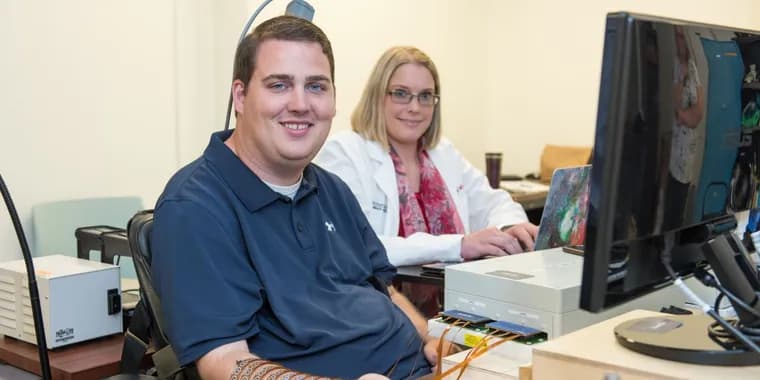
BCI Pioneers Coalition, a group for people who have taken part in brain-computer interface (BCI) trials, has published a set of guidelines for researchers who run such trials. Ian Burkhart cofounded the coalition in 2022. It lets trial participants share their experiences with each other and with researchers, and over the last year its members have developed the guidelines from those experiences. The aim is to help academics, clinicians and companies run ethical trials that respect participants' autonomy. The guidelines were published on Tuesday and contain recommendations in 13 categories.
Burkhart had a brain implant placed in 2014. He was paralyzed from the chest down after a diving accident in 2010, when he was 19, and he volunteered to be the first person to trial a brain implant designed for hand control. An array of 96 electrodes was inserted into the part of his brain that controls movement and connected to a computer by a cable that plugged into his head. Algorithms interpreted the signals and passed them to a sleeve of electrodes on his arm, which let him control it. The first movements were small, but he came to pour beads from bottles, move small and delicate objects and play Guitar Hero, though only during lab visits. He took part in two years-long clinical trials during the seven-and-a-half-year period he had the array implanted. 'It was a fantastic experience,' he says, but he would do some things differently knowing what he knows now.
Jennifer Chandler, a professor of law and neuroethics at the University of Ottawa who also worked on the guidelines, says general clinical trial ethics rules already exist, but BCI trials differ. 'These are people who have a device embedded in their brain, are in trials sometimes for years and years,' and they contribute a significant investment of time, of the body and of intellectual effort.
One category covers recognition and compensation. Burkhart says he went to the lab two or three days a week, four hours at a time, which he calls easily a part-time job. As the trial went on he learned more, gave more constructive feedback and says he was a key member of the research team. He suggests participants in that position might want to be listed as coauthors on scientific papers or publicly named as research collaborators. He and his colleagues acknowledge that not everyone will want this.
Privacy is another category. The guidelines say researchers have a duty to prepare participants for possible media attention, and the article notes that fully concealing a participant's identity may be hard in some cases. On brain data, the guidelines state that it 'should be understood as the participant's personal information.' They push for participants to be able to access their own brain data whenever they want, which has not always been possible. They also want to make sure people are not stopped from sharing it with their own doctors by embargoes or nondisclosure agreements (NDAs) meant to keep findings from competitors. Burkhart says firm NDAs are not super common in trials, but the group wants to make sure it does not happen. He was not much bothered by data collection in his own case, where researchers recorded movement-related activity, but people with implants that turn thoughts into words might feel differently.
The guidelines also cover what happens after a trial. About five years after Burkhart's implant, the research team ran into funding problems, and he was told it would have to be removed and could be put back once funding was secured. He kept it until 2021, when it was removed after an infection began where the cable entered his scalp. Losing the device was hard: he had regained the ability to move his arm and then lost it again. The article also cites Rita Leggett, an Australian woman with a brain implant to treat epilepsy, who has said she felt she 'became one' with it. When the company that made it went bust two years later, the device was removed against her will, an act ethicists have described as a potential breach of human rights. The guidelines say researchers should instead commit to maintaining brain devices for a 'reasonable period' after a trial ends, give participants plenty of time to prepare for removal surgery, and set aside extra funds to support participants who need it.
The article concedes limits. Some guidelines are vague and may overlap with existing ethics standards, and they do not all spell out explicit solutions. They were developed with feedback from a small group, since few people live with BCIs. The team hopes to grow and expand them over time, and Burkhart plans to discuss them with researchers at an upcoming neuroscience conference. Chandler calls it 'a living document' and 'version one.'
Key facts
- BCI Pioneers Coalition, cofounded in 2022 by Ian Burkhart, published guidelines on Tuesday with recommendations in 13 categories for researchers running BCI trials.
- Participants should be able to access their own brain data at any time and share it with their own doctors without being blocked by embargoes or NDAs; the guidelines treat brain data as the participant's personal information.
- Researchers should commit to maintaining implanted devices for a 'reasonable period' after a trial, give participants time to prepare for removal surgery and set aside extra funds to support them.
- Burkhart, who had a 96-electrode implant for hand control, says trial participation was like a part-time job at two or three days a week, four hours at a time, and suggests offering coauthorship or named collaborator status.
- The article says some guidelines are vague, may overlap with existing ethics standards and were built with feedback from a small group; Chandler calls them 'version one.'
Why it matters
BCI trials ask a lot of volunteers: a device in the brain, sometimes for years, plus large amounts of time and effort. Existing clinical trial ethics rules were not written with that in mind, Chandler says. These guidelines come from people who have lived it, and they target gaps the article illustrates with real cases: Burkhart's implant was threatened and then removed after funding problems and an infection, and Rita Leggett's device was removed against her will after its maker went bust.
Who it affects
Mainly academics, clinicians and companies running BCI trials, who are the intended audience, and the people who volunteer for them. The article says the number of people living with BCIs is still very low. Brain data privacy matters most for implants meant to turn thoughts into words, which Burkhart says may raise more concern than the movement signals recorded in his own case.
How to use it
The guidelines are aimed at researchers designing and running BCI trials, and they are recommendations. In practice that means planning for participant recognition and compensation, giving participants access to their own brain data and the freedom to share it with their doctors, preparing them for media attention, and setting up post-trial device maintenance and removal support, including extra funds, before a trial begins. Burkhart plans to discuss the guidelines with researchers at an upcoming neuroscience conference.
How solid is it
The guidelines come from BCI Pioneers Coalition members with input from Jennifer Chandler, a professor of law and neuroethics at the University of Ottawa, and are reported by MIT Technology Review's The Checkup newsletter. The article itself says some guidelines are vague and may overlap with existing ethics standards, and that they were developed with feedback from a small group. Chandler describes them as a living document, version one.
Risks and caveats
The guidelines are recommendations; the article does not describe them as legally binding. Not all of them spell out explicit solutions. Items such as coauthorship will not suit everyone, as Burkhart and colleagues acknowledge, and concealing a participant's identity may be difficult in some cases. The small group behind the feedback may not represent the wider range of people with implants.
“This is a living document, and this is version one. It's just the starting point.”
— Jennifer Chandler, professor of law and neuroethics at the University of Ottawa