Bill Gates bets at least $1 billion on AI's upside
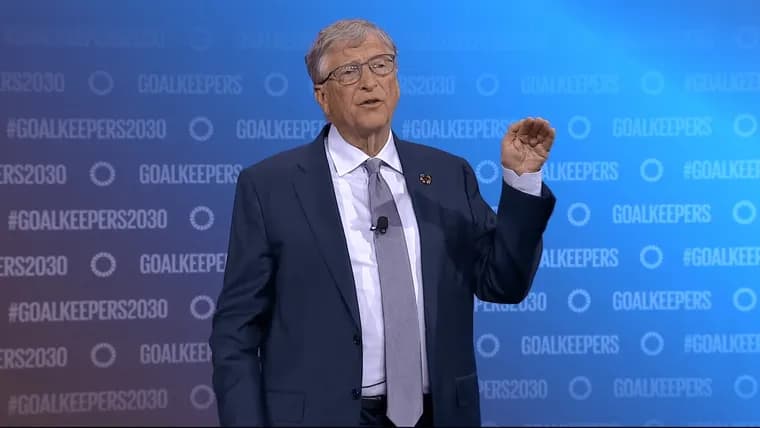
The Gates Foundation says it will spend at least $1 billion over the next two years to widen access to artificial intelligence in health, education, and agriculture. The pledge appears in the foundation's 2026 Goalkeepers report, where co-founder Bill Gates frames it as a response to a widening gap between rich and poor that AI could either close or deepen. 'AI could be a great equalizer - or widen the gap,' Gates writes. 'This is not a long-range prediction. It's a present-tense choice.' He argues that the decisions made over the next 12 to 18 months about how AI is built, funded, and deployed will decide whether the technology mainly benefits people who already have the most or reaches people who have the least.
Gates places language at the center of the problem. More than 90 percent of the data used to train early large language models came from English sources, he says, so about a billion mostly English-speaking users see AI improve every month while, in his words, nothing moves for the other seven billion. He points to a concrete gap in accuracy: leading speech recognition systems have an error rate below 6 percent in English but fail more than 60 percent of the time in Yoruba, a West African language. In a medical emergency, he argues, a bad translation can mean the difference between life and death.
Gates also argues the market will not close this gap on its own. He calls it 'an extraordinary engine of innovation, but a terrible guarantor of equal opportunity': left alone, it builds the most capable tools first for people who can pay. The foundation's money is meant to counter that by funding AI tools for workers in education, health care, and farming, and by helping fold non-English sources into the large datasets that models are trained on so developers can build in more languages.
To back the case, the report cites pilot projects already running. At clinics in Kenya's Penda Health network, an AI assistant that helps staff with diagnosis and drug dosing is credited with a 16-percentage-point rise in diagnostic accuracy. In Sierra Leone, students using the Gemini Guided Learning tool made learning gains of up to 1.7 years over an eight-week pilot. In India, the MahaVISTAAR AI advisory service for farmers already reaches more than 740,000 people at a cost to the government of less than 18 cents per person.
The billion dollars is a slice of a much larger commitment: the Gates Foundation aims to spend around $200 billion before it closes in 2045, a total Bloomberg calculates at 99 percent of Gates' remaining fortune, a figure tied to that full 2045 plan rather than to the AI pledge specifically. The report also marks a shift in tone. In an earlier essay of nearly 6,000 words, Gates struck a far darker note, accusing the tech industry of knowingly downplaying AI's risks because too much money is on the line, and naming lasting job losses, the misuse of AI to build bioweapons, and the psychological toll of always-available AI companions as real dangers. The new report argues the other side: that the same technology is an enormous opportunity, provided its benefits are secured through policy rather than left to chance.
Key facts
- The Gates Foundation will spend at least $1 billion over the next two years to widen AI access in health, education, and agriculture.
- More than 90 percent of the data behind early large language models came from English sources; leading speech recognition systems have an error rate below 6 percent in English versus more than 60 percent in Yoruba.
- Cited pilots: a 16-percentage-point rise in diagnostic accuracy at Kenya's Penda Health clinics, learning gains of up to 1.7 years in an eight-week Sierra Leone pilot of Gemini Guided Learning, and India's MahaVISTAAR farm-advisory service reaching more than 740,000 people at less than 18 cents per person.
- The $1 billion pledge is part of a total of around $200 billion the foundation plans to spend before closing in 2045, which Bloomberg calculates at 99 percent of Gates' remaining fortune, a figure tied to that full plan rather than the AI pledge alone.
- The pledge follows an earlier, nearly 6,000-word essay in which Gates warned of AI-driven job losses, bioweapon misuse, and the psychological toll of AI companions, and accused the tech industry of downplaying those risks.
Why it matters
The notable thing is the reversal in register, not a change in Gates' underlying view. He made the case for AI's dangers in an earlier, nearly 6,000-word essay accusing the industry of downplaying the risks because too much money is on the line. The Goalkeepers report argues the other half of that case: that AI, 'if shaped well, could expand who has access to solutions, opportunities, and knowledge that has too often been out of reach,' but only if it is deliberately steered there rather than left to spread on its own. Gates frames the next 12 to 18 months, covering how AI is built, funded, and deployed, as the window that decides which way it goes, which is why the foundation is putting money behind it now instead of treating the outcome as settled either way.
Who it affects
The foundation's own framing splits the world in two: about a billion mostly English-speaking users who see AI improve every month, and the other seven billion whom it says the current wave of models mostly bypasses. The billion dollars targets workers and users in the second group: clinical staff and patients at Penda Health's clinics in Kenya, students in Sierra Leone using the Gemini Guided Learning tool, and farmers in India served by the MahaVISTAAR advisory line. Developers who currently lack non-English training data are also a target, since part of the money is meant to open up non-English sources for them to build on.
How to use it
There is no product or signup here: this is grant funding routed through the Gates Foundation into named programs and into datasets, not a service the public can buy or subscribe to. The nearest thing to a template is the three pilots the report cites, each built for one worker group rather than a general audience: a clinical diagnosis assistant for staff at Penda Health's clinics in Kenya, a guided-learning tool for students in Sierra Leone, and an advisory line for farmers in India through MahaVISTAAR. Anyone looking to apply the approach elsewhere has these three as the closest thing to worked examples in the report.
How solid is it
The source is the Gates Foundation's own 2026 Goalkeepers report, so the figures are the foundation's account of its own pilots rather than independent evaluation. The three results cited, the 16-percentage-point diagnostic gain in Kenya, the up to 1.7-year learning gain in Sierra Leone, and the reach and cost of the India farming service, are explicitly presented in the report as evidence meant to back the approach, and at least the Sierra Leone figure comes from a short, eight-week pilot rather than a longer trial. No reaction from AI companies, governments, or outside commentators to the report is included here.
Risks and caveats
The 99-percent-of-fortune figure, from Bloomberg, describes the foundation's total spending plan of around $200 billion through 2045, not the $1 billion AI pledge specifically; the two should not be conflated. Gates' accusation that the tech industry downplays AI's risks for money comes from his earlier essay, which the article does not tie to any named company or individual, nor does it say when or where that essay appeared. The pledge itself commits to a goal, wider AI access in poorer regions, without yet specifying how the billion dollars divides across health, education, agriculture, and the data effort, or what mechanism will fold non-English sources into large datasets.
“AI could be a great equalizer - or widen the gap”
— Bill Gates, Gates Foundation co-founder, in its 2026 Goalkeepers report