blaze, a Rust build tool, claims edit rebuilds 10× to 24× faster than cargo
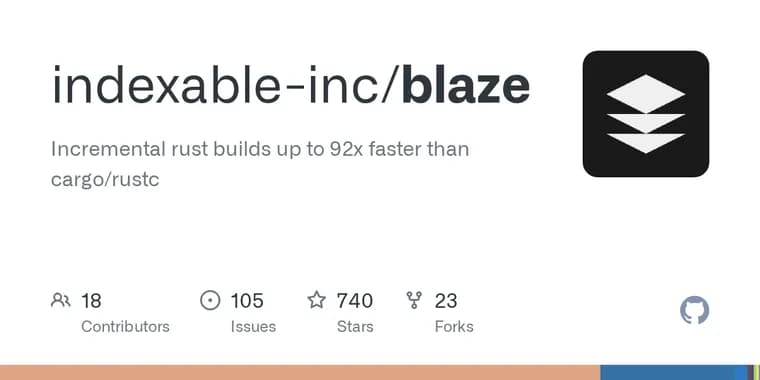
blaze is a Rust build tool from ix (indexable-inc), published on GitHub. It was called ra-jit until 2026-10-24, and cargo ra-jit still works. The pitch is "the same commands as cargo, with blaze in front": you type blaze run, blaze test or blaze build instead of the cargo equivalents, and every other cargo command passes straight through to cargo. Where cargo is installed, cargo blaze run does the same as blaze run.
The first build runs cargo, then waits a few seconds while blaze loads the project. After that, blaze keeps the project compiled in memory. When you edit a function and build again, it compiles only the functions you changed and writes them into the program cargo already built, instead of linking the whole thing again from scratch. The Finished line then says [ra-jit], which is blaze's engine. A program that opts in can also take the new code while it keeps running, which is hot reload.
The README gives its speed claims as averages over real projects, compared with cargo build: edits rebuild 10× faster on macOS arm64, 24× faster on Linux aarch64 and 11× faster on Linux x86-64. With live edits, it quotes about 20 ms from saving a file to a running program using the new code. Per-project numbers, charts, and memory and disk use are on a separate benchmarks page.
There are trade-offs. blaze supports macOS on Apple silicon and Linux; on Windows every build is cargo's. It is its own toolchain: it builds every project with its own Rust, currently the nightly of 2026-10-25, whatever the project pins, and both stable code and #![feature(...)] code build. It downloads that Rust once (about 100 to 135 MB) or uses rustup's. It trades memory for speed, at a few GB for a small project. The authors call it young and advise keeping cargo check or CI as the final word, and ask users to report any difference from cargo.
Install is a one-line curl script, with crates.io and Nix options. Running nix run github:indexable-inc/blaze opens a Game of Life demo window. Its rules, colours and speed can be changed while it runs on macOS on Apple silicon only; elsewhere the window runs without live edits. It needs Nix and builds blaze from source the first time.
The README credits the projects it builds on: rust-analyzer (whose analysis and MIR blaze compiles from), Cranelift from the Bytecode Alliance (the fast code generator), LLVM and inkwell (for the optimised tiers), salsa (the incremental engine), object, Rust and its compiler crates, and rustd from DioxusLabs (whose code blaze includes). It states that none of these projects endorses blaze. It is licensed MIT or Apache-2.0 and was made at ix for den's native app. The authors say they are working with a few teams on fast Rust CI and remote builds built on blaze, and invite teams that wait on Rust builds to get in touch at andrew@ix.dev, with early access offered.
Key facts
- blaze runs beside cargo and keeps a Rust project compiled in memory; after an edit it recompiles only the changed functions and writes them into the program cargo already built.
- README averages over real projects, versus cargo build: 10× faster on macOS arm64, 24× on Linux aarch64, 11× on Linux x86-64.
- With live edits, about 20 ms from saving a file to a running program using the new code.
- It supports macOS on Apple silicon and Linux, builds with its own Rust (nightly of 2026-10-25), and costs a few GB of memory for a small project.
- The project was called ra-jit until 2026-10-24 and describes itself as young, advising cargo check or CI as the final word.
Why it matters
Waiting on rebuilds after every small edit is a daily cost in Rust work. blaze attacks it by skipping the link step and patching only the changed functions into a program cargo already built. If the README's averages hold on your code, an edit-rebuild loop drops from cargo's pace to milliseconds. The README also describes hot reload for programs that opt in, so new code can reach a running program.
Who it affects
Rust developers on macOS with Apple silicon or on Linux, the two platforms blaze supports. Windows users get cargo's build for every command. Teams that wait on Rust CI and remote builds are also a target: the authors say they are working with a few such teams and offer early access.
How to use it
Install with the one-line curl script from the README, or via crates.io or Nix. It works with or without Rust installed, since blaze downloads its own Rust once (about 100 to 135 MB) or uses rustup's. In any Rust project, run blaze run, blaze test or blaze build in place of the cargo commands. The first build runs cargo and then waits a few seconds for blaze to load the project; later edits rebuild in milliseconds. Other cargo commands pass through. The licence is MIT or Apache-2.0. For release news, the README suggests watching the GitHub releases.
How solid is it
The figures come from the project's own README, and nobody independent is cited. The README describes them only as averages over real projects; the project list and hardware sit on a separate benchmarks page. The speedups are for edit rebuilds, not the first build, which runs cargo. The 92x in the Hacker News headline does not appear in the README text; the stated averages are 10×, 24× and 11×. No adoption numbers or third-party reviews are given. The authors call the tool young.
Risks and caveats
blaze builds every project with its own Rust, currently the nightly of 2026-10-25, whatever the project pins, so results can differ from your pinned toolchain. The authors say your own toolchain and CI should stay the final word and ask users to report differences from cargo. It uses a few GB of memory for a small project. Windows is not covered. Live edits in the demo window work only on macOS on Apple silicon. The project was renamed on 2026-10-24, and none of the upstream projects it credits endorses it.
“blaze runs beside cargo and keeps your project compiled in memory.”
— blaze README