Δτ-Bench tests AI agents as their tools change; best result is 42.3%
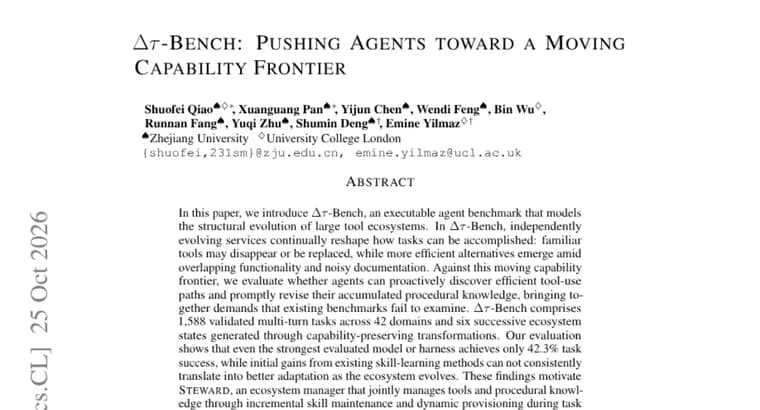
A new paper introduces Δτ-Bench, an executable benchmark for AI agents that models how large tool ecosystems change over time. In this benchmark, independently evolving services keep reshaping how a task can be done: familiar tools may disappear or be replaced, while more efficient alternatives emerge, amid overlapping functionality and noisy documentation.
Against this moving capability frontier, the authors test whether agents can proactively discover efficient tool-use paths and promptly revise the procedural knowledge they have accumulated. They say existing benchmarks fail to examine these demands together.
The benchmark comprises 1,588 validated multi-turn tasks across 42 domains and six successive ecosystem states. The states are generated through capability-preserving transformations.
The headline result is weak. Even the strongest evaluated model or harness achieves only 42.3% task success. The authors also report that initial gains from existing skill-learning methods cannot consistently translate into better adaptation as the ecosystem evolves.
Those findings motivate Steward, the authors' own ecosystem manager. It jointly manages tools and procedural knowledge through incremental skill maintenance and dynamic provisioning during task execution. In the authors' experiments, Steward sustains higher task success across ecosystem changes with lower skill-maintenance overhead, while improving both recovery from disrupted workflows and adoption of more efficient alternatives.
Key facts
- Δτ-Bench is an executable agent benchmark that models the structural evolution of large tool ecosystems, with tools disappearing, being replaced, or superseded by more efficient ones.
- It has 1,588 validated multi-turn tasks across 42 domains and six successive ecosystem states, generated through capability-preserving transformations.
- Even the strongest evaluated model or harness reaches only 42.3% task success.
- Initial gains from existing skill-learning methods do not consistently carry over into better adaptation as the ecosystem changes.
- The authors propose Steward, which manages tools and procedural knowledge together and, in their experiments, sustains higher task success with lower skill-maintenance overhead.
Why it matters
Agents that rely on tools and saved procedures face a problem: the tools they learned to use can vanish, be replaced, or be beaten by something more efficient. The authors say existing benchmarks fail to examine the combined demand of finding efficient tool-use paths and promptly revising accumulated procedural knowledge. Δτ-Bench is built to test exactly that, and a best result of 42.3% task success suggests the gap is large.
Who it affects
Researchers building and evaluating tool-using agents and skill-learning methods are the direct audience, since the paper reports that gains from existing skill-learning methods do not consistently survive ecosystem change. Anyone designing agents that must keep working as services change has a reason to look at how Steward handles tools and procedural knowledge together.
How to use it
The practical reading is as a test design: evaluate an agent across successive ecosystem states rather than a single frozen one, and check whether it recovers from disrupted workflows and adopts more efficient alternatives. Steward's idea is to maintain skills incrementally and provision tools dynamically during task execution. No release, code or dataset availability is stated in the abstract.
How solid is it
This is a preprint abstract, and the claims are the authors' own. The benchmark size is concrete: 1,588 validated multi-turn tasks, 42 domains, six ecosystem states. The abstract names no authors or institutions and does not say which model or harness achieved 42.3%. No baseline numbers for Steward or for the skill-learning methods are given, so the size of Steward's improvement and of the overhead reduction is not quantified.
Risks and caveats
Steward's advantages are reported as experimental findings by the same authors who built the benchmark, with no figures attached. The existing skill-learning methods and the other evaluated models are not named, and the 42 domains are not listed, so the result is hard to judge from the abstract alone. The 42.3% figure is the maximum across evaluated systems, not an average.