Blue Origin tests Northstar engine it says costs 1/4 of the BE-4
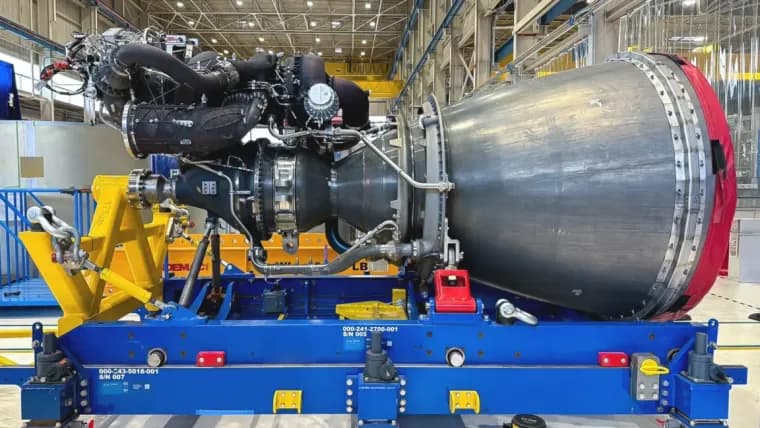
Blue Origin announced two significant upgrades to its New Glenn rocket on Thursday, at the UP.Summit conference at the Shuttle Landing Facility at Kennedy Space Center in Florida. The company says the changes reduce the cost of manufacturing the vehicle and expand its capacity for payload delivery to geostationary orbit and the Moon. With the upgrades, Blue Origin aims to eventually position New Glenn to launch more than 1,000 times a year. "There has never been higher demand for launch, ever," said Dave Limp, chief executive officer of Blue Origin.
The first upgrade is a new engine called Northstar. Blue Origin has already begun test firing it, and it will eventually replace the BE-4 engine that powers New Glenn's first stage. Limp described Northstar as a simplified but more powerful version of the BE-4. It has half the number of parts and 30 percent less mass, and about 65 percent of it can be 3D-printed. Blue Origin believes it can manufacture the engine at 25 percent of the cost of a BE-4, and eventually reach the point where each engine can be assembled in less than a day. The company is deep into development and testing and has started a test-firing campaign.
On thrust, the BE-4 powering New Glenn today produces 640,000 pounds. Limp said Northstar will have a starting thrust of 715,000 pounds. Like the BE-4, Northstar burns methane and liquid oxygen, using an oxygen-rich staged combustion cycle and a single-shaft turbopump architecture.
Separately, the company said it is developing a hydrogen-oxygen third stage for New Glenn, called GS3, to give the rocket an extra kick.
Limp said Blue Origin will continue to manufacture the existing BE-4 for United Launch Alliance, whose Vulcan rocket uses two of the engines. "To get access to space at a lower cost, we have to look at every part of the vehicle," Limp said. "This is going to be a game-changer."
Key facts
- Northstar, a new methane and liquid-oxygen engine now in a test-firing campaign, is meant to eventually replace the BE-4 on New Glenn's first stage.
- Per Dave Limp, Northstar has half the parts and 30 percent less mass than the BE-4, and about 65 percent of it can be 3D-printed.
- Blue Origin believes it can build Northstar at 25 percent of a BE-4's cost and eventually assemble an engine in under a day; starting thrust is 715,000 pounds versus 640,000 for the BE-4.
- A hydrogen-oxygen third stage, GS3, is also in development for New Glenn.
- Blue Origin will keep making the BE-4 for United Launch Alliance, whose Vulcan rocket uses two per vehicle.
Why it matters
Blue Origin ties both upgrades to a stated goal of eventually positioning New Glenn to launch more than 1,000 times a year. The pitch is lower manufacturing cost, with a claimed quarter of the BE-4's price, plus more payload capacity to geostationary orbit and the Moon. Northstar keeps the BE-4's basic design (methane and liquid oxygen, oxygen-rich staged combustion, single-shaft turbopump) while cutting parts and mass and adding thrust. Limp frames it as demand-driven: he says there has never been higher demand for launch.
Who it affects
New Glenn is the vehicle directly changed, and Blue Origin is the company building the engine and stage. United Launch Alliance is the named outside party: Limp said Blue Origin will continue to manufacture the existing BE-4 for ULA, whose Vulcan rocket uses two of the engines.
How to use it
Nothing here is available to buy or use yet. Northstar is in a test-firing campaign, and GS3 is in development. For readers tracking launch hardware, the figures to watch are the ones Limp gave: 715,000 pounds of starting thrust against the BE-4's 640,000, half the parts, 30 percent less mass, and a target of under a day to assemble each engine.
How solid is it
The facts come from company statements by Limp, relayed by Ars Technica from the UP.Summit announcement. The test firing is described as already begun. The cost figure is a belief, not a demonstrated result: Blue Origin "believes it can" manufacture Northstar at 25 percent of a BE-4's cost, and the under-a-day assembly time is something the company hopes to reach eventually. No dollar cost is given.
Risks and caveats
No timescale is given for when Northstar will replace the BE-4 or when it will first fly. No date or performance figures (thrust, payload) are given for GS3, and no payload numbers are given for geostationary orbit or the Moon. The 1,000-launches-a-year goal carries only the word "eventually". The 715,000 pounds is a starting thrust, and no final figure or thrust type (sea level or vacuum) is stated.
“To get access to space at a lower cost, we have to look at every part of the vehicle.”
— Dave Limp, chief executive officer of Blue Origin