Brevis compresses model checkpoints by treating compression as program synthesis
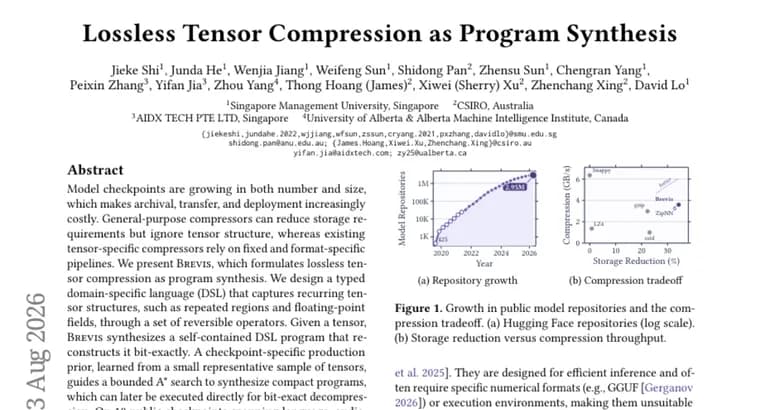
Researchers present Brevis, a lossless compressor for model checkpoint tensors that reframes compression as program synthesis rather than encoding. The authors note that general-purpose compressors like zstd and gzip shrink files but ignore tensor structure, while existing tensor-specific compressors are locked to fixed, format-specific pipelines. Brevis instead uses a typed domain-specific language (DSL) built from reversible operators that capture recurring tensor patterns, such as repeated regions and floating-point fields. Given a tensor, Brevis synthesizes a self-contained DSL program that reconstructs the tensor bit-exactly; a production prior learned from a small representative sample of tensors guides a bounded A* search toward compact programs, which are then executed directly to decompress the data losslessly. Tested on 10 public checkpoints spanning language, audio, and image generation models, Brevis reduced 2.13 TB of checkpoint data to 1.41 TB, a 33.93% overall storage reduction. Against four general-purpose compressors, including zstd and gzip, Brevis produced archives up to 30.87% smaller. It also beat two tensor-specific compressors, ZipNN and DFloat11, producing smaller archives than both. Under a practical concurrency configuration, Brevis reached 3.60 GB/s compression throughput and 6.61 GB/s decompression throughput while preserving every source byte.
Key facts
- Brevis formulates lossless tensor compression as program synthesis: a typed DSL of reversible operators plus a bounded A* search produce a self-contained program that reconstructs each tensor bit-exactly.
- On 10 public checkpoints spanning language, audio, and image generation models, Brevis cut 2.13 TB of data to 1.41 TB, a 33.93% storage reduction.
- Brevis produces archives up to 30.87% smaller than four general-purpose compressors, including zstd and gzip.
- Brevis also beats the tensor-specific compressors ZipNN and DFloat11 on archive size.
- Under a practical concurrency configuration, Brevis achieves 3.60 GB/s compression and 6.61 GB/s decompression while preserving every source byte.
Why it matters
Model checkpoints keep growing in number and size, which makes archival, transfer, and deployment increasingly costly. General-purpose compressors save space but ignore the structure specific to tensors, and prior tensor-specific compressors are stuck with fixed, format-specific pipelines. Brevis's contribution is treating compression itself as a search problem: rather than applying one fixed encoding scheme, it synthesizes a bespoke, self-contained decompression program for each tensor from a typed DSL of reversible operators, guided by a production prior learned from a small sample of the checkpoint's own tensors.
Who it affects
Anyone storing, archiving, or transferring large model checkpoints, including teams running language, audio, and image generation models, since the 10 test checkpoints span all three categories. Lower storage costs and faster transfer for large models translate directly into infrastructure savings for organizations maintaining many checkpoint versions.
How to use it
Brevis is described as a compression method: it synthesizes a DSL program per tensor via a bounded A* search using a checkpoint-specific production prior, then that program is executed directly for bit-exact decompression. The source text does not give pricing, licensing, or release details, so how it would be packaged or distributed is not stated.
How solid is it
The result is empirical and benchmarked against named baselines: Brevis was tested on 10 public checkpoints totaling 2.13 TB, spanning language, audio, and image generation models, and compared directly against four general-purpose compressors (including zstd and gzip) and two tensor-specific compressors (ZipNN and DFloat11), beating all of them on archive size while also reporting concrete throughput numbers (3.60 GB/s compression, 6.61 GB/s decompression) under a stated but unspecified 'practical concurrency configuration'.
Risks and caveats
The source text does not identify the specific 10 checkpoints tested, give a per-compressor breakdown of the 30.87% figure (versus zstd, gzip, or the other two compressors individually), or specify the hardware or exact concurrency configuration behind the reported throughput numbers, so the generality of the gains across different hardware and checkpoint types cannot be assessed from what is available here.