BridgeVLA++ adds memory to vision-language-action robots
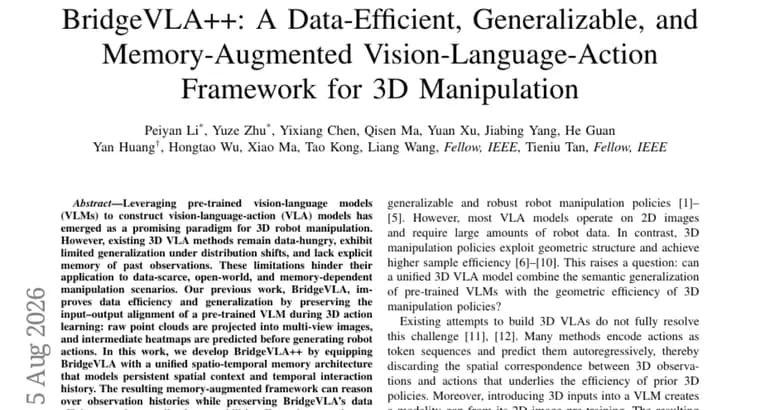
A team behind the BridgeVLA vision-language-action (VLA) framework has released a successor, BridgeVLA++, that adds explicit memory to how robots handle 3D manipulation tasks. The authors argue that existing 3D VLA methods share three weaknesses: they need large amounts of training data, generalize poorly when conditions shift from training, and have no explicit memory of what they observed earlier. Those gaps matter most in data-scarce settings, open-world environments, and tasks where the robot must recall something it saw or did before.
The original BridgeVLA already addressed data efficiency and generalization by keeping a pre-trained vision-language model's input-output alignment intact during 3D action learning: raw point clouds get projected into multi-view images, the model predicts intermediate heatmaps, and only then generates the robot's actions. BridgeVLA++ builds on that pipeline by adding a unified spatio-temporal memory architecture that models both persistent spatial context and the history of temporal interactions, letting the system reason over sequences of past observations rather than treating each moment in isolation.
According to the authors, the memory-augmented framework preserves BridgeVLA's original data efficiency and generalization while adding this new capability. They report that BridgeVLA++ performs strongly on spatial manipulation tasks and generalizes robustly, and that it reaches state-of-the-art results on two benchmarks specifically designed to be memory-dependent, without giving up the efficiency or generalization the original model had. The team also says the framework works in bimanual manipulation, where a robot coordinates two arms, and that it was validated on an additional real-world robotic platform beyond whatever setup was used during development, which they present as evidence of scalability across tasks, environments, and hardware.
The paper's own text does not name the two memory-dependent benchmarks, does not give numeric results, does not specify which real-world platform was used for validation, and does not state a release timeline. A project website is linked for further detail.
Key facts
- BridgeVLA++ extends the earlier BridgeVLA framework by adding a unified spatio-temporal memory architecture for 3D robot manipulation.
- The memory module models both persistent spatial context and temporal interaction history, letting the system reason over past observations.
- The authors report state-of-the-art results on two (unnamed) memory-dependent manipulation benchmarks, without sacrificing BridgeVLA's original data efficiency and generalization.
- The framework is also reported to work in bimanual manipulation and was validated on an additional real-world robotic platform.
- No benchmark names, numeric scores, or a release timeline appear in the paper's text; a project website is provided for further detail.
Why it matters
Most vision-language-action models for 3D manipulation are built to react to a single, current observation. That works for simple pick-and-place tasks but breaks down whenever a robot needs to remember something it saw earlier, such as where an object was before it got occluded, or what step of a multi-stage task it already completed. BridgeVLA++ targets that gap directly by giving the underlying BridgeVLA pipeline explicit spatio-temporal memory, while the authors say it keeps the data efficiency and generalization that made the original model attractive in the first place.
Who it affects
The work is aimed at robotics and embodied-AI researchers building 3D manipulation systems, particularly those working on data-scarce or open-world settings where collecting large task-specific datasets is expensive. It also speaks to teams working on bimanual robots, since the authors report the framework performing effectively there, and to anyone evaluating VLA architectures on real hardware rather than only in simulation, given the reported validation on an additional real-world platform.
How to use it
The paper's text does not describe pricing, licensing, or code release terms. A project website is linked (bridgevla-plus.github.io) for further technical detail; the source text does not state whether code, weights, or benchmark data are published there.
How solid is it
The claims come from the authors' own paper describing their extensions to their prior BridgeVLA work. They report strong performance on spatial manipulation tasks, state-of-the-art results on two memory-dependent benchmarks, and successful validation on an additional real-world platform and in bimanual settings, but the source text supplies no benchmark names, no numeric scores, and no comparison figures against baseline methods, so the strength of the results cannot be independently assessed from the text alone.
Risks and caveats
The available text is a paper abstract-level description: it names no institutions, no specific benchmarks, no numbers, and no release date. Without those specifics, claims of 'state-of-the-art' performance and 'robust' generalization rest entirely on the authors' own characterization rather than independently verifiable figures.