Bubble Bobble creator's 1989 column predicted AI rip-off games
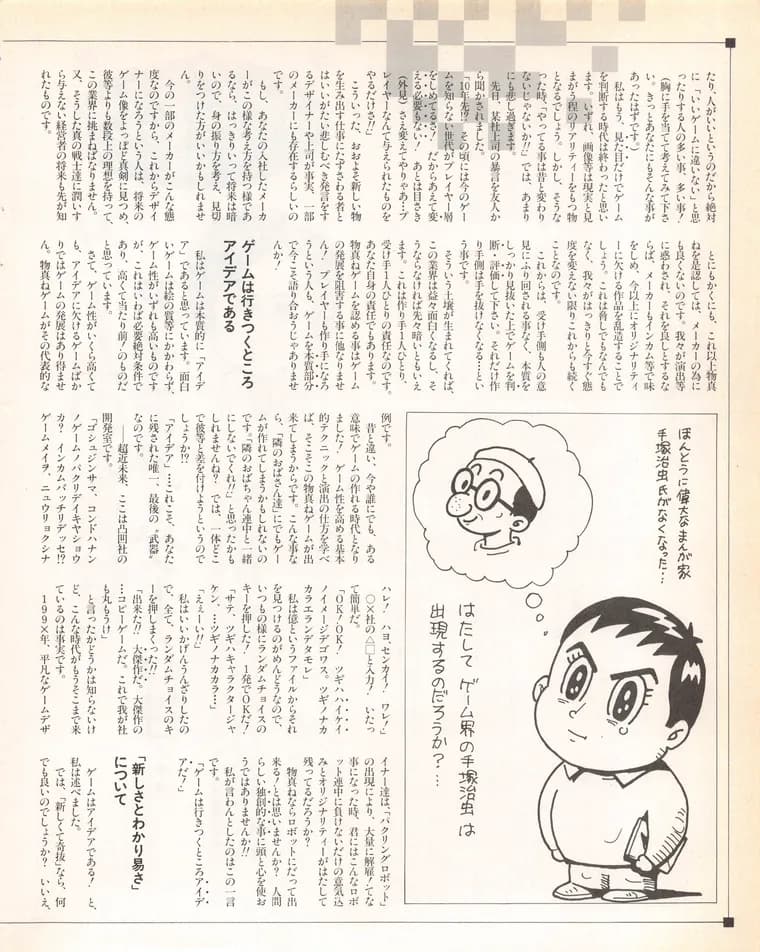
A blog post on gingerbeardman.com translates and revisits part 2 of a column written by Fukio Mitsuji, known as MTJ, the designer behind Bubble Bobble, Rainbow Islands, Syvalion, Volfied and Magical Puzzle Popils. The column, titled Introduction to Game Design, ran in the Japanese arcade magazine GAMEST No. 31 in April 1989. In it, MTJ attacks the industry habit of churning out imitation games, first quoting an unnamed manager at an unnamed company defending the practice: "Ten years from now!? By then the player base will be a generation that doesn't even know today's games! So there's no need to go changing anything! Just tweak the surface, the outside, and players just play whatever they're handed!!" MTJ answers with a piece of science fiction set at a fictional studio, Dekoboko Co. There, a designer talks to a machine he calls the Pakuringu Robotto, the blog author renders it as the Rip-O-Bot, which asks which game to copy this time and promises the takings will be splendid. The designer types in a rival company's title, hits a random-choice key to pick a background image from hundreds of millions of files, then hammers the same key through the character selection, and the machine spits out a finished copycat game. MTJ writes that this is not far off: he predicts that by the 199X (his own shorthand for the coming decade), ordinary game designers could be laid off en masse once the Rip-O-Bot arrives, and asks readers whether they will still have the drive and originality to outdo the robots when that happens. His answer, repeated as the thesis of the column, is that a game is, in the end, the idea; robots can imitate, so a designer's energy should go into the kind of original work only a human can make, since technique alone leaves no real difference between a designer and a machine. The same GAMEST issue carries a hand-drawn tribute to Osamu Tezuka, the "god of manga", who had died on 9 February 1989 shortly before the issue went to press, with MTJ's page asking whether a Tezuka of the game world will ever appear. Mitsuji himself died in 2008 at age 48, decades before the tools he described existed. The blog author, who transcribed the Japanese text from a scan and assembled the English quotes from multiple machine translators compared and lightly edited by hand, connects the column directly to current generative AI tools and to his own new game-making tool, Jinks, which he built to spend less time on boilerplate like input, scoring and display and more time on gameplay and systems, while acknowledging Jinks could just as easily be used to make a copycat game.
Key facts
- The column is by Fukio Mitsuji (MTJ), designer of Bubble Bobble, Rainbow Islands, Syvalion, Volfied and Magical Puzzle Popils, published as part 2 of his series in GAMEST No. 31, April 1989.
- MTJ's fictional Rip-O-Bot, at a studio he calls Dekoboko Co., generates a full copycat game from random-choice menu picks after a designer types in a rival title to imitate.
- MTJ predicts ordinary game designers could be laid off en masse once such a machine arrives, and argues the idea, not technique, is a designer's one remaining weapon.
- The same GAMEST issue mourns manga artist Osamu Tezuka, who died 9 February 1989, with a hand-drawn page asking who will be the Tezuka of the game world.
- The blog author transcribed the scanned Japanese original himself and built the English quotes from multiple machine translations, which he compared, combined and lightly edited.
Why it matters
The piece resonates now because MTJ, writing in 1989 from inside Japan's arcade industry, described the mechanics of AI-generated imitation, prompt in a title, spin a random background, spin a random cast, out comes a passable copy, decades before generative tools made that literal. His conclusion, that imitation is cheap and the idea is the only thing a machine cannot hand a designer, is offered by the blog author as a still-useful answer to the same question generative AI raises today.
Who it affects
Game designers and other creative professionals weighing what generative tools leave for human effort, plus readers of retro game history and Japanese arcade culture; MTJ frames the stakes specifically for people who dreamed of becoming game designers, the audience his original column addressed.
How to use it
The full translated column, with the original Japanese scan, the Rip-O-Bot dialogue and the Tezuka tribute page, is on gingerbeardman.com; the author also links it to Jinks, his own tool for building games faster by handling boilerplate like input, scoring and display so more time goes to gameplay and systems.
How solid is it
The account rests on MTJ's own published column: the blog author transcribed the Japanese text himself from a scan of the original vertical layout and built the English quotes by running the page through multiple machine translators, then comparing, combining and lightly editing the results rather than commissioning a professional translation.
Risks and caveats
The English quotes are machine-assisted and self-edited rather than professionally translated, and the author notes the robot's original mix of Kansai, Kyushu and Hiroshima dialect with archaic courtly Japanese cannot be fully reproduced in English. The manager MTJ quotes at the start of the column, and the company he worked for, are never named, and the source does not say whether Jinks, the author's own tool, has shipped or is still in development.
“In the end, a game IS the idea!”
— Fukio Mitsuji (MTJ), GAMEST No. 31, April 1989, as translated by the blog's author