C3LM reaches state of the art in retrosynthesis with Top-K training
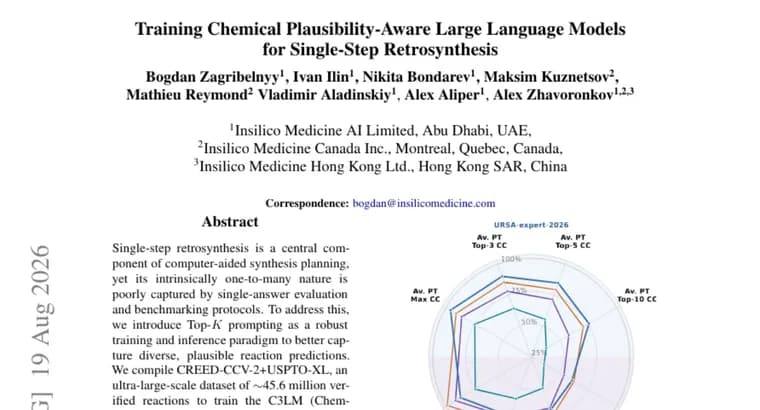
Single-step retrosynthesis, working backward from a target molecule to the reactions that could produce it, is a core piece of computer-aided synthesis planning. The researchers argue that standard single-answer evaluation and benchmarking protocols poorly capture this problem's true nature: a given target usually has many chemically valid precursor routes, not one. To address that, they introduce Top-K prompting, a training and inference paradigm designed to make a model produce a diverse set of plausible reaction predictions rather than a single guess.
To train with this paradigm, the team compiled CREED-CCV-2+USPTO-XL, described as an ultra-large-scale dataset of about 45.6 million verified reactions. They used it to train a model called C3LM (Chemistry Constraint-Consistent Language Model). Fine-tuning combines two reward signals: one based on a tool called ChemCensor, and a separate novelty-oriented reward meant to push predictions toward less obvious but still plausible reactions. With this setup, the authors report that C3LM achieves state-of-the-art performance on the OOD URSA-expert-2026 benchmark.
A further analysis looked at how unique each system's predicted reactions are. It found that LLM-based models and conventional (non-LLM) retrosynthesis models tend to explore complementary parts of the space of possible reactions, meaning each catches valid routes the other misses. The authors take this as motivation for ensemble-based retrosynthesis systems that combine both types of model. They frame Top-K, plausibility-aware training overall as a practical new direction for future LLM-based synthesis planning.
Key facts
- Top-K prompting is introduced as a training and inference paradigm for single-step retrosynthesis, aimed at capturing the diverse, plausible reaction predictions that single-answer evaluation misses.
- The team compiled CREED-CCV-2+USPTO-XL, an ultra-large-scale dataset of about 45.6 million verified reactions, to train a model called C3LM (Chemistry Constraint-Consistent Language Model).
- Fine-tuning integrates a ChemCensor-based reward with a separate novelty-oriented reward.
- C3LM is reported to achieve state-of-the-art performance on the OOD URSA-expert-2026 benchmark.
- Analysis of reaction uniqueness shows LLM-based and conventional retrosynthesis models explore complementary reaction spaces, motivating ensemble systems that combine both.
Why it matters
Retrosynthesis, predicting which reactions could produce a target molecule, is a central task in computer-aided synthesis planning used across chemistry and drug discovery. The paper's core argument is that this task is intrinsically one-to-many: many different reaction routes can be valid for the same target, yet common single-answer evaluation protocols do not capture that diversity. Top-K prompting reframes both training and inference around producing a set of plausible predictions instead of one, which the authors position as a new direction for LLM-based synthesis planning rather than an incremental tweak to existing models.
Who it affects
The work is aimed at researchers and toolmakers building computational retrosynthesis and synthesis-planning systems, and by extension chemists who rely on such tools to plan how to make a target compound. The complementary-coverage finding between LLM-based and conventional retrosynthesis models is also relevant to anyone deciding whether to deploy one type of model or combine both in a production pipeline.
How to use it
The practical recipe described is: pair a very large, verified reaction dataset (here, about 45.6 million reactions across CREED-CCV-2+USPTO-XL) with Top-K prompting during both training and inference, and fine-tune with a combination of a ChemCensor-based reward and a novelty-oriented reward. The text does not describe the internal workings of ChemCensor or the novelty-oriented reward beyond naming them, so reproducing the exact setup would require consulting the full paper rather than the abstract alone.
How solid is it
The central claim, state-of-the-art performance on the OOD URSA-expert-2026 benchmark, comes from the authors themselves. The abstract names no authors or institutions, and no prior state-of-the-art result or numeric performance score is given for comparison, so there is no way from this text alone to gauge the size of the reported improvement. No definition or origin of the OOD URSA-expert-2026 benchmark is given either, which limits independent assessment of how the result should be weighed.
Risks and caveats
The state-of-the-art claim is self-reported and not accompanied by comparison numbers or a description of the benchmark it was measured on, both of which are missing from the available text. The ChemCensor-based and novelty-oriented rewards are named but not detailed, so their individual contributions to the result cannot be assessed from this material. The complementary-reaction-space finding is presented as motivation for future ensemble systems rather than as an ensemble system that has itself been built and tested.