Empirical Variational Autoencoder (EVA) learns its own latent priors for sequence generation
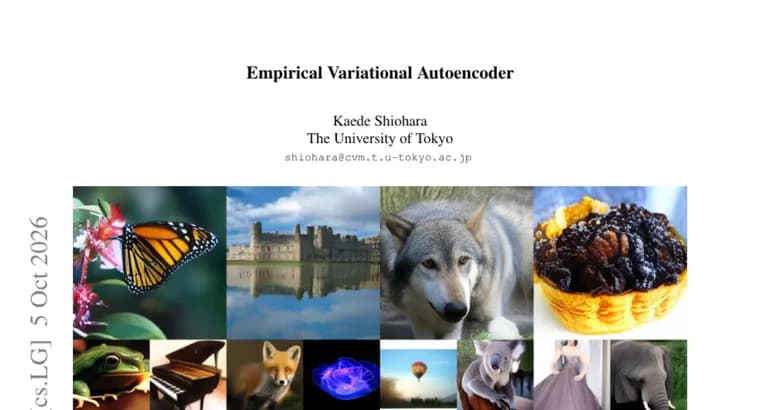
A paper listed on Hugging Face Papers presents the Empirical Variational Autoencoder, or EVA. It is described as a general generative framework for continuous-valued sequences, meaning data that is not vector-quantized.
EVA starts from the evidence lower bound of the standard Variational Autoencoder (VAE), but changes how the latent prior is handled. A conventional VAE constrains its latent space toward a standard Gaussian. EVA replaces that constraint with self-predicted priors: it learns autoregressive latent priors empirically from the training data. According to the authors, this can be implemented with only an additional single linear layer on top of a VAE.
The authors say the change significantly alleviates the latent distribution gap between prior and posterior, a gap they describe as typically observed in conventional VAEs. In their account, closing that gap leads to high-fidelity ancestral sampling for sequential data generation.
For evidence, the paper points to what it calls extensive experiments on image and sound synthesis. The authors report that EVA achieves competitive generation quality with autoregressive diffusion baselines despite its much faster inference time. The text describes the result only in these terms; it gives no metrics, benchmark scores, datasets, model sizes or speedup factors, and the baselines are identified only as autoregressive diffusion baselines.
Key facts
- EVA (Empirical Variational Autoencoder) is proposed as a general generative framework for continuous-valued, non-vector-quantized sequences.
- It builds on the VAE evidence lower bound but learns autoregressive latent priors from training data, replacing the standard-Gaussian constraint with self-predicted priors.
- The authors say it can be implemented with only an additional single linear layer on top of VAEs.
- The authors claim it significantly alleviates the prior-posterior latent distribution gap seen in conventional VAEs, giving high-fidelity ancestral sampling.
- On image and sound synthesis, the authors report generation quality competitive with autoregressive diffusion baselines and much faster inference time.
Why it matters
Standard VAEs tie their latent space to a standard Gaussian, and the authors argue this leaves a gap between prior and posterior that hurts sampling. EVA's answer is to let the model predict its own prior from the data. If the reported results hold, the appeal is a simple VAE-based route to quality that the authors describe as competitive with autoregressive diffusion baselines, at much faster inference time.
Who it affects
Mainly researchers working on generative models for continuous sequential data, such as image and sound synthesis, who compare VAE-style and diffusion-style approaches. Practitioners who already run VAEs are the natural audience, since the method sits on top of an existing VAE.
How to use it
According to the authors, EVA can be implemented with only an additional single linear layer on top of a VAE, so adopting it would not mean replacing the underlying architecture. No code or model release is mentioned in the source. Anyone wanting to try it would need to work from the paper's description.
How solid is it
The evidence is the authors' own report of extensive experiments on image and sound synthesis, and only the abstract-level summary is available here. The abstract says quality is competitive, not better than or equal to the baselines. No numerical results are given: no metrics, benchmark scores, datasets, model sizes or inference speedup factors. The baselines are described only as autoregressive diffusion baselines, with no specific models named.
Risks and caveats
Claims such as significantly alleviating the latent distribution gap and much faster inference time are the authors' own and come without figures in the source text, so they cannot be checked here. Competitive quality does not mean the method wins, and the comparison is with autoregressive diffusion baselines only as the authors choose to describe them. Independent replication would be needed before treating EVA as a substitute for diffusion approaches.
“EVA achieves competitive generation quality with autoregressive diffusion baselines despite its much faster inference time.”
— From the paper's abstract