CausalWAM proposes sparse routing so world action models act on causes
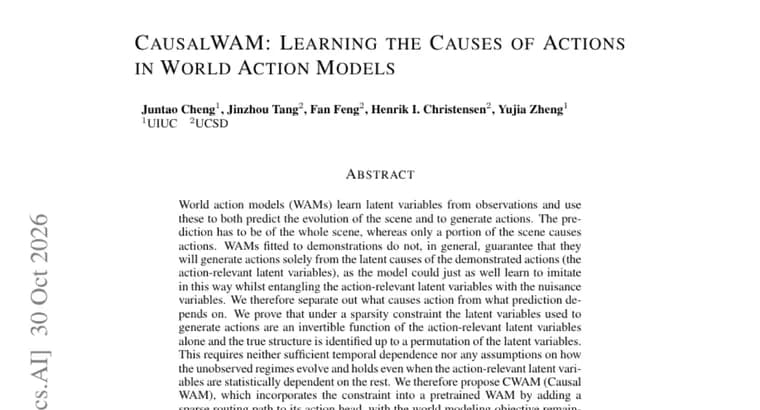
World action models (WAMs) learn latent variables from observations and use them for two jobs: predicting how a scene evolves and generating actions. The paper starts from a mismatch between those jobs. Prediction has to cover the whole scene, but only a portion of the scene actually causes actions.
The authors argue that a WAM fitted to demonstrations does not, in general, guarantee that it generates actions solely from the latent causes of the demonstrated actions, which they call the action-relevant latent variables. The model could imitate the demonstrations just as well while entangling those variables with nuisance variables. So the paper sets out to separate what causes action from what prediction depends on.
The theoretical result is an identifiability proof. The authors state that under a sparsity constraint, the latent variables used to generate actions are an invertible function of the action-relevant latent variables alone, and the true structure is identified up to a permutation of the latent variables. They say this requires neither sufficient temporal dependence nor any assumptions on how the unobserved regimes evolve, and that it holds even when the action-relevant latent variables are statistically dependent on the rest.
The practical method is CWAM (Causal WAM). It incorporates the sparsity constraint into a pretrained WAM by adding a sparse routing path to the model's action head. The world modeling objective stays unchanged. The authors say experiments on both synthetic data and real-world robots validate the theory and show improved efficiency in closed-loop success. The text gives no numbers for those results.
Key facts
- CWAM (Causal WAM) adds a sparse routing path to the action head of a pretrained world action model; the world modeling objective is unchanged.
- The problem: prediction must cover the whole scene, but only part of it causes actions, and a WAM fitted to demonstrations can entangle action-relevant latents with nuisance variables.
- The authors prove that under a sparsity constraint, the latents used to generate actions are an invertible function of the action-relevant latents alone, with structure identified up to a permutation.
- The authors say the result needs neither sufficient temporal dependence nor assumptions on how unobserved regimes evolve, and holds when action-relevant latents depend statistically on the rest.
- Experiments on synthetic data and real-world robots are said to validate the theory and show improved efficiency in closed-loop success.
Why it matters
World action models use one set of learned latents both to predict the scene and to produce actions. If action generation draws on nuisance variables that merely correlate with the demonstrated behaviour, imitation can look fine while the model acts on the wrong things. This paper addresses that gap by restricting action generation to the action-relevant latents and backing the restriction with a proof, rather than only an empirical fix. It leaves the world modeling objective untouched, so the change targets the action side of an existing model.
Who it affects
Mainly researchers and engineers working on world action models and learning robot policies from demonstrations, since the method is described as an addition to a pretrained WAM. The abstract does not name the specific WAM, robots or tasks involved.
How to use it
The abstract describes the recipe at a high level: take a pretrained WAM, add a sparse routing path to its action head so that actions are generated from the action-relevant latents, and keep the world modeling objective as it is. No code, model or dataset release is mentioned, so a reader would need the full paper for implementation details.
How solid is it
The theoretical claim is stated as a proof under a sparsity constraint, and the authors say it requires neither sufficient temporal dependence nor assumptions on unobserved regimes. The empirical side is thin in the available text: experiments on synthetic data and real-world robots are said to validate the theory, but no success rates, baselines or sample sizes are given. 'Improved efficiency in closed-loop success' is not defined or quantified. This is a preprint listing with a single abstract to go on.
Risks and caveats
The headline experimental claim cannot be checked from the abstract, because it reports no figures, baselines or task details. The result depends on a sparsity constraint, so how well it carries over to a given pretrained model is something only the full paper can show. The abstract does not say which WAM CWAM was built on or which robots were used, which limits what can be inferred about how general the gains are.
“We therefore separate out what causes action from what prediction depends on.”
— From the paper's abstract