FDSML trains on fractal images and lifts retrieval Recall@1
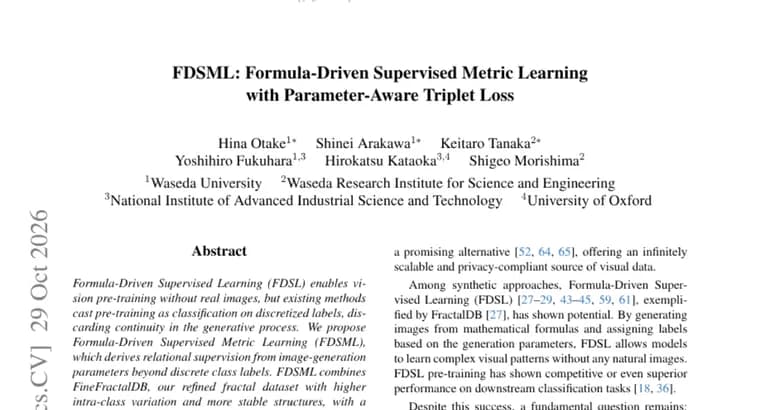
Formula-Driven Supervised Learning (FDSL) lets a vision model be pre-trained without any real images, using images generated from mathematical formulas. The authors of this paper argue that existing FDSL methods treat pre-training as classification on discretized labels, which throws away the continuity of the generative process that made the images.
Their answer is Formula-Driven Supervised Metric Learning (FDSML). Instead of relying only on discrete class labels, it derives relational supervision from the parameters used to generate each image. FDSML has two parts. The first is FineFractalDB, the authors' refined fractal dataset, which they say has higher intra-class variation and more stable structures. The second is a Parameter-Aware Triplet (PA-Triplet) Loss, which assigns positives and negatives according to distances in the underlying Iterated Function System parameter space. The objective trains embeddings to respect relative similarity orderings derived from those parameters.
The reported results are on ResNet-50. Against FDSL pre-training, Recall@1 rises from 65.6% to 74.0% on Stanford Online Products, a gain of 8.4 percentage points, and from 56.2% to 78.4% on Stanford Cars, a gain of 22.2 percentage points. These are absolute Recall@1 values, not relative changes.
Beyond retrieval, the authors say experiments show FDSML remains competitive on downstream classification and improves robustness under several corruption settings. They conclude that the results suggest parameter-derived relational supervision gives a stronger synthetic pre-training signal than label-based classification for transfer beyond recognition.
Key facts
- FDSML pre-trains vision models on synthetic fractal images and takes its supervision from the image-generation parameters, not only from discrete class labels.
- It pairs FineFractalDB, a refined fractal dataset, with a Parameter-Aware Triplet Loss that picks positives and negatives by distance in Iterated Function System parameter space.
- On ResNet-50, Recall@1 on Stanford Online Products goes from 65.6% to 74.0% over FDSL pre-training.
- On Stanford Cars, Recall@1 goes from 56.2% to 78.4% over FDSL pre-training.
- The authors report competitive downstream classification and better robustness under several corruption settings, without numbers for either.
Why it matters
Pre-training without real images sidesteps the need for collected photo data, and FDSL is one way to do it. The paper's point is that the usual recipe, classification over discrete labels, wastes information: the generator's parameters vary continuously, so images can be ranked by how similar their parameters are. FDSML uses that ordering as the training signal. The authors say their results suggest this gives a stronger synthetic pre-training signal for transfer beyond recognition, such as image retrieval.
Who it affects
Mainly researchers working on synthetic or formula-driven pre-training and on metric learning for image retrieval. The source describes the work only in terms of ResNet-50 and two retrieval benchmarks, Stanford Online Products and Stanford Cars.
How to use it
The practical recipe in the abstract is to generate fractal images from Iterated Function System parameters, build positives and negatives for triplets from parameter distances, and train embeddings with the PA-Triplet Loss on the FineFractalDB dataset. No code or dataset release is mentioned.
How solid is it
This is a preprint abstract, and the figures are the authors' own. The two headline numbers are concrete: Recall@1 from 65.6% to 74.0% on Stanford Online Products and from 56.2% to 78.4% on Stanford Cars, on ResNet-50, against FDSL pre-training. The classification results are described only as competitive, and no numbers are given for the robustness improvement or which corruption settings were tested. The authors word their conclusion as a suggestion, not a proof.
Risks and caveats
Only ResNet-50 is mentioned; no other architectures are reported. Only two retrieval benchmarks are named, and no other datasets' results are given. The classification results are described only as 'competitive', with no downstream classification numbers, and robustness improves only under several corruption settings, not all. No training cost, dataset size or compute figures are given.
“These results suggest that parameter-derived relational supervision provides a stronger synthetic pre-training signal than label-based classification for transfer beyond recognition.”
— FDSML paper abstract