CERA-MoA co-evolves agent routing and training in Mixture-of-Agents systems
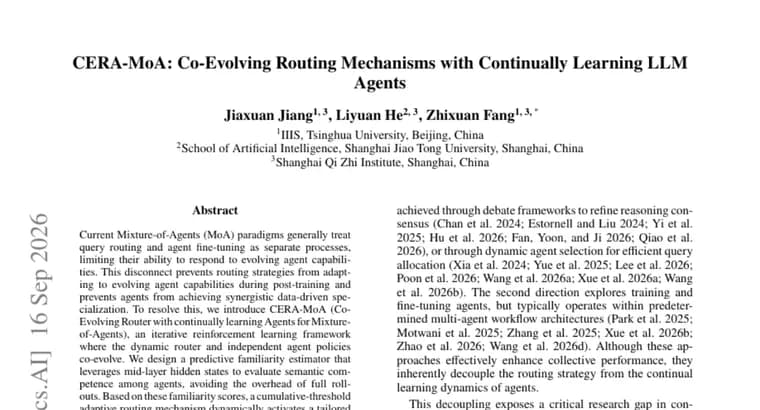
Researchers describe CERA-MoA (Co-Evolving Router with continually learning Agents for Mixture-of-Agents), a reinforcement learning framework for Mixture-of-Agents (MoA) systems, in which several LLM-based agents work together to answer queries. The authors argue that current MoA setups treat two things separately that should not be separate: the router, which decides which agent handles a given query, and the fine-tuning of the agents themselves. Because the router is not updated as the agents' abilities change during training, it cannot adapt to their evolving capabilities, and because routing decisions are not fed back into training, agents cannot achieve the data-driven specialization the authors say the setup should allow.
CERA-MoA's answer is to have the router and the independent agent policies co-evolve through an iterative reinforcement learning process. The framework includes a predictive familiarity estimator, which reads mid-layer hidden states of each agent to estimate its semantic competence on a query, without running each agent all the way through on that query first (a full rollout). Those familiarity scores feed a cumulative-threshold adaptive routing mechanism, which activates only a minimal, tailored subset of agents for each query, a design meant to trade off task performance against efficiency. The same competence signal also steers training: the framework allocates training samples to agents based on their current, evolving competence, which the authors say promotes capability differentiation among agents rather than convergence on the same behavior.
The authors report that CERA-MoA outperforms both static-agent routing baselines, where the routing policy does not adapt, and fixed-workflow fine-tuning baselines, where the pipeline of agents stays fixed, in experiments spanning multiple domains. The text does not name the benchmarks, the specific domains tested, model sizes, or the size of the improvement, and it gives no author affiliations, publication venue, or release date.
Key facts
- CERA-MoA is a reinforcement learning framework in which a query router and independent LLM agent policies co-evolve, rather than being trained as two separate stages.
- A predictive familiarity estimator reads agents' mid-layer hidden states to gauge semantic competence, avoiding the cost of running a full rollout for every agent.
- A cumulative-threshold adaptive routing mechanism uses those familiarity scores to activate only a minimal, tailored subset of agents per query.
- Training samples are allocated to agents based on their evolving competence, which the authors say drives agents toward distinct specializations.
- The authors report CERA-MoA beats static-agent routing and fixed-workflow fine-tuning baselines across multiple domains, though the text gives no benchmark names, numbers, or domain details.
Why it matters
Mixture-of-Agents systems split work across several specialized LLM agents, with a router deciding which agent handles which query. Today, that router and the agents' own fine-tuning are typically developed as two disconnected processes: the router does not track how agents' skills change during training, and agent training is not shaped by how the router actually uses each agent. CERA-MoA closes that loop by updating router and agents together, aiming to keep the system from routing to agents whose real capabilities have already moved on since the router was last trained.
Who it affects
The work targets researchers and engineers building or studying Mixture-of-Agents architectures, where multiple LLM-based agents cooperate or specialize to answer queries. It is a methods paper rather than a shipped product, so its direct audience is people designing multi-agent LLM systems and routing strategies, not end users of a deployed tool.
How to use it
The source describes CERA-MoA as a training framework, not a hosted service: it defines a router, a familiarity estimator, and a reinforcement learning loop that jointly updates routing and agent policies. No code release, license, pricing, or availability is mentioned in the text, so it is not clear from the source how or whether the method can be reused outside the authors' own experiments.
How solid is it
The authors state that experiments across various domains show CERA-MoA beating static-agent routing and fixed-workflow fine-tuning baselines. The source does not name the benchmarks or domains used, does not give the size of the improvement, and does not state model sizes or training cost, so the strength of the result cannot be independently assessed from the text alone.
Risks and caveats
The claims come from the paper's own abstract-level description, with no author affiliations, publication venue, or release date given in the source. Without benchmark names or numbers, "outperforms" and "extensive experiments" are the authors' own characterization rather than independently verifiable figures, and the practical overhead of the familiarity estimator and adaptive routing mechanism at scale is not discussed.