Basel Action Network: AI e-waste could circle Earth six times by 2050
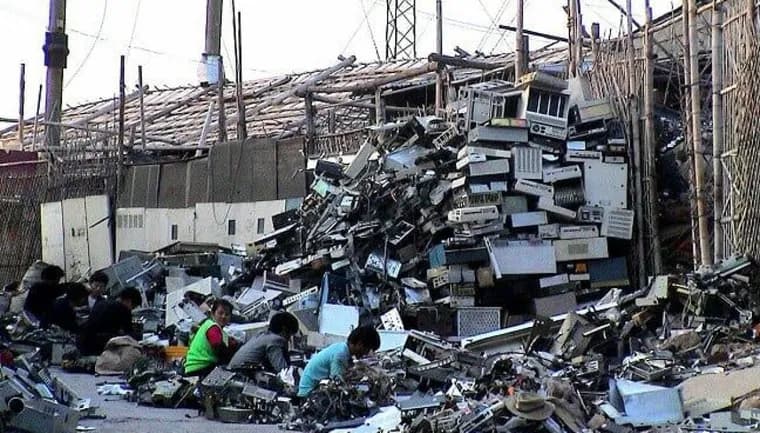
The Basel Action Network (BAN), a nonprofit named after the Basel Convention on hazardous-waste trade, has published a report arguing that the electronic-waste toll of the AI buildout is being drastically undercounted. Servers and accelerators such as GPUs make up just 13 percent of a datacenter's equipment by weight, the report says; once power distribution, backup power, networking and cooling gear are counted too, the total e-waste could run 40 to 60 times higher than the most widely cited academic projections, which have focused chiefly on the compute hardware. BAN's model starts from what the industry says it plans to build and calculates the waste that buildout implies. It projects that AI infrastructure will generate between 395 million and 617 million tonnes of e-waste from 2025 to 2050, enough to fill 15 million to 23 million shipping containers; lining up a representative 20 million of those containers end to end would stretch about 244,000 km, roughly six times Earth's circumference. A reference 100 MW AI datacenter alone produces about 7,000 metric tons of equipment across the five categories BAN tracks, including roughly 2,700 tonnes of copper in its cabling and busbars, much of which the report says will need replacing when the facility is upgraded. The projection rests on assumed replacement cycles that are short relative to a facility's lifetime: BAN says GPUs and other AI accelerators are swapped out every two to three years versus five to seven years for traditional general-purpose servers, with the model assuming whole servers get replaced alongside new Nvidia GPU generations because OEMs ship hyperscalers complete, preconfigured systems. Other categories cycle on their own schedules: three to four years for networking gear, eight years for power distribution, and five years each for backup power and cooling systems. The 46-page paper is the first in a planned series; a second installment will look at how reuse, refurbishment and repurposing could cut the waste volume, a third will assess toxicity including PFAS contamination, and a fourth will cover mitigation. BAN says no hyperscaler, government or international body has published a plan for handling e-waste at the scale it projects, and that current infrastructure is already insufficient to process even today's volumes safely. BAN founder and chief of strategic direction Jim Puckett said the environmental debate around AI has so far focused on electricity, carbon and water while largely overlooking what happens to the hardware itself, and warned that without planning, the AI buildout could become an even worse toxic-waste crisis than the one already under way.
Key facts
- BAN projects 395 million to 617 million tonnes of AI infrastructure e-waste from 2025 to 2050, enough to fill 15 million to 23 million shipping containers.
- A line of 20 million of those containers end to end would run about 244,000 km, roughly six times Earth's circumference.
- Servers and GPUs account for only 13 percent of a datacenter's equipment by weight; counting power, cooling and networking gear puts total e-waste 40 to 60 times higher than prior academic estimates.
- A reference 100 MW AI datacenter generates about 7,000 metric tons of equipment waste, including roughly 2,700 tonnes of copper in cabling and busbars alone.
- GPUs are replaced every two to three years versus five to seven years for traditional servers, and BAN says no hyperscaler, government or international body has published a plan for handling the projected waste.
Why it matters
The environmental case against AI has so far run on electricity, carbon and water. BAN's report reframes the debate around a fourth cost that has had almost no scrutiny: what happens to the physical hardware once it is replaced. Because the model counts power, cooling and networking equipment alongside compute, not just the GPUs everyone talks about, it produces a total that dwarfs prior projections and puts hardware turnover, not just power draw, at the center of AI's environmental footprint.
Who it affects
The waste falls on the hyperscalers and colocation operators building AI datacenters, the OEMs that supply them preconfigured racks, and the recycling and hazardous-waste industry that BAN says already lacks the capacity to process current volumes safely, let alone the scale projected here. Communities near e-waste processing and disposal sites, and any regulator eventually asked to set rules for this waste stream, are also in the report's frame, even though none is named directly.
How to use it
This is the first of four planned reports from BAN. It sets out the scale of the problem; a second installment will examine reuse, refurbishment and repurposing as ways to cut the volume, a third will look at toxicity including PFAS contamination, and a fourth will address mitigation. Anyone planning AI infrastructure procurement or environmental-impact disclosure has reason to watch for those follow-ups rather than treating this first paper as the complete picture.
How solid is it
The 395 million to 617 million tonne range, and the 40 to 60 times multiplier over academic estimates, are model outputs built on assumed industry build-out plans and assumed hardware replacement cycles, not on e-waste that has already been measured or generated. BAN states its replacement-cycle assumptions explicitly (two to three years for GPUs, three to four for networking, eight for power distribution, five for backup power and cooling) and argues its assumption that whole servers get replaced with new GPU generations is plausible given how OEMs ship hyperscalers complete systems, but the report itself frames these as assumptions rather than observed outcomes.
Risks and caveats
BAN is an advocacy nonprofit focused on hazardous-waste trade, and a report warning of a coming waste crisis serves that mission; that does not make the model wrong, but it is a reason to read the projection as a modeled upper-bound scenario rather than a forecast. The report names no specific hyperscaler or cloud provider as responsible, gives no dollar figure for handling or recycling the waste, and describes no government or regulatory response, deferring mitigation to a later paper in the series. It also does not state what share of e-waste is currently processed safely, only that today's infrastructure is insufficient for the volumes involved.
“To date the environmental debate around AI has focused on electricity, carbon and water while largely overlooking what happens to the hardware itself. If companies and governments do not begin planning for this new waste tsunami, today's AI buildout could become an even more cataclysmic toxic waste crisis than we are already experiencing.”
— Jim Puckett, BAN founder and chief of strategic direction