Chunked KV-cache compression creates periodic weak spots, paper finds
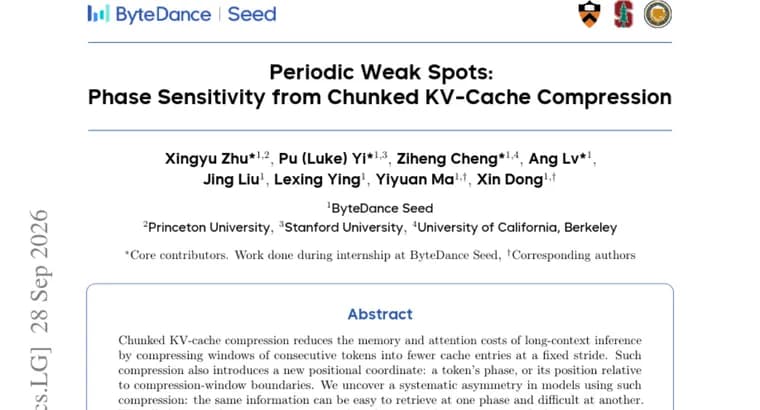
Chunked KV-cache compression cuts the memory and attention costs of long-context inference by squeezing windows of consecutive tokens into fewer cache entries at a fixed stride. A new paper points out a side effect. The compression adds a positional coordinate that the authors call a token's phase: its position relative to compression-window boundaries.
The authors report a systematic asymmetry in models that use such compression. The same information can be easy to retrieve at one phase and difficult at another. They name this periodic variation in retrieval performance phase sensitivity. In large open-weight models with chunked compression, long-context retrieval accuracy can differ by up to 40 percentage points across phases. These periodic weak spots can stay hidden behind average benchmark scores.
To study the effect, the authors pretrain a family of transformers from scratch across multiple KV-compression designs, and phase sensitivity shows up in all of the variants. A mechanistic analysis with causal interventions reveals what they call phase specialization: different attention components contribute asymmetrically to retrieving information that sits at different source phases. They also analyze idealized retrieval models, which they say show how gradient flow dynamics may favor sharp phase specialization.
The practical conclusion is about evaluation. Models with chunked KV-cache compression need to be measured across compression phases, because high average accuracy can coexist with systematic positional failures.
Key facts
- Chunked KV-cache compression packs windows of consecutive tokens into fewer cache entries at a fixed stride, which introduces a token's phase: its position relative to window boundaries.
- The same information can be easy to retrieve at one phase and hard at another; the authors call this phase sensitivity.
- In large open-weight models with such compression, long-context retrieval accuracy can differ by up to 40 percentage points across phases.
- Transformers pretrained from scratch across multiple KV-compression designs reproduce the effect, and causal interventions point to phase specialization among attention components.
- The authors conclude that such models must be evaluated across compression phases, since high average accuracy can coexist with systematic positional failures.
Why it matters
KV-cache compression is a way to make long-context inference cheaper in memory and attention cost. This work says the savings can come with a hidden positional pattern: retrieval quality that rises and falls with where information sits relative to compression-window boundaries. The authors say average benchmark scores can conceal these periodic weak spots, so a model that looks strong on paper may fail systematically on certain positions.
Who it affects
Anyone who builds, evaluates or relies on models that use chunked KV-cache compression for long-context work. The 40-point gap is reported for large open-weight models with such compression, though the abstract does not name them. Researchers designing new compression schemes are also affected, since the effect appeared across several designs in the authors' from-scratch models.
How to use it
The practical takeaway from the authors is an evaluation rule: measure retrieval across compression phases rather than relying on a single average. In a test setup, that means placing the same information at different positions relative to window boundaries and comparing the results.
How solid is it
The claims rest on the paper's abstract. The effect is shown in two ways: in large open-weight models, and in a family of transformers pretrained from scratch across multiple KV-compression designs, where it reproduces across the variants. Causal interventions support the mechanistic story. The gradient-flow explanation is offered more tentatively: the authors say the dynamics "may" favor sharp phase specialization, and that analysis is on idealized retrieval models. The 40-point figure is a maximum ("up to"), not a typical gap. The abstract names no authors, institutions or specific models.
Risks and caveats
The 40 percentage points is the largest reported difference, not an average. The abstract gives no compression ratio, stride, context length, benchmark name or model sizes, so it is hard to tell how widely the size of the effect generalizes. It proposes no fix or mitigation for phase sensitivity. The gradient-flow explanation comes from idealized models and is described only as something that may happen.