Claude Opus 5.5 and GPT-6 Astra falter on robot tasks in ICLWorld
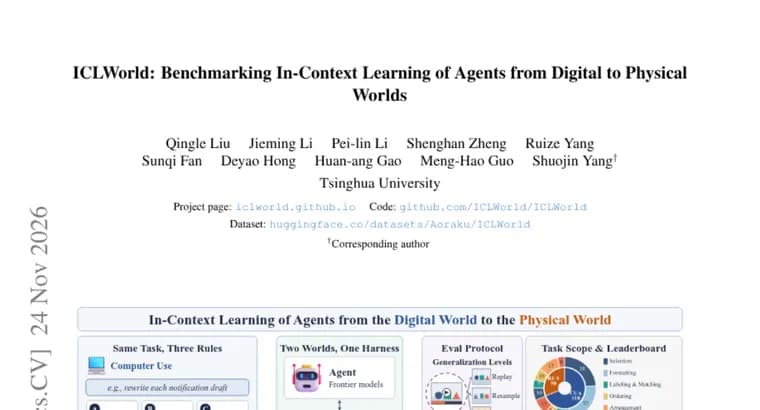
A paper presents ICLWorld, an online benchmark of in-context learning (ICL), the ability of agents to pick up new rules from context and adapt to user-specific requirements at inference time. The authors argue that the same frontier agents now operate both computers and robots, yet this ability is still poorly assessed. In their account, existing benchmarks are largely offline, rely on text or static images and risk training-data contamination, while robot evaluations are limited to method-level ablations.
ICLWorld covers both computer use and robot use. It comes with UIverse, a unified harness that turns every environment into a user interface. The team built 30 environments, recorded 630 demonstration videos (more than 10 hours) and designed 160 tasks with customized, often counter-intuitive rules that cannot be satisfied without learning from the context. Each task has three rule versions, given as text or video. Generalization is tested at three levels, ranging from replaying the demonstration to new instances and unseen environments.
Six frontier models were evaluated. The strongest were Claude Opus 5.5 and GPT-6 Astra: they succeeded on 82% and 76% of computer-use runs respectively, but only 27% and 26% of robot-use runs. In a control with no rule, success fell to at most 8%.
Two further results concern GPT-6 Astra. It succeeded under all three rule versions on only 38% of computer-use tasks, half its rate under a single rule. On the robot side, it answered 98% of rule questions correctly yet completed only 20% of those tasks.
The authors also report that frontier agents learn rules about as well from video as from text and transfer them across environments. Weaker agents rely on text, and lose most of their video-based success once the demonstrated situation is resampled. The paper concludes that there are substantial gaps between the digital and the physical world, and between identifying a rule and acting on it.
Key facts
- ICLWorld is an online benchmark of in-context learning for computer-use and robot-use agents, with 30 environments, 160 tasks and 630 demonstration videos.
- Claude Opus 5.5 and GPT-6 Astra succeeded on 82% and 76% of computer-use runs, against 27% and 26% of robot-use runs.
- A no-rule control cut success to at most 8%.
- GPT-6 Astra passed all three rule versions on only 38% of computer-use tasks, half its single-rule rate.
- On robot tasks, GPT-6 Astra answered 98% of rule questions correctly but completed only 20% of those tasks.
Why it matters
Agents are expected to follow rules they meet only at the moment of use, such as a particular user's requirements. The authors say the same frontier agents now run computers and robots, but that this skill has been poorly measured. Their critique of earlier tests is specific: mostly offline, built on text or static images, exposed to training-data contamination, and on the robot side limited to method-level ablations. ICLWorld is their answer, an online test that spans both domains and uses rules the agent has to learn from context.
Who it affects
The results bear most directly on people who build or evaluate agents for computer use and robotics. Those relying on Claude Opus 5.5 or GPT-6 Astra get a side-by-side view: both did far better on computer-use runs than on robot-use runs. The authors also draw a line between model classes. Frontier agents handled video and text instructions comparably well, while weaker agents leaned on text.
How to use it
The design offers a checklist for testing rule learning in an agent. Use rules that cannot be satisfied without the context, including counter-intuitive ones. Run a no-rule control to see how often success happens without the rule. Vary the rule across several versions, since GPT-6 Astra's computer-use rate halved when all three had to succeed. Check generalization beyond replaying a demonstration, on new instances and unseen environments. And score understanding separately from execution: a correct answer about a rule did not guarantee a completed task.
How solid is it
These are the authors' own measurements, reported in their paper across six frontier models, 30 environments and 160 tasks. The no-rule control, capped at 8% success, supports the claim that the tasks depend on learning from context. The summary has limits. Only two of the six models are named, and the other four scores are not given. The video-versus-text and cross-environment transfer findings come without numbers. It also does not say whether the robot-use environments are physical robots or simulations, and mentions no code or dataset release.
Risks and caveats
The headline figures are success rates on this benchmark's own tasks, with deliberately customized rules, so they should not be read as general success rates for computer or robot work. The 38%, 98% and 20% figures are reported for GPT-6 Astra only and should not be extended to Claude Opus 5.5 or other models. The abstract-level account gives no explanation for why agents do worse on robot use than on computer use.
“These findings reveal substantial gaps between the digital and the physical world and between identifying a rule and acting on it.”
— The ICLWorld paper