CoT-Proxy distills AI agents without teacher chain-of-thought
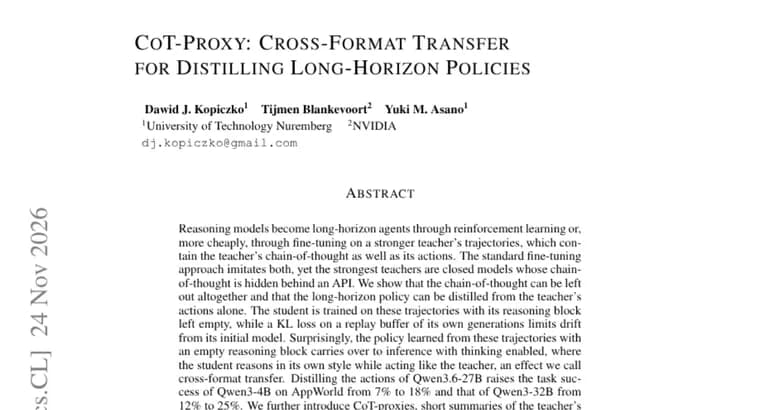
A paper titled CoT-Proxy, listed on Hugging Face, tackles a practical problem in building long-horizon agents. Reasoning models can become such agents through reinforcement learning or, more cheaply, through fine-tuning on a stronger teacher's trajectories, which contain both the teacher's chain-of-thought and its actions. The standard fine-tuning approach imitates both. But the strongest teachers are closed models whose chain-of-thought is hidden behind an API.
The authors say the chain-of-thought can be left out altogether, and the long-horizon policy distilled from the teacher's actions alone. The student is trained on these trajectories with its reasoning block left empty. Meanwhile, a KL loss on a replay buffer of the student's own generations limits drift from its initial model.
The authors report a result they call surprising: the policy learned with an empty reasoning block carries over to inference with thinking enabled. There the student reasons in its own style while acting like the teacher. They name this effect cross-format transfer.
On the AppWorld benchmark, distilling the actions of Qwen3.6-27B raised the task success of Qwen3-4B from 7% to 18%, and that of Qwen3-32B from 12% to 25%. The authors also introduce CoT-proxies, which are short summaries of the teacher's reasoning placed after the empty reasoning block. These raised Qwen3-4B further, to 35%.
Because neither actions nor CoT-proxies need the hidden chain-of-thought, the authors say the recipe applies unchanged to closed teachers. Distilling GPT-5.6 Luna from its visible outputs and the reasoning summaries its API returns raised Qwen3-4B from 7% to 48% on AppWorld and from 3% to 28% on SWE-bench Verified.
Key facts
- The method distills a long-horizon agent policy from a teacher's actions while the student's reasoning block stays empty, with a KL loss on a replay buffer limiting drift from the initial model.
- The policy carries over to inference with thinking enabled, an effect the authors call cross-format transfer.
- Learning from Qwen3.6-27B actions, Qwen3-4B went from 7% to 18% task success on AppWorld and Qwen3-32B from 12% to 25%.
- CoT-proxies, short summaries of the teacher's reasoning, raised Qwen3-4B further, to 35% on AppWorld.
- With GPT-5.6 Luna as teacher, using visible outputs and API reasoning summaries, Qwen3-4B rose from 7% to 48% on AppWorld and from 3% to 28% on SWE-bench Verified.
Why it matters
Fine-tuning on a stronger teacher's trajectories is the cheaper route to a long-horizon agent compared with reinforcement learning. The standard version copies the teacher's chain-of-thought along with its actions, yet the strongest teachers hide that reasoning behind an API. The paper's answer is to stop depending on it: train on actions, optionally add short reasoning summaries, and leave the reasoning block empty. The reported cross-format transfer is the novel piece, since a student trained this way can still run with thinking enabled.
Who it affects
The work is most relevant to researchers and engineers who fine-tune smaller reasoning models into agents, especially those who want to learn from a closed teacher. The students reported here are Qwen3-4B and Qwen3-32B, and the teachers are the open Qwen3.6-27B and GPT-5.6 Luna.
How to use it
The recipe as described has these parts. Take the teacher's trajectories and keep its actions. Train the student on them with its reasoning block left empty. Apply a KL loss on a replay buffer of the student's own generations to limit drift from the initial model. To add CoT-proxies, place short summaries of the teacher's reasoning after the empty reasoning block. At inference, the authors report that the learned policy carries over to runs with thinking enabled.
How solid is it
These are the authors' own results from a research paper. The gains are stated as before and after task success rates on AppWorld for the Qwen teacher and on AppWorld and SWE-bench Verified for GPT-5.6 Luna. SWE-bench Verified figures are given only for Qwen3-4B with the Luna teacher. The available text gives no teacher scores on either benchmark and no comparison figures against standard fine-tuning that imitates the full chain-of-thought.
Risks and caveats
Absolute success remains limited: the best reported figures for Qwen3-4B are 48% on AppWorld and 28% on SWE-bench Verified, so most SWE-bench Verified tasks still fail. The 35% and 48% AppWorld results come from different teacher setups and should be read separately. The number of training trajectories, training cost and compute are not given. The source also offers no explanation of why cross-format transfer occurs, and it does not discuss API terms of service for distilling closed models.
“We show that the chain-of-thought can be left out altogether and that the long-horizon policy can be distilled from the teacher's actions alone.”
— The authors of the CoT-Proxy paper