cmHC paper contracts the Birkhoff polytope to balance stream mixing in hyper-connections
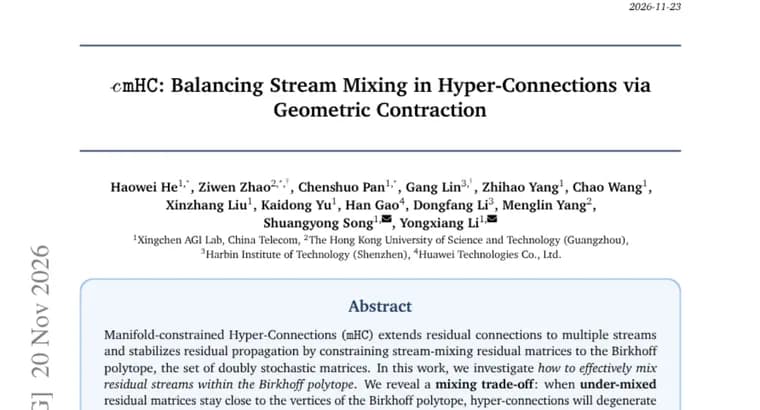
The paper builds on Manifold-constrained Hyper-Connections (mHC). That method extends residual connections to multiple streams and stabilizes residual propagation by constraining the stream-mixing residual matrices to the Birkhoff polytope, the set of doubly stochastic matrices. The new work asks how to mix the residual streams effectively inside that polytope.
The authors describe a mixing trade-off. If the residual matrices stay close to the vertices of the Birkhoff polytope (under-mixing), hyper-connections degenerate into a set of nearly independent streams. If the matrices concentrate around the uniform barycenter of the polytope (over-mixing), the streams become less distinguishable from each other. They say they validate this theoretically by bounding the cumulative residual mixing, the stream difference and the gradient difference of mixing coefficients across layers.
From these findings they propose Contraction for Manifold-Constrained Hyper-Connections (cmHC), described as an exact doubly stochastic method that geometrically contracts the Birkhoff polytope toward its interior. The contraction counters under-mixing by forcing the residual matrices to explore deeper into the polytope. The authors say this comes with a provable stream mixing bound and no new parameterization. To prevent over-mixing, they apply a moderate contraction at the shallow layers, which they say enables stable gradient propagation in extremely large-scale model pretraining.
The authors state that extensive experiments across dense and mixture-of-experts models at various parameter scales demonstrate the effectiveness and scalability of cmHC. They also developed fused operators for cmHC on Ascend NPUs, reducing hyper-connection execution latency by up to 44.8%.
Key facts
- cmHC (Contraction for Manifold-Constrained Hyper-Connections) geometrically contracts the Birkhoff polytope toward its interior while staying exactly doubly stochastic.
- The paper names a mixing trade-off: under-mixed matrices near the polytope's vertices give nearly independent streams; over-mixed matrices near the uniform barycenter make streams hard to tell apart.
- The contraction comes with a provable stream mixing bound and no new parameterization; a moderate contraction at shallow layers guards against over-mixing.
- Experiments span dense and mixture-of-experts models at various parameter scales.
- Fused cmHC operators on Ascend NPUs reduce hyper-connection execution latency by up to 44.8%.
Why it matters
Hyper-connections widen the residual path of a network into several streams, and mHC keeps them stable by constraining the mixing matrices to doubly stochastic ones. This paper points out that the constraint alone does not settle how well the streams mix. Matrices stuck near the polytope's vertices leave the streams almost independent, and matrices pulled to the center blur them together. cmHC is the authors' answer to both failure modes with a single geometric operation.
Who it affects
Mainly researchers and engineers who design residual architectures and pretrain large dense or mixture-of-experts models. The Ascend NPU operators are also relevant to teams that run training or inference on that hardware.
How to use it
The source gives the method at the level of an abstract: contract the Birkhoff polytope toward its interior, and apply a moderate contraction at the shallow layers. No code, model release or open-source availability is mentioned. The contraction factor and the definition of shallow layers are not specified, so an implementation would need the full paper.
How solid is it
The text is an abstract, so every claim is the authors' own. They say the mixing trade-off is validated theoretically through bounds on cumulative residual mixing, stream difference and gradient difference across layers. They also report extensive experiments on dense and mixture-of-experts models. No benchmark results, loss figures, model sizes or parameter counts are given; the only figure is the 44.8% latency reduction, which is a maximum ('up to'), not a typical result.
Risks and caveats
The 44.8% figure is stated only for fused operators on Ascend NPUs, and the baseline it is measured against is not stated. It is not stated to apply to other hardware. Claims about effectiveness, scalability and stable gradient propagation at extremely large scale cannot be weighed here without the numbers behind them.
“when under-mixed residual matrices stay close to the vertices of the Birkhoff polytope, hyper-connections will degenerate into a set of nearly independent streams”
— cmHC paper abstract