Google Research's DeepCrossAttention reaches same quality up to 3x faster
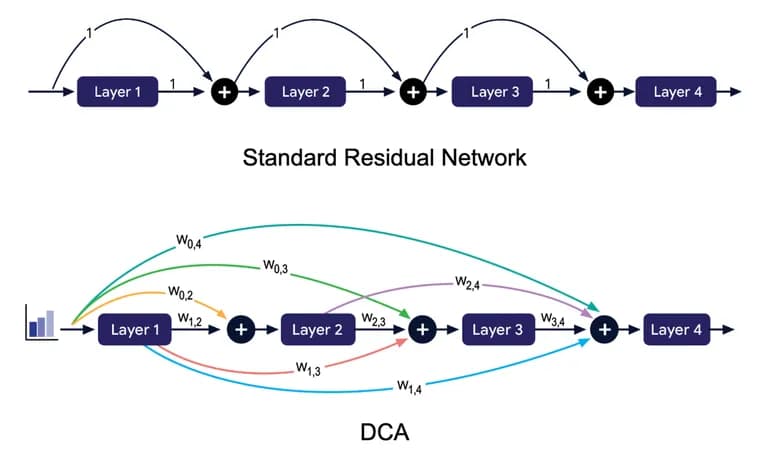
On November 23, 2026, Kyriakos Axiotis (Staff Research Scientist) and Thomas Fu (Principal Engineer) of Google Research published a blog post presenting DeepCrossAttention (DCA), the subject of their ICML 2025 paper "DeepCrossAttention: Supercharging Transformer Residual Connections". The post says DCA lets models reach the same quality up to three times faster, with a negligible increase in parameters.
The problem, as the authors frame it: deep networks rely on residual ("skip") connections, which add a copy of a layer's input to its output so the model always has the original data to refer back to. That standard operation is a point-wise sum. It is cheap, but it treats all prior representations with equal weight. The post says this leads to information dilution in deep networks: specific, high-resolution details from earlier layers get averaged out or distorted, the network struggles to retrieve them selectively, and it has to recompute them, which cuts learning efficiency.
DCA generalizes residual connections by letting each layer dynamically select and route features from the history of preceding layers. Instead of a rigid additive pipeline, the authors recast residual learning as a dynamic routing problem. A lightweight, layer-wise module decides how to combine previous embeddings on a per-token basis. The post describes this as using learnable weights and depth-wise cross-attention, and says it relies on an expanded residual stream. The authors say DCA achieves comparable or improved learning while reducing the parameters needed by up to 30-40%.
The authors tested DCA on controlled synthetic setups, large-scale language modeling benchmarks and image classification tasks. They report significant improvements in convergence speed, training stability and final model quality. On C4 (a cleaned Common Crawl corpus) and LM1B (the 1 Billion Word Language Model Benchmark), DCA reached the performance of standard transformers in up to five times fewer training steps. Trained for the same duration or number of steps, it consistently reached lower perplexity than standard residual connections. To reach a perplexity below 14 on LM1B, a standard transformer of fixed width needed 42 layers, while the DCA model got a lower perplexity with 30 layers, a 29% reduction in depth and parameter count.
DCA adds less than 0.2% to total model size, which the post calls negligible in compute and memory footprint. It does increase memory bandwidth, because representations from different layers are presented intact rather than blended. Because DCA can be initialized to behave identically to a standard residual network, it need not be trained from scratch. Retrofitting it onto an already pre-trained transformer and briefly continuing training cut perplexity by 0.19 on LM1B, against 0.02 for continued standard training.
The second half of the post surveys related work, which the authors say shows dynamic routing is a highly active area. They write that DCA and similar dynamic residual techniques are already seeing significant adoption and success. Moonshot AI's attention residuals share DCA's core idea of replacing fixed addition with selective retrieval: a learnable softmax attention with a layer-specific pseudo-query lets each layer weight and retrieve earlier representations. The post says this prevents unbounded growth of hidden states and dilution of early-layer information, improves gradient stability, and boosts performance on reasoning-heavy tasks such as coding and mathematics. A "Block AttnRes" variant groups layers into blocks to recover the benefits of full attention with much less memory overhead. The post adds that the recent Inkling 2 model from Thinking Machines adopted this design along with DCA's cross attention (Q/K/V split) mechanism.
Hyper-connections widen the residual stream into several parallel channels, using a fixed-size stack where layer outputs are mixed by learnable matrices. According to the post, that unconstrained mixing breaks the identity-mapping property of residual connections, which can amplify or attenuate signals and cause instability at scale. Manifold-constrained hyper-connections fix this by constraining the mixing matrices to be doubly stochastic with the Sinkhorn-Knopp algorithm, which restores stable signal propagation and prevents exploding or vanishing gradients while keeping the wider stream's expressivity.
The authors close with an expectation: next-generation models will dynamically route and weigh past layer representations based on the specific tokens or inputs being processed, so that all layers can work as specialized experts in tandem. They credit collaborators from Google and academic partners, including Mike Heddes, Adel Javanmard, MohammadHossein Bateni and Vahab Mirrokni.
Key facts
- DeepCrossAttention (DCA) replaces the plain sum in transformer residual connections with learnable weights and depth-wise cross-attention, so each layer picks which earlier layers' outputs to use, per token.
- Headline claim: the same quality up to three times faster; on C4 and LM1B, DCA matched standard transformers in up to five times fewer training steps.
- On LM1B, reaching perplexity below 14 took 42 layers in a standard transformer but 30 layers with DCA, a 29% cut in depth and parameter count.
- DCA adds less than 0.2% to model size and can start out behaving like a standard residual network; retrofitting a pre-trained model cut LM1B perplexity by 0.19 versus 0.02 for continued standard training.
- The post also covers Moonshot AI's attention residuals, hyper-connections and manifold-constrained hyper-connections, and says Thinking Machines' Inkling 2 adopted a related design.
Why it matters
Residual connections are a core part of how transformers are built, and the standard operation is a simple point-wise sum. DCA argues that equal-weight summation dilutes early-layer detail and forces networks to recompute it. If the claimed gains hold, the same quality would take fewer steps, or fewer layers and parameters. The post places DCA in a wider line of work on dynamic residuals, alongside attention residuals and hyper-connections, which it calls a highly active research area.
Who it affects
Mainly researchers and engineers who design and train large language models and other deep transformer networks. The post notes the work was evaluated on language modeling and image classification. It also says Moonshot AI's attention residuals share DCA's principles, and that Thinking Machines' Inkling 2 adopted that design plus DCA's cross attention (Q/K/V split).
How to use it
The post gives no code, weights or product release. The practical hook it describes is that DCA can be initialized to behave identically to a standard residual network, so a team can retrofit it onto an already pre-trained transformer and continue training briefly rather than starting over. On LM1B that retrofit cut perplexity by 0.19, against 0.02 for continued standard training. The full method is in the ICML 2025 paper "DeepCrossAttention: Supercharging Transformer Residual Connections".
How solid is it
The source is Google Research's own blog post, written by two of the people behind the paper, and the work was presented at ICML 2025. The figures come from the authors' own experiments on C4 and LM1B. The headline "up to three times faster" is not tied to a specific benchmark in the post, and it sits next to separate "up to five times fewer steps" and "up to 30-40%" parameter figures that the post does not reconcile. The 29% result is a concrete LM1B comparison (42 versus 30 layers, perplexity below 14). The post gives no absolute perplexity values apart from that threshold, and no model sizes, hardware or compute. It gives no numbers for the image classification or synthetic experiments, and cites no independent replication. Adoption by other labs is described only as sharing or adopting a similar design.
Risks and caveats
All the claims are "up to" maxima from the authors' own tests, so typical gains may be smaller. The post says DCA increases memory bandwidth, since representations from different layers are presented intact rather than blended, even though added parameters are under 0.2% of model size. Its statement that DCA and similar techniques are "already seeing significant adoption and success" is the authors' own, and no outside evidence is given for it. The closing prediction that next-generation models will route and weigh past layers by token is an expectation, with no timescale. The post describes DCA's "two primary mechanisms" only loosely, so the paper is the place to check the details before relying on the claims.
“We expect that next-generation models will dynamically route and weigh past layer representations based on the specific tokens or inputs being processed.”
— Kyriakos Axiotis and Thomas Fu, Google Research