Code World Model splits world evolution from visual rendering
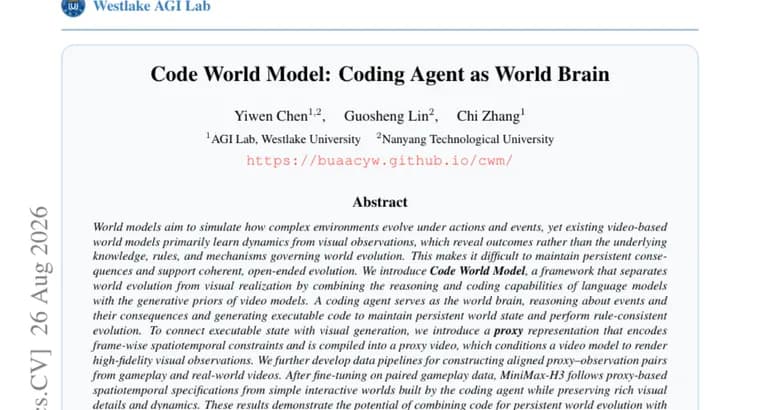
Most world models, systems built to simulate how an environment changes in response to actions and events, are trained on video and learn to reproduce what state transitions look like without learning the rules and mechanisms that actually produce them. A paper describes this as the reason such models struggle to keep the consequences of an action alive over time or to keep a scene evolving in a coherent, open-ended way. It proposes Code World Model (CWM), a framework that separates the two jobs a world model normally does at once: understanding how the world should change, and rendering what that change looks like. Rather than asking a single video model to do both, CWM hands the first job to a coding agent and the second to a video model.
In CWM, a coding agent functions as the world's brain. It reasons about events and their consequences and writes executable code that keeps track of the world's persistent state, so the same rules govern the world consistently as the simulation runs. To connect that code-based state to something a video model can actually render, the authors introduce a proxy representation that encodes spatiotemporal constraints frame by frame; this proxy is compiled into a proxy video, which conditions the video model and steers it toward rendering high-fidelity visuals that match the coding agent's rules. The paper also describes building data pipelines to construct aligned pairs of proxy representations and real observations, drawn from both gameplay footage and real-world video, needed to train a video model to follow the proxy this way.
After fine-tuning on paired gameplay data, the video model MiniMax-H3 was able to follow the proxy-based spatiotemporal specifications the coding agent generates for simple interactive worlds, while keeping the visual detail and dynamics video models are known for. The paper reports no benchmark scores or comparisons against other world models: its claim is framed as a proof of concept rather than a measured result, presenting the combination of code for persistent, rule-governed world evolution with a video model for visual realization as a viable path toward open-ended world models. The text names no authors or institution, and it does not say whether MiniMax-H3 is an existing released model repurposed here or one trained specifically for this work, only that it was fine-tuned on paired gameplay data.
Key facts
- Code World Model (CWM) is a framework that separates world evolution, tracked through code, from visual realization, handled by a video model: it targets a weakness of video-only world models, which capture outcomes but not the rules that produce them.
- A coding agent acts as the world's brain: it reasons about events and their consequences and writes executable code to maintain persistent world state and enforce rule-consistent evolution.
- A proxy representation encodes frame-by-frame spatiotemporal constraints and compiles into a proxy video, which conditions a video model to render high-fidelity visuals that match the coding agent's rules.
- The researchers built data pipelines to construct aligned proxy-observation pairs from gameplay footage and real-world video.
- After fine-tuning on paired gameplay data, the video model MiniMax-H3 followed the coding agent's proxy-based spatiotemporal specifications for simple interactive worlds while preserving rich visual detail and dynamics.
Why it matters
World models, systems that predict how an environment changes in response to actions, are meant to underpin simulated games, agent training grounds and other virtual settings. Most current ones are trained purely on video, so they learn what state transitions look like without learning the rules that produce them, which is exactly why they struggle to keep the consequences of an action alive many steps later or to keep a scene evolving in an open-ended, coherent way. Code World Model responds by moving rule-keeping out of the video model entirely: a coding agent that reasons about events and writes executable code takes over maintaining persistent state and enforcing consistent rules, while a separate video model is left to do only what it is good at, rendering realistic visuals conditioned on that state.
Who it affects
The immediate audience is researchers building world models and simulated environments, for uses such as game-world generation and training grounds for embodied or robotic agents, where a scene has to keep behaving consistently over many steps rather than just look plausible frame to frame. It also concerns teams building on top of existing video generation models, since CWM treats a video model, here MiniMax-H3, purely as a rendering component that an external reasoning system steers, rather than as the system that has to do the reasoning itself.
How to use it
The paper describes a method, not a released product: it does not mention a code or dataset release, pricing or a public demo. Reproducing the pipeline it describes would need three pieces: a coding agent that reasons about events and outputs executable world-state code, a compiler step that turns that code into a proxy video encoding spatiotemporal constraints frame by frame, and a video model fine-tuned to follow that proxy video, which the paper demonstrates by fine-tuning MiniMax-H3 on paired gameplay data. The authors also describe building data pipelines to construct aligned proxy-observation pairs from gameplay and real-world video, which would be needed to fine-tune a video model the same way.
How solid is it
Every claim here comes from the paper's own description of the method; the source text names no authors, no institution, and no publication venue or date. It reports no quantitative evaluation, benchmark scores or comparison to baseline world models, so there is no independent measure of how much more consistent or persistent CWM's simulated worlds are next to purely video-based ones. It also does not say whether MiniMax-H3 is an existing released model repurposed for this work or one trained specifically for it, only that it was fine-tuned on paired gameplay data, and the demonstrations described are limited to simple interactive worlds built by the coding agent rather than complex or long-horizon environments.
Risks and caveats
The paper reports no benchmark numbers and no evaluation against baseline world models. Its central claim, that combining code-driven state with video rendering yields more persistent and coherent worlds than video-only approaches, therefore rests on the authors' description rather than on a measured result. The demonstrated setting is explicitly simple interactive worlds, so it remains untested whether the approach holds up as a world grows more complex, spans a longer horizon or requires the coding agent to track many more events at once. The paper does not mention releasing code or the data pipelines it describes, so outside groups cannot yet reproduce or independently test the claims.
“A coding agent serves as the world brain, reasoning about events and their consequences and generating executable code to maintain persistent world state and perform rule-consistent evolution.”
— the paper