Hebero benchmark trains one robot policy on 40 manipulation tasks
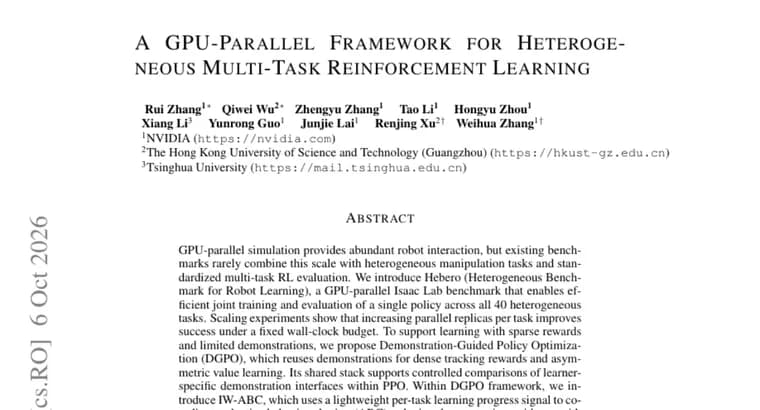
The paper introduces Hebero (Heterogeneous Benchmark for Robot Learning), a GPU-parallel benchmark built on Isaac Lab. Its starting point is a gap the authors describe: GPU-parallel simulation gives robots abundant interaction data, but existing benchmarks rarely combine that scale with heterogeneous manipulation tasks and standardized multi-task reinforcement learning evaluation. Hebero is meant to fill it by enabling efficient joint training and evaluation of a single policy across all 40 heterogeneous tasks. Scaling experiments show that increasing the number of parallel replicas per task improves success under a fixed wall-clock budget.
On the method side, the paper proposes Demonstration-Guided Policy Optimization (DGPO). It is aimed at learning with sparse rewards and limited demonstrations, and it reuses demonstrations in two ways: for dense tracking rewards and for asymmetric value learning. Its shared stack supports controlled comparisons of learner-specific demonstration interfaces within PPO.
Inside the DGPO framework the paper introduces IW-ABC. It uses a lightweight per-task learning progress signal to coordinate two mechanisms. The first is adaptive behavior cloning (ABC), which relaxes demonstration guidance as a task progresses. The second is importance weighting (IW), which emphasizes lagging tasks in PPO updates.
The headline numbers: with 50 demonstrations per task, IW-ABC achieves 90.1% state-input mean success, outperforming the strongest baseline, FAMO-ABC, by 7.8 percentage points. Its visual counterpart reaches 93.5% mean success. Finally, real-world experiments show that a single multi-task policy trained in simulation can successfully perform four tasks on a physical Piper robot. A project page is available at https://hebero-rl.github.io/.
Key facts
- Hebero is a GPU-parallel Isaac Lab benchmark for jointly training and evaluating a single policy across 40 heterogeneous robot manipulation tasks.
- DGPO (Demonstration-Guided Policy Optimization) reuses demonstrations for dense tracking rewards and asymmetric value learning to cope with sparse rewards and limited demonstrations.
- IW-ABC, built on DGPO, combines adaptive behavior cloning with importance weighting that emphasizes lagging tasks in PPO updates.
- With 50 demonstrations per task, IW-ABC reaches 90.1% state-input mean success, 7.8 percentage points above the strongest baseline FAMO-ABC; the visual version reaches 93.5%.
- A single simulation-trained multi-task policy performed four tasks on a physical Piper robot.
Why it matters
Multi-task robot learning needs both scale and variety, and the paper argues existing benchmarks rarely offer both together with standardized multi-task RL evaluation. Hebero packages 40 heterogeneous manipulation tasks into one GPU-parallel Isaac Lab setup so one policy can be trained and scored across all of them. The accompanying DGPO and IW-ABC methods target a practical problem in this setting: learning from sparse rewards when only a limited number of demonstrations is available.
Who it affects
Mainly researchers working on multi-task reinforcement learning, imitation learning from demonstrations, and robot manipulation in simulation, who need a common benchmark and baselines to compare against. Teams that train in Isaac Lab and want to transfer policies to real arms such as the Piper robot may also find the sim-to-real demonstration relevant.
How to use it
The abstract points to a project page at https://hebero-rl.github.io/. The abstract does not say that code or data have been released, so check the project page before planning to reproduce results. Conceptually, DGPO's shared stack within PPO is designed for controlled comparisons of different ways of feeding demonstrations to a learner, which is how a researcher would use it as a testbed.
How solid is it
This is a preprint abstract: the numbers are the authors' own results. The headline figure is a mean success of 90.1% with state input and 50 demonstrations per task, and a 7.8 percentage point margin over the strongest baseline FAMO-ABC. The visual variant's 93.5% is a separate result. The real-world claim is modest in scope: four tasks on one physical robot, a Piper.
Risks and caveats
The abstract does not give the FAMO-ABC baseline's own success rate, only the 7.8-point margin. It does not state how many demonstrations the visual variant or the baselines used. Real-world success rates, number of trials and which four tasks were performed are not given. Training time, GPU hardware and compute cost are not stated, and the replica counts and wall-clock budget in the scaling experiments are not specified. No comparison with other benchmarks' numbers or with single-task policies is reported.
“Real-world experiments further demonstrate that a single multi-task policy trained in simulation can successfully perform four tasks on a physical Piper robot.”
— Abstract of the Hebero paper