CodeSpecWeave synthesizes 4,670 coding tasks with interdependent specs
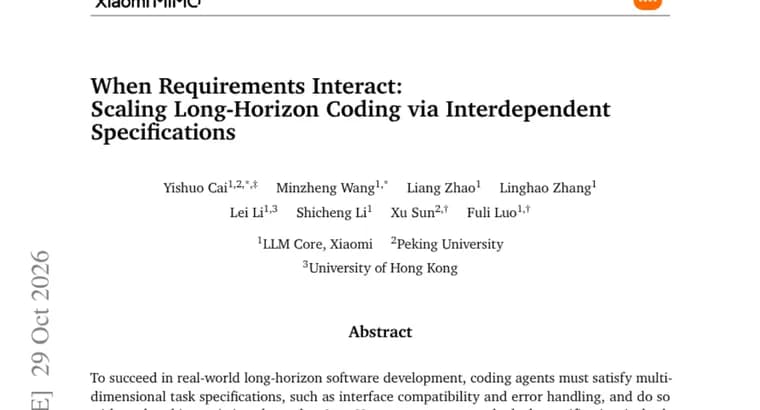
A new paper introduces CodeSpecWeave, a framework for synthesizing coding tasks with rich, interdependent specifications. The starting point is a gap the authors describe: to succeed in real-world, long-horizon software development, coding agents must satisfy multi-dimensional task specifications, such as interface compatibility and error handling, and do so without breaking existing dependencies. Current work, they say, lacks specifications in both quantity and diversity, and often stresses the primary goal while ignoring complex constraints.
The authors name two difficulties in building such tasks. First, naively adding specifications risks reducing a task to a trivial checklist instead of forcing the agent to reason about the requirements jointly. Second, verifying these subtle interactions risks overlooking hidden flaws or rejecting valid alternative solutions.
CodeSpecWeave answers with two agents. Grounded in real developer seeds, a synthesis agent iteratively develops both the coupled task requirements and the executable tests. A review agent then audits solution trajectories from multiple models to guarantee that the tests are reliable.
Using this pipeline, the authors construct 4,670 training tasks across 2,865 repositories. They report that applying reinforcement learning on these tasks significantly improves performance over the base model on DeepSWE-v1.1, and that it largely outperforms existing baselines.
They also curate CodeSpecWeave-Bench, a benchmark of 100 tasks and 1,044 specifications. According to the authors, it clearly separates frontier models and reveals significant headroom in handling interdependent engineering constraints.
Key facts
- CodeSpecWeave is a framework for synthesizing coding tasks whose specifications depend on one another, such as interface compatibility and error handling without breaking existing dependencies.
- A synthesis agent develops coupled requirements and executable tests from real developer seeds; a review agent audits solution trajectories from multiple models to check test reliability.
- The pipeline produced 4,670 training tasks across 2,865 repositories.
- The authors report that reinforcement learning on these tasks significantly improves on the base model on DeepSWE-v1.1 and largely outperforms existing baselines.
- CodeSpecWeave-Bench has 100 tasks and 1,044 specifications, and the authors say it separates frontier models and shows significant headroom.
Why it matters
Real software work rarely comes as a single goal. A change has to keep interfaces compatible, handle errors and leave existing dependencies intact, all at once. The authors argue that current coding-task datasets under-represent this, with too few and too uniform specifications. CodeSpecWeave targets that gap by making the requirements of a task interact, so an agent has to reason about them jointly rather than tick off a list.
Who it affects
The work is most relevant to researchers who train and evaluate coding agents, especially on long-horizon tasks. Teams building reinforcement learning environments for software engineering are the natural audience for the training tasks, and those comparing frontier models are the audience for CodeSpecWeave-Bench.
How to use it
The paper describes a method rather than a product. The source mentions no release of code, data or benchmark, so there is nothing to download from the text itself. The practical takeaway is the recipe: derive tasks from real developer seeds, develop requirements and executable tests together, and have a second agent audit solution trajectories from multiple models before trusting the tests.
How solid is it
All results are the authors' own claims, and the text gives no numbers for them. It does not say how large the gain on DeepSWE-v1.1 is, and it does not name the base model, the baselines or the frontier models tested on the benchmark. The training setup is not described. The scale figures are concrete: 4,670 training tasks, 2,865 repositories, 100 benchmark tasks and 1,044 specifications. The claims about improvement and model separation cannot be checked from this text alone.
Risks and caveats
The authors themselves flag the central risks of the approach: added specifications can collapse into trivial checklists, and verifying subtle interactions can miss hidden flaws or reject valid alternative solutions. The review agent is their safeguard, but how well it works is not quantified in the text. With no named authors or institutions and no scores in the available text, treat the headline claims as unverified until the full paper is read.