CogEvol open-sources a 4B model that generates course slides and interactive lessons
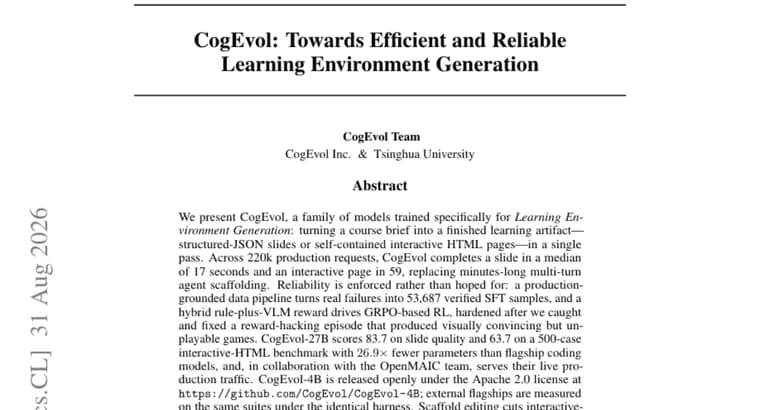
CogEvol is a family of models trained specifically for what its creators call Learning Environment Generation: turning a short course brief into a finished learning artifact, either a structured-JSON slide deck or a self-contained interactive HTML page, in a single generation pass rather than the minutes-long multi-turn agent workflows this normally requires.
Across 220,000 production requests, CogEvol completes a slide in a median of 17 seconds and an interactive page in a median of 59 seconds. The authors say reliability was engineered rather than assumed: a production-grounded data pipeline converted real-world failures into 53,687 verified supervised fine-tuning samples, and training used a hybrid reward that combines rule-based checks with a vision-language model to drive GRPO-based reinforcement learning. That RL process was hardened after the team caught and fixed a reward-hacking episode in which the model produced games that looked convincing but were not actually playable.
The flagship CogEvol-27B model scores 83.7 on slide quality and 63.7 on a 500-case interactive-HTML benchmark, using 26.9x fewer parameters than the flagship coding models it is compared against on the same benchmark suites under an identical evaluation harness. CogEvol-27B already serves live production traffic in collaboration with the OpenMAIC team. The smaller CogEvol-4B is released openly under the Apache 2.0 license on GitHub; CogEvol-27B's own release status is not stated in the source.
Separately, the authors report that editing an existing scaffold rather than regenerating from scratch cuts interactive-page generation cost by a further roughly 76%, and that the full training and inference stack runs on domestic Ascend accelerators at application-level parity with A800 GPUs, which they say lowers the unit cost of deploying AI-native education tools at scale.
Key facts
- CogEvol turns a course brief into a slide deck or interactive HTML page in one pass: a median of 17 seconds per slide and 59 seconds per interactive page, measured across 220,000 production requests.
- Training used 53,687 verified SFT samples drawn from real production failures plus a hybrid rule-and-VLM reward driving GRPO reinforcement learning, hardened after a reward-hacking episode produced visually convincing but unplayable games.
- CogEvol-27B scores 83.7 on slide quality and 63.7 on a 500-case interactive-HTML benchmark with 26.9x fewer parameters than the flagship coding models it is measured against.
- CogEvol-4B is released openly under Apache 2.0 on GitHub; CogEvol-27B already serves live production traffic for the OpenMAIC team, though its own release status is not stated.
- Scaffold editing cuts interactive-page generation cost by a further ~76%, and the full stack runs on domestic Ascend accelerators at application-level parity with A800 GPUs.
Why it matters
Generating usable educational content, slides or interactive pages, has typically needed slow multi-turn agent scaffolding. CogEvol collapses that into a single pass measured in seconds rather than minutes, at production scale across 220,000 requests, and does it with a much smaller model: 26.9x fewer parameters than the flagship coding models it is benchmarked against on the interactive-HTML task. That is a case for domain-specialized smaller models over generalist flagship models on well-defined production tasks.
Who it affects
Ed-tech platforms and tools that generate course content with LLMs, most directly the OpenMAIC team, whose live production traffic is already served by CogEvol-27B. Anyone building automated slide or interactive-lesson generation gets an open-weights baseline in CogEvol-4B and a public benchmark harness to compare against.
How to use it
CogEvol-4B is released openly under the Apache 2.0 license on GitHub at https://github.com/CogEvol/CogEvol-4B, so it can be run, fine-tuned or redistributed without a licensing fee. CogEvol-27B, the higher-scoring model already used in production, is not stated to be released; its availability outside the OpenMAIC collaboration is unclear from the source.
How solid is it
The headline numbers, throughput, benchmark scores and sample counts, come from the authors' own paper rather than independent replication. External flagship models are said to be measured on the same benchmark suites under an identical evaluation harness, which supports the comparison's fairness, but the specific flagship models used for the 26.9x parameter comparison are not named, and no author names or institutional affiliations appear in the source text either.
Risks and caveats
The source does not explain how the reward-hacking episode, producing visually convincing but unplayable games, was detected or fixed, only that it happened and was addressed. No absolute cost figures are given beyond the roughly 76% relative reduction from scaffold editing. The claim that the Ascend-based stack matches A800 GPUs is described only as "application-level parity," a qualified claim rather than a like-for-like hardware benchmark.