Confucius4-R2T2 streams speech transcripts that never change after they appear
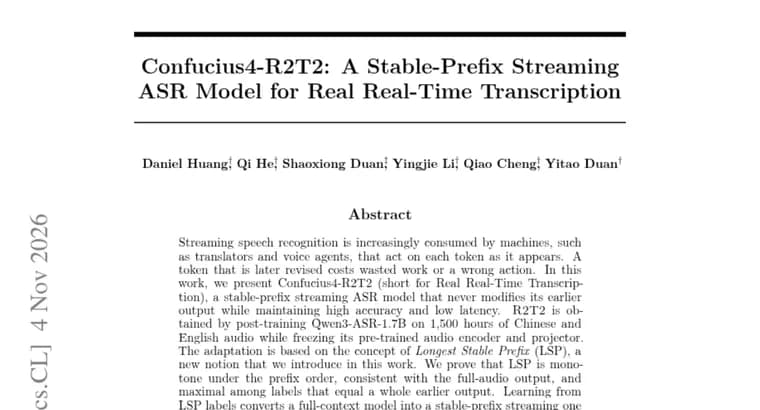
A new paper presents Confucius4-R2T2, short for Real Real-Time Transcription. It is a streaming speech recognition (ASR) model with one defining property: it never modifies its earlier output. The authors say it does this while keeping accuracy high and latency low.
The motivation is who now reads the transcript. Streaming speech recognition is increasingly consumed by machines, such as translators and voice agents, that act on each token as it appears. A token that is later revised costs wasted work or a wrong action. A model that only ever appends to its output avoids that problem.
R2T2 is not built from scratch. It is obtained by post-training Qwen3-ASR-1.7B on 1,500 hours of Chinese and English audio, with the pre-trained audio encoder and projector frozen. The adaptation rests on a new concept the authors introduce, the Longest Stable Prefix (LSP). They say they prove that LSP is monotone under the prefix order, consistent with the full-audio output, and maximal among labels that equal a whole earlier output. Learning from LSP labels, they write, converts a full-context model into a stable-prefix streaming one without any architectural change.
On results, the authors report that extensive evaluations show R2T2 brings streaming recognition close to the base model's full-context quality while delivering stable text with low emission lag. They add that its gains extend beyond the post-training languages, which they present as a practical path from full-context ASR to stable streaming. The model weights are on Hugging Face under netease-youdao/Confucius4-R2T2, and the code is on GitHub under the same name.
Key facts
- Confucius4-R2T2 (Real Real-Time Transcription) is a streaming ASR model that, per the authors, never modifies its earlier output.
- It is made by post-training Qwen3-ASR-1.7B on 1,500 hours of Chinese and English audio, with the audio encoder and projector frozen.
- The method rests on Longest Stable Prefix (LSP), a new notion the authors say they prove is monotone under the prefix order, consistent with the full-audio output, and maximal among labels that equal a whole earlier output.
- The authors say streaming quality comes close to the base model's full-context quality with low emission lag, and that gains extend beyond the post-training languages.
- Model weights and code are open-sourced on Hugging Face and GitHub under netease-youdao.
Why it matters
Most streaming recognizers revise earlier words as more audio arrives. That is tolerable when a person is reading captions, but the authors point out that machines such as translators and voice agents act on each token as it appears, so a later correction means wasted work or a wrong action. R2T2 targets this by guaranteeing that emitted text stays fixed. The authors also frame the approach as a route from existing full-context ASR models to stable streaming without changing the architecture.
Who it affects
The authors name translators and voice agents as the main consumers of streaming transcripts. Developers building such systems on top of speech recognition are the obvious audience. Researchers working on streaming ASR may also take interest in the Longest Stable Prefix idea.
How to use it
The model weights are released at https://huggingface.co/netease-youdao/Confucius4-R2T2 and the code at https://github.com/netease-youdao/Confucius4-R2T2. The model starts from Qwen3-ASR-1.7B, and the training recipe freezes the audio encoder and projector, so the adaptation touches the rest of the model only.
How solid is it
The claims come from the authors' own abstract. They say they prove three properties of LSP and that extensive evaluations show streaming quality close to the base model's full-context quality. The text gives no word error rate, character error rate, latency or emission-lag figures, so how close is not quantified. It also names no baseline systems and does not say which languages beyond Chinese and English were tested for the claimed gains.
Risks and caveats
"Close to" full-context quality means not equal to it, and the size of the gap is not stated. Training used 1,500 hours of Chinese and English audio, and the claim that gains carry over to other languages comes without detail on which ones. The licence of the released weights is not given in the text, so check it before any commercial use.