EDGAR uses one-step diffusion to clean up Gaussian head avatars
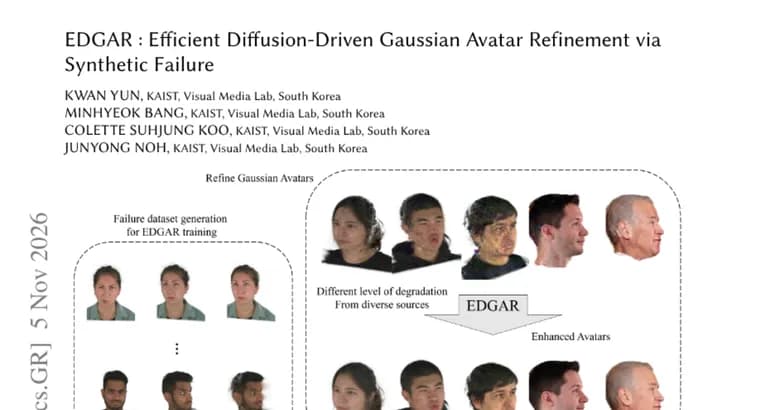
Gaussian splatting has made efficient, photorealistic head avatars possible, but methods that build an avatar from a single monocular video or from images still end up with under-constrained geometry and texture. The visible result is artifacts: blurring, stretching and temporal instability. EDGAR (Efficient Diffusion-Driven Gaussian Avatar Refinement) is a conditional diffusion framework meant to fix these artifacts while preserving identity fidelity.
To train it, the authors build EDGAR-SET, a hybrid triplet dataset made of real-captured and synthetic-rendered samples. It simulates realistic failure cases of Gaussian avatars by pairing degraded renderings with ground-truth and reference images.
The model refines degraded frames through a fusion block. The block injects identity features, extracted by the self-supervised Sapiens model, into a one-step diffusion backbone. The authors say this removes artifacts effectively without sacrificing efficiency. EDGAR also uses a Mixture-of-Experts (MoE) architecture to handle different degradation types and severity levels.
The pipeline does not run the model on every output frame. The refined multi-view renderings serve as pseudo-targets to optimise a single underlying Gaussian avatar, so the final avatar can be rendered without applying EDGAR to each frame.
For evaluation, the authors ran experiments on three different Gaussian avatar reconstruction methods, each under three different settings. They report improvements in both perceptual and reconstruction measures over the raw outputs and over an SDEdit-style refinement baseline. Cross-view evaluation shows improved calibrated consistency, and tests under large yaw and open-mouth expressions are said to verify robustness under extreme settings. The authors conclude that the results indicate a useful operating regime for recoverable appearance artifacts. The code is available on the project page at https://kwanyun.github.io/edgar/.
Key facts
- EDGAR is a conditional diffusion framework that corrects blurring, stretching and temporal instability in Gaussian-splatting head avatars while preserving identity.
- It is trained on EDGAR-SET, a hybrid triplet dataset of real-captured and synthetic-rendered samples that pairs degraded renderings with ground-truth and reference images.
- A fusion block feeds identity features from the self-supervised Sapiens model into a one-step diffusion backbone, and a Mixture-of-Experts design covers different degradation types and severities.
- Refined multi-view renderings become pseudo-targets for optimising one Gaussian avatar, so EDGAR need not run on every output frame.
- Tested on three Gaussian avatar reconstruction methods under three settings each, it improves perceptual and reconstruction measures over raw outputs and an SDEdit-style baseline; code is released.
Why it matters
Gaussian splatting gives fast, photorealistic head avatars, but building one from monocular video or images leaves geometry and texture under-constrained, and artifacts follow. EDGAR targets that gap as a refinement step. Its notable design choice is to use the diffusion model only to produce pseudo-targets, then bake the improvement into one Gaussian avatar, so the finished avatar renders without running EDGAR on every frame.
Who it affects
The work is aimed at people building or using Gaussian-splatting head avatars from monocular video or image inputs, and at researchers working on avatar refinement. The authors tested it across three different reconstruction methods, which suggests it is meant as an add-on rather than a replacement for any one of them.
How to use it
The code is available at https://kwanyun.github.io/edgar/. In the described workflow, you take the multi-view renderings from an existing Gaussian avatar, refine them with EDGAR, and use the refined views as pseudo-targets to optimise a single underlying Gaussian avatar. The source gives no further setup details.
How solid is it
The claims come from the authors' own paper summary. Experiments cover three Gaussian avatar reconstruction methods, each under three settings, with gains reported over raw outputs and an SDEdit-style refinement baseline, plus cross-view and extreme-pose checks (large yaw, open-mouth expressions). The text states the improvements only qualitatively and gives no metric values. The three methods, the three settings and the size of EDGAR-SET are not named in the source.
Risks and caveats
The authors limit their conclusion to a useful operating regime for recoverable appearance artifacts, so it should not be read as a fix for every kind of avatar failure. The source gives no numbers on speed beyond describing the backbone as one-step, and no figures for the improvements, so the size of the gains cannot be judged from this text.
“These results collectively indicate a useful operating regime for recoverable appearance artifacts.”
— EDGAR paper abstract