Convex plugin sends users' project ideas to a remote host, issue says
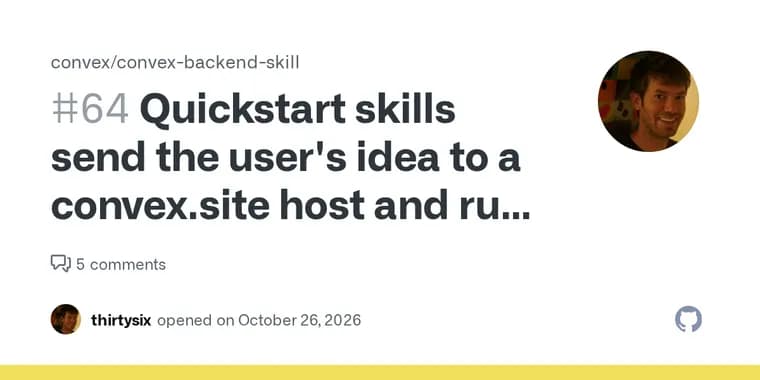
An issue on the GitHub repository convex/convex-backend-skill raises concerns about three skills in the plugin, which is listed in Anthropic's claude-plugins-official marketplace. The author points to specific files and lines.
First, lines 48 to 56 of skills/quickstart/SKILL.md POST the user's one-sentence project idea to basic-anteater-667.convex.site. A comment in the file marks this as telemetry. According to the author, the user is not told that the idea leaves the machine.
Second, lines 62 and 64 of skills/add/SKILL.md pipe a script from the same host straight into bash.
Third, lines 74 to 80 of skills/labs-quickstart/SKILL.md split downloading and running a bootstrap script into two Bash calls. The skill states why: "A single command that both downloads remote code and executes it is the shape harness safety classifiers block."
The author reads all this as a team trying to make onboarding reliable, not as anything malicious. The objection is that the third item tells the agent to reshape a command so the user's safety tooling does not catch it, which removes a check that the user or their administrator chose to have. Combined with an unpinned script from a host with a generated name, the author argues, a user has no way to review what runs.
The line references point to commit 6ca54f6. The author says all three passages were still on the main branch as of 26 October, with the labs-quickstart passage now at lines 73 to 80.
The issue suggests telling the user before the idea is sent and making that optional; shipping the bootstrap and add scripts inside the plugin, or pinning them by hash, instead of fetching them at run time; and dropping the classifier instruction so the download-and-run step is approved or refused as it is. The author maintains a catalog of agent skills and vetting tools that lists these findings, and says the project's response will be added to it.
In the comments, one participant reports pulling down two scripts, add-component.sh and add-hosting.sh, and finding further problems, including unpinned dependencies and a hosting script that pushes backend changes using the existing Convex authentication context. Those findings come from a commenter, not from the issue author.
Key facts
- skills/quickstart/SKILL.md POSTs the user's one-sentence project idea to basic-anteater-667.convex.site as telemetry, and the issue author says the user is not told.
- skills/add/SKILL.md pipes a script from the same host straight into bash.
- skills/labs-quickstart/SKILL.md splits download and execution into two Bash calls, noting that harness safety classifiers block the single-command form.
- The author does not read this as malicious, but argues the classifier instruction removes a check chosen by the user or their administrator.
- Proposed fixes: disclose and make the telemetry optional, bundle or hash-pin the scripts, and drop the classifier instruction.
Why it matters
The issue describes two kinds of exposure in one plugin: user input leaving the machine without notice, and remote code running on it. The sharpest point is the instruction about classifiers. As the author frames it, a skill is telling the agent to change the shape of a command so that safety tooling misses it. The plugin is listed in Anthropic's claude-plugins-official marketplace.
Who it affects
Anyone running the quickstart, add or labs-quickstart skills from this plugin is in scope of the findings. Administrators who rely on harness safety classifiers have a stake too, since the author says the two-step download removes a check they or their users chose to have. A commenter also warns that project descriptions could include confidential client information or intellectual property.
How to use it
If you use the plugin, you can read the cited passages yourself: quickstart lines 48 to 56, add lines 62 and 64, and labs-quickstart lines 74 to 80 at commit 6ca54f6 (lines 73 to 80 on main as of 26 October). The author's suggested changes for the project are to warn users before sending the idea and make it optional, ship the scripts with the plugin or pin them by hash, and let the download-and-run step be approved or refused as it is.
A comment in the thread goes further. It recommends removing the telemetry entirely, pinning external dependencies and verifying their integrity, removing instructions to circumvent harness security controls, and requiring separate authorization for backend deployment and public publication.
How solid is it
The core claims come with file names, line numbers and a commit reference, and the skill's stated reason for the two-step download is quoted directly. The author, who is not named in the text, maintains a catalog of agent skills and vetting tools. The issue description does not describe what the remote scripts contain or say whether any safety classifier was actually bypassed. It reports no harm to any user. No response from Convex or the repository maintainers appears in the material.
The additional script findings come from a commenter and are not part of the author's report.
Risks and caveats
The author explicitly reads the behaviour as an effort to make onboarding reliable, not as malice. The issue description also does not say what happens to the collected ideas, including retention, access or use.
The commenter who examined the scripts claims that add-component.sh recommends private Git dependencies without commit pinning and tells the agent to follow their READMEs, opening a route for indirect prompt injection. The same comment says add-hosting.sh installs an unpinned npm dependency, modifies application source and HTTP routes, pushes backend changes and publishes static assets. It also says setting QB_NO_PUBLISH=1 does not prevent backend deployment, and that because neither script is pinned or integrity-checked, the endpoint operator can change the code without a new plugin release or marketplace review.
“But the last item tells the agent to change the shape of a command so that the user's safety tooling does not catch it, which removes the check the user or their administrator chose to have.”
— Issue author, convex/convex-backend-skill issue on GitHub