Codex and Claude Code beat video models in visual reasoning test
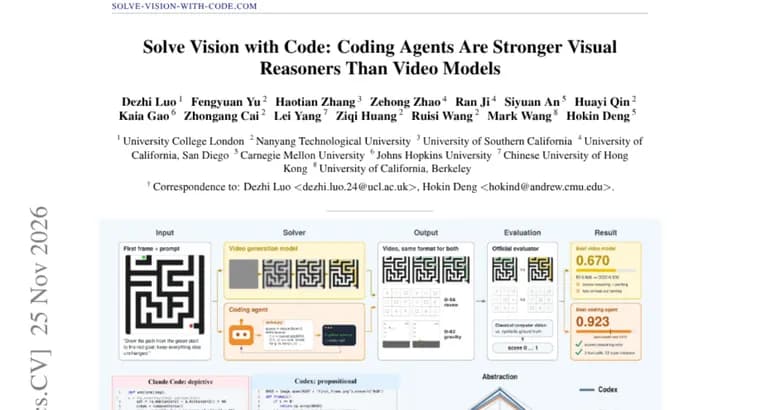
Video generation models are increasingly tested as visual reasoners: given a first frame and a natural-language prompt, can a model produce a video in which the specified task is carried out? That route is considered advantageous because the reasoning unfolds directly in the frames, not through language or code. According to the paper's authors, it had not been tested against a symbolic alternative under the same conditions.
Their study gives both approaches the same tasks, with identical inputs, output specification and evaluator. Instead of denoising pixels, a coding agent writes a program that renders the answer video, and an unmodified rule-based evaluator scores it. The test bed is VBVR-Pro-Bench (Xu et al., 2026), a suite of 500 instances spanning five cognitive categories with symbolic ground truth. The agent receives the same first frame and prompt as the video model. It has no access to ground truth, metadata or generation models, and gets one attempt per instance.
Three closed-model agents led the reported results. Codex with gpt-6-astra scored 0.923, Claude Code with Fable 5.1 scored 0.894, and Gemini CLI with Gemini 3.1 Pro scored 0.893. Each finished more than 0.22 above the strongest video model, a gap in score and not a percentage. Among 23 runnable open-weight models, the best was GLM-5 at 0.572, which the authors place above all video models except one trained with reinforcement learning (RL).
The authors conclude that for tasks whose solutions can be computed from a first frame and a prompt, program synthesis is currently a substantially more reliable route to visual reasoning than video generation. They also separate two kinds of agent-written programs. Depictive programs navigate the image to recover a transferable scheme, while propositional programs operate on hard-coded values. The authors say the distinction reveals how visual reasoning unfolds in these programs and what that implies about the nature of such reasoning in general.
Key facts
- Coding agents and video models received the same tasks, with identical inputs, output specification and rule-based evaluator.
- VBVR-Pro-Bench has 500 instances in five cognitive categories; agents got one attempt each and no access to ground truth, metadata or generation models.
- Codex with gpt-6-astra scored 0.923, Claude Code with Fable 5.1 scored 0.894 and Gemini CLI with Gemini 3.1 Pro scored 0.893, each more than 0.22 above the strongest video model.
- GLM-5, the best of 23 runnable open-weight models, reached 0.572, above every video model except the RL-trained one.
- The conclusion is limited to tasks whose solutions can be computed from a first frame and a prompt.
Why it matters
Video generation has been treated as a promising medium for visual reasoning because the work happens in the frames themselves. The authors say that assumption had not been tested against a symbolic alternative under matching conditions. Their comparison holds the inputs, output specification and evaluator constant, and reports that writing code to render the answer comes out well ahead for computable tasks.
Who it affects
The result is most relevant to researchers who evaluate video models as visual reasoners and to anyone comparing them with coding agents such as Codex, Claude Code or Gemini CLI. It also speaks to users of open-weight models: the best of the 23 runnable ones, GLM-5, scored 0.572, well short of the three closed-model agents at 0.893 to 0.923.
How to use it
For a task whose solution can be computed from a starting image and a written instruction, the findings suggest that having an agent write a program to produce the video is currently the more reliable option. Teams running their own comparisons can follow the study's setup: same first frame and prompt for both sides, same output specification, one unmodified evaluator. The depictive versus propositional split offers a further question to ask of any solution: does the program work from the image to recover a transferable scheme, or does it operate on hard-coded values?
How solid is it
These are the authors' own reported results on one benchmark of 500 instances with symbolic ground truth, scored by a rule-based evaluator. The account here rests on a short summary of the paper on Hugging Face. It does not name the compared video models or give their exact scores, reports no per-category results, and states no code release or peer-review status.
Risks and caveats
The claim covers only tasks that can be computed from a first frame and a prompt. It makes no statement about other visual tasks or about video generation quality in general. The agents had a single attempt per instance. No cost, compute, runtime or token figures are given for either approach, so the scores do not show which route is cheaper or faster. The lead over video models also depends on which system writes the code: GLM-5's edge over video models excludes the RL-trained one.
“for tasks whose solutions can be computed from a first frame and a prompt, program synthesis is currently a substantially more reliable route to visual reasoning than video generation”
— The paper's authors