DexEngine turns human demos into executable robot arm-hand data
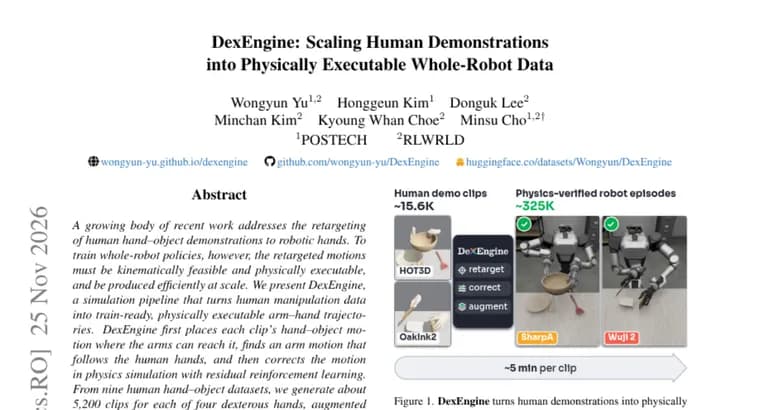
The authors of a paper listed on Hugging Face present DexEngine, a simulation pipeline that turns human manipulation data into train-ready, physically executable arm-hand trajectories for robots.
Their starting point is that a growing body of recent work retargets human hand-object demonstrations to robotic hands. Training whole-robot policies asks for more, they argue: the retargeted motions must be kinematically feasible and physically executable, and they must be produced efficiently at scale.
DexEngine works on each clip in stages. It first places the clip's hand-object motion where the robot arms can reach it. It then finds an arm motion that follows the human hands. Finally, it corrects the motion in physics simulation using residual reinforcement learning.
Using nine human hand-object datasets as input, the authors generate about 5,200 clips for each of four dexterous hands. These are augmented into 65,000 trajectories (116 hours) and 325,000 episodes (578 hours) in total.
The authors report that DexEngine, even with arms attached, tracks objects more accurately than prior floating-hand methods, and that it runs over 10x faster than methods based on reinforcement learning (RL).
They also test the data by training policies on it. Those policies far outperform ones trained on the same clips without physics correction, or with the arms attached after a floating-hand correction. The authors take this as evidence that fine-tuning data need physics correction. Mid-training on DexEngine data improves the policies further at an equal fine-tuning budget, both in simulation and on a real robot.
Key facts
- DexEngine is a simulation pipeline that converts human manipulation data into physically executable arm-hand trajectories.
- It places each hand-object motion within arm reach, finds an arm motion that follows the human hands, then corrects it in physics simulation with residual reinforcement learning.
- Nine human datasets yield about 5,200 clips for each of four dexterous hands, augmented into 65,000 trajectories (116 h) and 325,000 episodes (578 h) in total.
- The authors report better object tracking than prior floating-hand methods and speed over 10x that of RL-based ones.
- Policies mid-trained on the data improve further at equal fine-tuning budget, in simulation and on a real robot.
Why it matters
Moving a human hand motion onto a robotic hand is only part of the job when the goal is a policy for the whole robot. According to the authors, the motions also have to be reachable and physically executable by the arms and hands, and cheap enough to produce in bulk. DexEngine is their attempt to meet those conditions in one pipeline, starting from existing human hand-object datasets.
Who it affects
The work is most relevant to researchers and teams who train whole-robot manipulation policies, especially with dexterous hands, and to those who retarget human demonstrations to robots. The reported finding on physics correction speaks directly to anyone preparing fine-tuning data from human clips.
How to use it
The practical recipe has three steps: position each clip's hand-object motion where the arms can reach it, find an arm motion that follows the human hands, and correct the result in physics simulation with residual reinforcement learning. The authors use the resulting data for mid-training and report gains at the same fine-tuning budget. The text this account draws on does not say whether the code or the dataset is released.
How solid is it
These are the authors' own results, as summarised in a short description of the paper. The scale figures are specific: nine input datasets, four hands, 65,000 trajectories and 325,000 episodes. Among the comparisons, only the speed advantage of over 10x is quantified. The policy gains from mid-training are reported both in simulation and on a real robot.
Risks and caveats
No figures are given for object tracking accuracy, policy success rates, or the size of the improvement from mid-training. The methods used for comparison are not named, and neither are the four hands or the real robot. The 10x speed claim applies to RL-based methods, not to all prior methods, and comes without an absolute runtime or hardware details.
“Policies trained on our data far outperform those trained on the same clips without physics correction or with the arms attached after a floating-hand correction, showing that fine-tuning data need physics correction.”
— The DexEngine authors