Entangle guides robots through unseen tasks from one human video
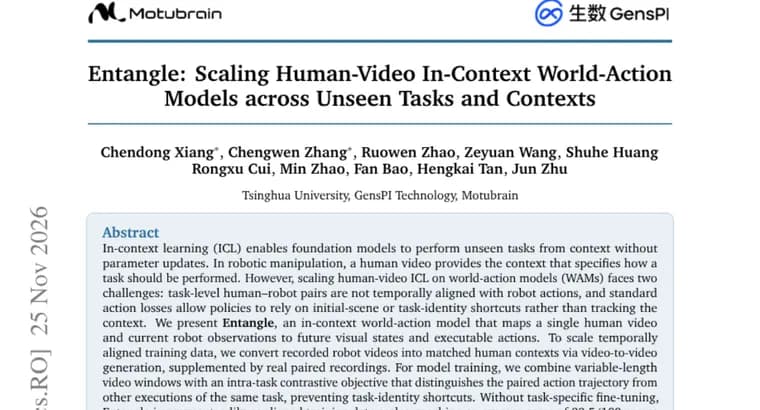
A research paper presents Entangle, an in-context world-action model (WAM) for robotic manipulation. It takes a single human video, which specifies how a task should be performed, plus the robot's current observations, and maps them to future visual states and executable actions. The idea draws on in-context learning, which lets foundation models perform unseen tasks from context without any parameter updates.
The authors name two obstacles to scaling this approach with human video on world-action models. First, human and robot recordings paired at the task level are not aligned in time with the robot's actions. Second, standard action losses let a policy take shortcuts, relying on the initial scene or the identity of the task instead of following the video it was given.
To get more temporally aligned training data, the team converts recorded robot videos into matching human videos using video-to-video generation, and supplements these with real paired recordings. In training, they combine variable-length video windows with an intra-task contrastive objective. This objective separates the action trajectory paired with a video from other executions of the same task, which is meant to prevent task-identity shortcuts.
According to the paper, Entangle improves steadily without task-specific fine-tuning as the amount of aligned training data grows. It reaches an average score of 83.5 out of 100 across six unseen tasks on an Astribot S1 robot. On seven unseen tasks in RoboTwin it achieves a 69.5% average success rate, 22.6 percentage points above Zero-WAM. In a setting called Context-OOD, the model transfers the behaviors shown in the context video to rearranged layouts and substituted tools, even though it was trained only on scene-aligned pairs. The project page is at https://entangle-robotics.github.io/.
Key facts
- Entangle maps one human video and current robot observations to future visual states and executable actions.
- Training data comes from robot recordings converted into matching human videos by video-to-video generation, plus real paired recordings.
- An intra-task contrastive objective and variable-length video windows target shortcuts that let a policy ignore the context video.
- The authors report an average score of 83.5/100 on six unseen tasks on an Astribot S1 robot, without task-specific fine-tuning.
- On seven unseen RoboTwin tasks the average success rate is 69.5%, 22.6 percentage points above Zero-WAM.
Why it matters
The goal is a robot that can take on a task it was not fine-tuned for by watching one video of a person doing it. In-context learning already lets foundation models handle unseen tasks without parameter updates, and the paper works on scaling that ability in world-action models for manipulation. It targets two specific problems: human and robot data that do not line up in time, and policies that guess the task from the starting scene or its identity while paying too little attention to the demonstration.
Who it affects
The work is most relevant to researchers and engineers building robot manipulation policies, especially those working on world-action models or on learning from human video. Teams short of paired human and robot data may take interest in the data recipe, which creates human versions of existing robot recordings through video-to-video generation and adds real paired recordings.
How to use it
Two ideas can be taken from the method as described. One is to build temporally aligned training pairs by generating human videos from recorded robot videos. The other is to add a contrastive objective within each task, so the model has to tell the paired action trajectory apart from other executions of that task, and to train on video windows of varying length. The authors list a project page at https://entangle-robotics.github.io/. The abstract does not say whether code, weights or data are released.
How solid is it
These are the authors' own results, taken from the paper's abstract. The real-robot figure is an average score of 83.5/100 over six unseen tasks on an Astribot S1, and the abstract gives no baseline for it, nor does it describe how the score is computed or how many trials were run. The RoboTwin result comes with a comparison: 69.5% average success on seven unseen tasks, 22.6 percentage points ahead of Zero-WAM. The claim of steady improvement with more aligned data and the Context-OOD transfer claim are stated in words, with no numbers given for the Context-OOD setting.
Risks and caveats
The size of the training data and the split between generated and real pairs are not stated in the abstract, so the cost of reproducing the scaling effect is unclear. The video-to-video generation model, the base model and the compute used are not named. The tests cover six real-robot tasks and seven RoboTwin tasks, none of them named, and limitations or failure cases are not discussed. A success rate of 69.5% also means the average unseen RoboTwin task still fails in a sizable share of cases.
“Under Context-OOD, although trained only on scene-aligned pairs, Entangle transfers context-specified behaviors across rearranged layouts and substituted tools.”
— Entangle paper abstract