Drex releases four open decision models that rank options without decoding
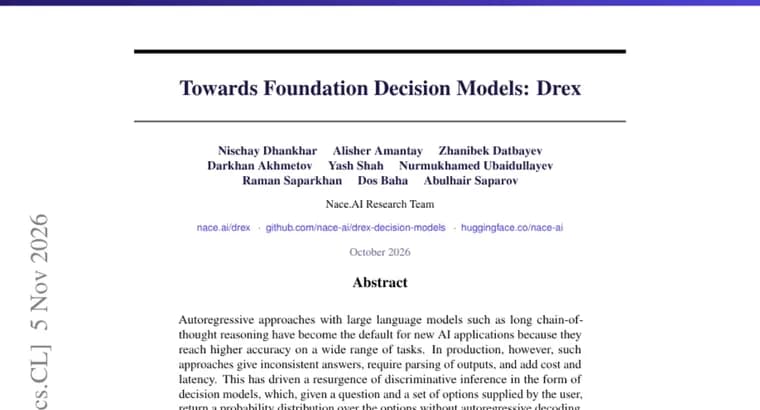
A paper on Hugging Face presents Drex, a family of four open decision models. The authors start from a production complaint about autoregressive LLM approaches such as long chain-of-thought reasoning: they reach higher accuracy on a wide range of tasks and have become the default for new AI applications, but in production they give inconsistent answers, require parsing of outputs, and add cost and latency.
Decision models are the proposed fix. Given a question and a set of options supplied by the user, they return a probability distribution over the options without autoregressive decoding. A request consists of a state, which can be a document, a record or an agent context, optionally with images, plus questions about it. Each question asks for a choice among options, a yes/no judgment, or a score on an ordered scale.
The family has four models: DLM (8B parameters), v1.5 (9B), v2.0 (35B with 3B active) and Max (27B). Training combines supervised fine-tuning with reinforcement learning from adjusted feedback (RLAF), plus vision tuning for Max. Ablations, the authors say, show that RLAF improves accuracy and that consistency losses improve robustness to option order.
The benchmark claims are all self-reported. On Decision Index 0.4.1, Max sets a new state of the art among the decision models the authors compare, scoring 67.52 on the public suite against 60.70 for Jev 1.14.0, a gap of 6.82. On Decision Bench v4, Max is statistically tied with d3-turbo and GPT-6 Sol and trails Claude Opus 5.5 by 1.6 points. On DecideBench it has the highest accuracy among decision models.
Speed is the other headline. Max answers a typical request in 183 ms, against about 2.0 s for GPT-6 Sol and 3.5 s for Claude Opus 5.5, which works out to roughly 11 times and 19 times faster. The authors also say Max's outputs are stable under option reordering. All four models are open source, with code and models linked from the GitHub repository nace-ai/drex-decision-models.
Key facts
- Drex is a family of four open decision models: DLM (8B), v1.5 (9B), v2.0 (35B with 3B active) and Max (27B).
- Instead of generating text, a decision model returns a probability distribution over options the user supplies, with no autoregressive decoding.
- On Decision Index 0.4.1, Max scores 67.52 on the public suite versus 60.70 for Jev 1.14.0, a new state of the art among the decision models compared.
- On Decision Bench v4, Max is statistically tied with d3-turbo and GPT-6 Sol and trails Claude Opus 5.5 by 1.6 points.
- Max answers a typical request in 183 ms, against about 2.0 s for GPT-6 Sol and 3.5 s for Claude Opus 5.5.
Why it matters
The paper targets a practical pain: long-reasoning LLMs are accurate, but in production they give inconsistent answers, need output parsing, and add cost and latency. Drex's approach is to skip text generation for tasks that are really selection or scoring. The model reads a state and a question and returns probabilities over the options, so the answer arrives in one pass in a fixed format. If the reported 183 ms holds up, that is roughly an order of magnitude faster than the frontier models it is compared against.
Who it affects
Teams that put models inside applications and need a dependable verdict rather than prose: classifying a document or record, judging yes or no, picking among options, or scoring on an ordered scale, including from an agent's context. The 8B to 35B sizes and open release also make the models relevant to anyone who wants to run such a component themselves.
How to use it
The models are published as open source through the GitHub repository nace-ai/drex-decision-models. A request supplies a state (a document, record or agent context, optionally with images) and one or more questions, each with options, a yes/no form, or an ordered scale. The output is a probability distribution over the options. Max is the only model with vision tuning. The source names no license for the models.
How solid is it
All figures come from the authors' own paper and abstract-level reporting, with no independent replication. The state-of-the-art claim is limited to the decision models the authors chose to compare, not to all models. Against general-purpose LLMs the picture is mixed: a statistical tie with d3-turbo and GPT-6 Sol and a 1.6-point deficit to Claude Opus 5.5 on Decision Bench v4. The units of the Decision Index scores are not given. The source also does not say what a typical request is for the latency comparison, or what hardware was used.
Risks and caveats
The speed comparison depends on an undefined typical request and unstated hardware, so the roughly 11x and 19x ratios are only indicative. The source does not explain what adjusted feedback means in RLAF. It gives no training-data or compute details and names no license. Decision models also fit only tasks that can be framed as choosing among supplied options or scoring, so they do not replace open-ended generation.
“In production, however, they give inconsistent answers, require parsing of outputs, and add cost and latency.”
— Drex paper abstract, describing autoregressive LLM approaches