DreamFree robot model skips video generation, runs a 14B backbone at 11Hz
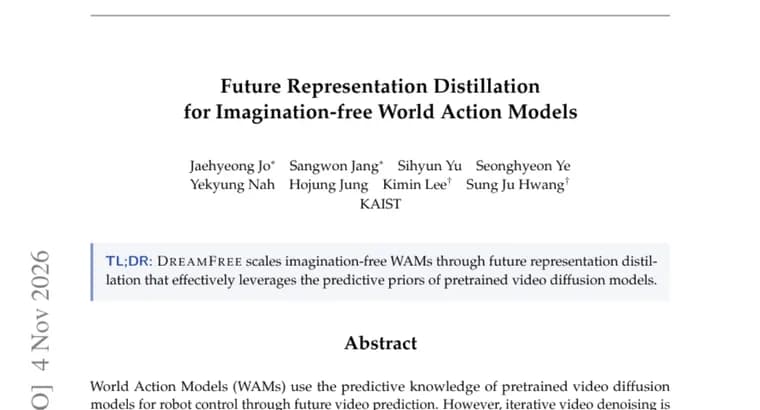
The paper starts from World Action Models (WAMs), which use the predictive knowledge inside pretrained video diffusion models to control robots by predicting future video. The authors name two problems with that approach: iterative video denoising is costly, and inaccurate visual predictions can compromise action prediction.
Their key idea is to make the same predictive knowledge available through visual representations computed from the current observation, so that actions can be predicted without generating any future video. The result is DreamFree, a WAM that repurposes a pretrained video diffusion model as a predictive visual encoder through representation distillation.
Training has two stages. First, the visual encoder learns to predict a frozen video diffusion model's representation using only the current observation. Then an action module is trained to predict actions by extracting action-relevant information from that visual encoder.
The authors report that across real-world and simulated tasks, DreamFree achieves higher success rates than state-of-the-art VLAs and WAMs. It does this while running real-time closed-loop control at 11Hz with a 14B video diffusion backbone.
They also say experiments show DreamFree can translate stronger video priors and additional video data into better robot control. It can also learn new robot tasks from video demonstrations, including videos from a different embodiment, without action annotation for the new tasks.
Key facts
- DreamFree is a World Action Model that turns a pretrained video diffusion model into a predictive visual encoder through representation distillation.
- Actions are predicted from the current observation alone; no future video is generated, which avoids costly iterative denoising.
- The visual encoder learns to predict a frozen video diffusion model's representation; an action module is then trained on top of it.
- The authors report real-time closed-loop control at 11Hz with a 14B video diffusion backbone, and higher success rates than state-of-the-art VLAs and WAMs.
- It is said to learn new tasks from video demonstrations, including from a different embodiment, without action annotation for the new tasks.
Why it matters
Existing WAMs get their predictive power by generating future video, and the authors say that is expensive because of iterative denoising, and risky because inaccurate predicted frames can hurt the actions. DreamFree keeps the video model's knowledge but moves it into a representation computed from the current observation. If the claims hold, large video priors become usable for real-time robot control without paying for video generation at run time.
Who it affects
Robotics researchers working on VLAs and WAMs are the direct audience. The claim that new tasks can be learned from video demonstrations, including from a different embodiment, without action labels for those tasks, would also matter to anyone who finds action-annotated robot data hard to collect.
How to use it
The source describes a method, not a release. The recipe is: freeze a pretrained video diffusion model, train a visual encoder to predict its representation from the current observation alone, then train an action module that extracts action-relevant information from that encoder. The authors say the approach benefits from stronger video priors and additional video data.
How solid is it
This is a preprint abstract, and every result is the authors' own claim. The source says DreamFree beats state-of-the-art VLAs and WAMs on real-world and simulated tasks and runs at 11Hz with a 14B video diffusion backbone, but it gives no success-rate figures, baseline names or margins. It does not state the number of tasks, robots or benchmarks, or the hardware behind the 11Hz figure.
Risks and caveats
The success-rate comparison cannot be checked from the abstract, since no numbers or baselines are given. The speed of baseline WAMs and any speedup over them are not stated, only DreamFree's own 11Hz. The abstract also does not name the video diffusion model used, mention code or model release, or discuss limitations.