Duo v1 is a full-duplex world model that sees, hears and responds live
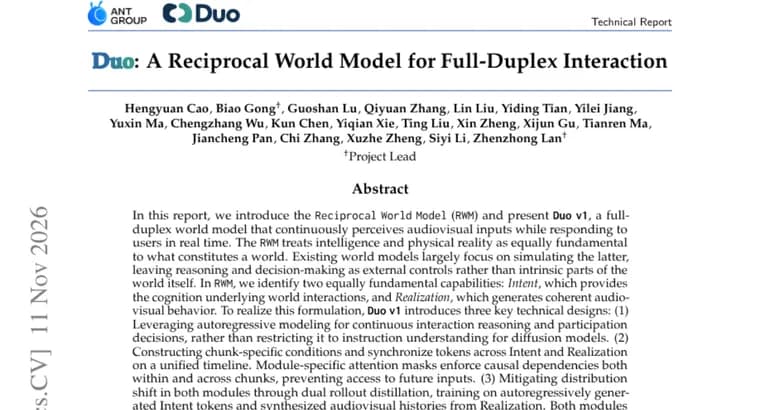
The authors of a report on Hugging Face Papers introduce the Reciprocal World Model (RWM) and present Duo v1, a full-duplex world model. It continuously perceives audiovisual input while responding to users in real time.
The argument starts from a criticism. The authors say existing world models largely focus on simulating physical reality, which leaves reasoning and decision-making as external controls rather than intrinsic parts of the world itself. The RWM instead treats intelligence and physical reality as equally fundamental to what constitutes a world. Within it, the authors identify two equally fundamental capabilities. Intent provides the cognition underlying world interactions. Realization generates coherent audio-visual behavior.
Duo v1 is built on three key technical designs. First, it uses autoregressive modeling for continuous interaction reasoning and for decisions about when to participate, rather than restricting autoregressive modeling to instruction understanding for diffusion models. Second, it constructs chunk-specific conditions and synchronizes tokens across Intent and Realization on a unified timeline; module-specific attention masks enforce causal dependencies both within and across chunks, so neither module can access future inputs. Third, it mitigates distribution shift in both modules through dual rollout distillation, training on autoregressively generated Intent tokens and on synthesized audiovisual histories from Realization.
Both modules continuously perceive real-time audio, video and text. That enables full-duplex interaction, with spontaneous conversations and interruptions. Beyond conversation, the authors say users can share real objects, reshape virtual scenes, guide assistants, or play audiovisual games without mouse or keyboard controls.
The authors call the release of Duo v1 their first step, with the next version coming soon, and say they look forward to broader exploration of this emerging field.
Key facts
- The report introduces the Reciprocal World Model (RWM) and presents Duo v1, a full-duplex world model that perceives audiovisual input while responding to users in real time.
- RWM has two capabilities the authors call equally fundamental: Intent (the cognition behind world interactions) and Realization (generation of coherent audio-visual behavior).
- Duo v1 rests on three designs: autoregressive interaction reasoning and participation decisions, a unified timeline with module-specific causal attention masks, and dual rollout distillation against distribution shift.
- Both modules take in real-time audio, video and text, allowing spontaneous conversation and interruptions, plus uses such as sharing real objects or playing audiovisual games without mouse or keyboard.
- The authors describe Duo v1 as a first step and say the next version is coming soon.
Why it matters
The authors' pitch is a change in what a world model is for. In their account, existing world models mostly simulate physical reality and treat reasoning and decision-making as external controls. RWM puts intelligence inside the world model, next to physical reality, and Duo v1 is the first release built on that idea. It aims at interaction that runs continuously and in both directions, so the model can take part in a conversation, be interrupted, and decide when to join in.
Who it affects
This is mainly of interest to researchers working on world models, full-duplex interaction and audiovisual generation. The authors also describe end-user scenarios: sharing real objects, reshaping virtual scenes, guiding assistants and playing audiovisual games without mouse or keyboard controls. These are described as capabilities of the system.
How to use it
The report describes Duo v1 as released, with a next version coming soon. The source does not say whether weights, code or a demo are publicly available, nor where. The practical value for a reader today is the design: a split into Intent and Realization modules on a shared timeline, causal attention masks inside and across chunks, and dual rollout distillation as the training remedy for distribution shift.
How solid is it
This is the authors' own description of their system, in the form of a report. No benchmark results, latency figures, model size, or training data details are reported. No comparison against other world models or full-duplex systems is given. The source does not report user studies or evaluation of the interaction capabilities; they are described as capabilities, not measured. No author names or institutions are given in the source text.
Risks and caveats
Treat the claims as unverified until numbers appear. The interaction scenarios, such as spontaneous conversation, interruptions and game play, are stated rather than measured. No date or timescale is given for the next version beyond "coming soon". The framing that existing world models leave reasoning as an external control is the authors' characterisation of the field, not something the report tests.
“The RWM treats intelligence and physical reality as equally fundamental to what constitutes a world.”
— Duo v1 report authors