DynaFlow trains an agent to build its own multi-agent workflows
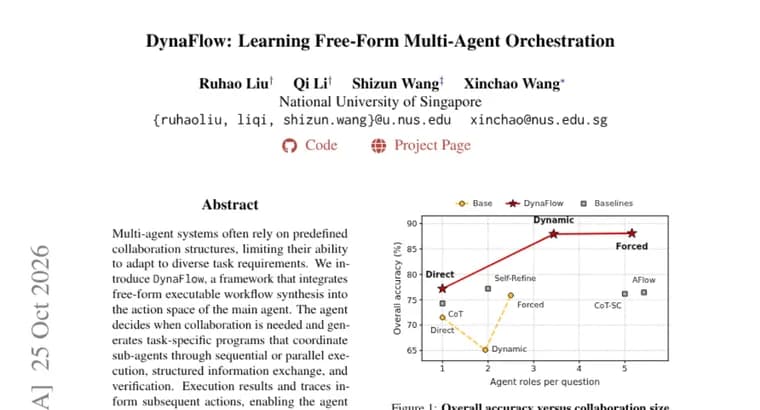
A paper listed on Hugging Face Papers, titled "DynaFlow: Learning Free-Form Multi-Agent Orchestration", takes aim at a common limit of multi-agent systems: they often rely on predefined collaboration structures, which limits how well they adapt to different task requirements.
DynaFlow is a framework that puts free-form executable workflow synthesis into the action space of the main agent. The agent decides when collaboration is needed. When it is, the agent generates task-specific programs that coordinate sub-agents through sequential or parallel execution, structured information exchange, and verification. Execution results and traces feed back into later actions, so the agent can adapt the collaboration as its reasoning progresses.
Training touches only the main agent. It first goes through supervised fine-tuning on distilled trajectories, then a refinement stage on examples filtered for unsupported premises, biased verification, and information-flow defects. All sub-agents stay fixed, which separates learning to orchestrate from improving the capability of the executors.
The evaluation covers six benchmarks spanning mathematical reasoning, scientific question answering, and multi-hop retrieval. DynaFlow reaches 88.08% overall accuracy in Forced mode, outperforming the strongest evaluated baseline by 10.90 percentage points. Both use the same Qwen3.5-27B backbone. A workflow analysis finds more explicit use, verification, and refinement of upstream outputs after training, which the authors present as evidence that cross-stage information flow is a key dimension of multi-agent orchestration.
Key facts
- DynaFlow lets the main agent synthesize free-form executable workflows as part of its action space, deciding when collaboration is needed.
- Generated programs coordinate sub-agents through sequential or parallel execution, structured information exchange, and verification.
- Only the main agent is trained: supervised fine-tuning on distilled trajectories, then refinement on examples filtered for unsupported premises, biased verification, and information-flow defects. Sub-agents stay fixed.
- Across six benchmarks (math reasoning, scientific question answering, multi-hop retrieval), it scores 88.08% overall accuracy in Forced mode, 10.90 percentage points above the strongest evaluated baseline with the same Qwen3.5-27B backbone.
- Workflow analysis shows more explicit use, verification, and refinement of upstream outputs after training.
Why it matters
Many multi-agent setups hard-code who talks to whom. DynaFlow instead treats the collaboration structure as something the main agent writes at run time, as a program, and learns to write well. The paper also separates orchestration from execution: sub-agents stay fixed, so any gain is attributed to better orchestration rather than to stronger executors. The authors point to cross-stage information flow, meaning how later steps use, check and refine earlier outputs, as a key dimension of orchestration.
Who it affects
Researchers and engineers building multi-agent or agentic reasoning systems are the main audience, especially those who now fix the collaboration pattern by hand. The evaluation covers math reasoning, scientific question answering and multi-hop retrieval, so results speak to those task types.
How to use it
The abstract describes the method but mentions no code, model or dataset release, so there is nothing to run yet. The recipe itself is clear enough to study: train only the orchestrating agent on distilled trajectories, filter the training examples for unsupported premises, biased verification and information-flow defects, and keep the sub-agents frozen.
How solid is it
The evidence is the abstract's own report. The 88.08% overall accuracy is stated for Forced mode only, and the 10.90-point margin is an absolute difference in percentage points over the strongest evaluated baseline on the same Qwen3.5-27B backbone. The baseline is not named and its score is not stated. Per-benchmark results and the names of the six benchmarks are not given, nor are the number and type of sub-agents or the teacher model used for distillation. The abstract does not say what Forced mode means. No authors or institutions are named in the source.
Risks and caveats
The headline number comes from a single mode whose meaning the abstract does not explain, and without the baseline's score or the benchmark list the size of the gain is hard to judge. No compute cost, latency or training-set size is given, so the price of generating and running workflows is unknown. The source gives no independent replication, and nothing indicates the work is peer reviewed.