Editable Visual Design turns AI-generated posters into editable layers
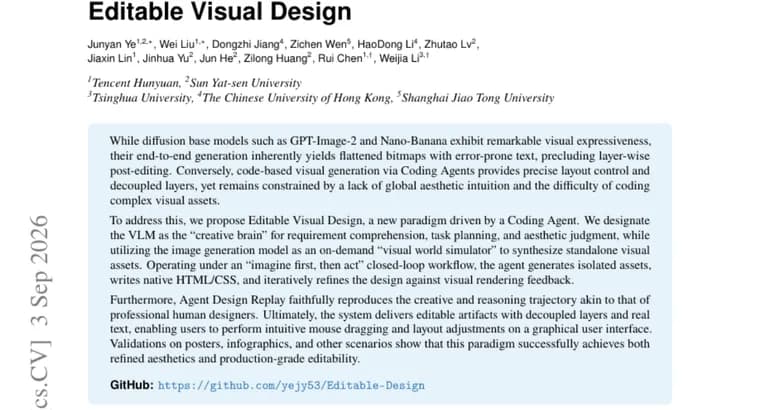
Junyan Ye and co-authors describe a tradeoff in current AI visual generation. End-to-end diffusion models such as GPT-Image-2 and Nano-Banana produce visually striking results, but their output is a flattened bitmap with error-prone text, which rules out editing individual layers afterward. Code-based generation through coding agents goes the other way: it gives precise layout control and keeps layers decoupled, but the agent lacks a global sense of aesthetics and struggles to code complex visual assets from scratch.
To close that gap, the paper proposes Editable Visual Design, a paradigm built around a Coding Agent. A vision-language model acts as the "creative brain": it reads the requirement, plans the task and makes aesthetic judgments. An image generation model is called only on demand, as a "visual world simulator" that synthesizes standalone visual assets the agent needs. The two work in an "imagine first, then act" closed loop: the agent generates isolated assets, writes native HTML and CSS to place them, and iteratively refines the layout by checking the rendered result against the visual feedback.
A second component, Agent Design Replay, is built to faithfully reproduce this creative and reasoning trajectory, which the authors compare to how a professional human designer works through a piece.
The payoff is the output format itself: because layout is written in HTML/CSS rather than rasterized, the result keeps decoupled layers and real, editable text rather than baked-in pixels. A user can then drag elements and adjust the layout directly in a graphical interface, the way one would edit a native design file. The authors report validating the approach on posters, infographics and other scenarios and say it achieves both refined aesthetics and production-grade editability, though the text gives no benchmark scores or comparison numbers to back that claim, and does not say which specific VLM or image generation model the system itself runs on.
Key facts
- Editable Visual Design pairs a VLM, used for planning and aesthetic judgment, with an image generation model called on demand to synthesize standalone visual assets.
- The Coding Agent writes native HTML/CSS for the layout and iteratively refines it against visual rendering feedback, in an "imagine first, then act" loop.
- This addresses a tradeoff: diffusion models like GPT-Image-2 and Nano-Banana give flat bitmaps with error-prone text, while pure coding agents give editable layers but weak aesthetics and struggle with complex assets.
- Agent Design Replay reproduces the creative and reasoning trajectory, which the authors liken to a professional human designer's process.
- Output artifacts keep decoupled layers and real text, so users can drag elements and adjust layout in a GUI; the authors say validations on posters and infographics show refined aesthetics and production-grade editability, without giving benchmark numbers.
Why it matters
AI image tools have forced a choice: diffusion models look polished but hand back a single flat image, with text that is often garbled and layers that cannot be pulled apart; coding agents produce structured, editable output but tend to look worse and choke on complex visual elements. Editable Visual Design targets exactly that gap, using a VLM for judgment and a diffusion model only for the assets it is good at, so the agent can write the actual layout in HTML/CSS instead of raw pixels.
Who it affects
Anyone producing posters, infographics or similar visual material with AI tools today has to pick a side of that tradeoff. A paradigm that hands back editable layers with real text, rather than a flattened image, changes what a designer or marketer can do after generation: adjust, rebrand or localize a design without starting over.
How to use it
The text describes a workflow, not a shipped product: a Coding Agent takes a design requirement, calls an image model on demand for individual assets, writes HTML/CSS to place them, and refines the result against rendered visual feedback until the layout is done. The output is a file with decoupled layers and editable text that a user manipulates by dragging elements in a GUI. The source does not mention any code, dataset or demo release.
How solid is it
The claims here are the authors' own. They report validating the paradigm on posters, infographics and other scenarios and say it achieves both refined aesthetics and production-grade editability, but the text supplies no benchmark scores, no comparison numbers against alternative methods, and no user-study results. It also does not specify which VLM or which image generation model the system itself runs on.
Risks and caveats
No institution, author affiliation, publication venue or date appears in the text, so the work's provenance beyond the named author is unclear. The reported success is described qualitatively, not measured against a stated baseline, which makes it hard to judge how much of an improvement this is over existing coding-agent or diffusion-based approaches.