EditVid unifies instruction and reference-guided video editing without training
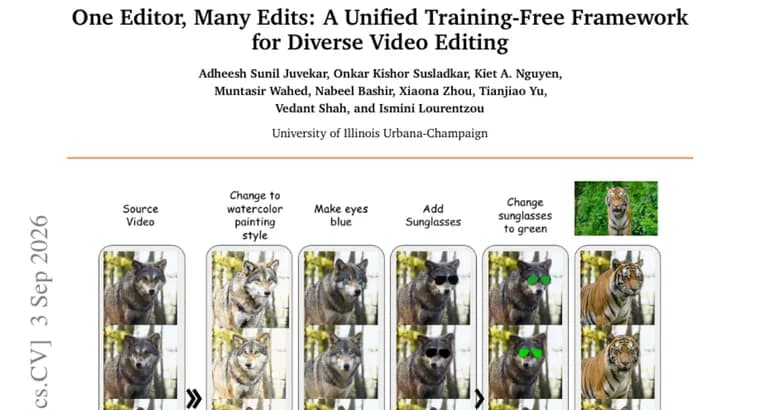
Researchers have introduced EditVid, a training-free framework that unifies multiple video editing paradigms inside a single system. Video editing today splits across separate approaches: instruction-guided edits, where a user types a text command, and subject-guided or reference-guided edits, where a reference image or object drives the change. Building one framework that handles both well has been difficult. EditVid combines three techniques to close that gap: sparse causal memory, which keeps edits locally coherent across frames; correspondence-based post-attention token injection, which preserves an edited subject's identity over long stretches of video; and soft latent blending, which keeps edits confined to the intended region rather than bleeding into the rest of the frame. Because the framework is training-free, it does not require task-specific fine-tuning to support each editing mode. The same system handles style transfer, attribute modification, object insertion, part-level editing and subject replacement, covering both instruction-guided and reference-guided workflows. On the FiVE benchmark, EditVid scores 78.16 FiVE-Acc, well ahead of the 58.95 scored by the strongest training-free baseline the authors evaluated against. It also achieves competitive results on IVEBench, a separate video-editing benchmark. Beyond automated scores, the authors ran a user study comparing EditVid against seven competing methods; evaluators preferred EditVid's output 51.8% of the time overall. The paper does not name the seven competing methods, give author or institutional details, state a release date, or mention code or model availability.
Key facts
- EditVid is a training-free framework unifying instruction-guided and reference-guided video editing in one system.
- It combines sparse causal memory (local coherence), correspondence-based post-attention token injection (long-range identity preservation), and soft latent blending (edit locality).
- Supports style transfer, attribute modification, object insertion, part-level editing, and subject replacement.
- Scores 78.16 FiVE-Acc on the FiVE benchmark versus 58.95 for the strongest training-free baseline, and achieves competitive results on IVEBench.
- A user study found 51.8% overall preference for EditVid over 7 competing methods (unnamed in the source).
Why it matters
Video editing tools have historically specialized: one system for text-instruction edits, another for swapping in a reference subject or object. EditVid's contribution is architectural, not just incremental accuracy: it demonstrates that a single training-free pipeline can cover both edit types and five distinct editing tasks without per-task fine-tuning, which lowers the engineering cost of building a general-purpose video editor.
Who it affects
The paper targets researchers and engineers building video editing systems, and by extension any product team evaluating whether to adopt a unified editing pipeline instead of maintaining separate specialized models for different edit types. No author names, institutional affiliations, or company backing are given in the source.
How to use it
The text does not mention code availability, a model release, licensing terms, or a venue such as a conference or journal. There is no indication of when or whether EditVid will be released for public or commercial use.
How solid is it
The claims rest on two forms of evidence: a benchmark comparison and a user study. On FiVE, EditVid's 78.16 FiVE-Acc clears the strongest training-free baseline's 58.95 by a wide margin, and it is described as competitive (not necessarily best) on the separate IVEBench benchmark. The user study adds a human-preference check: EditVid was preferred 51.8% of the time overall against seven competing methods, a majority but not an overwhelming one. The paper does not specify dataset size, compute cost, or runtime, which limits assessment of practical efficiency.
Risks and caveats
The source does not name the seven competing methods used in the user study, making it hard to judge how strong the comparison set was. No release date, code, or model weights are mentioned, so the framework's real-world availability and reproducibility remain unknown. A 51.8% preference margin, while a majority, is not dramatic, and the paper gives no author or institutional details that would help gauge the work's provenance.