English learners' word lists shifted from concrete to abstract over 70 years
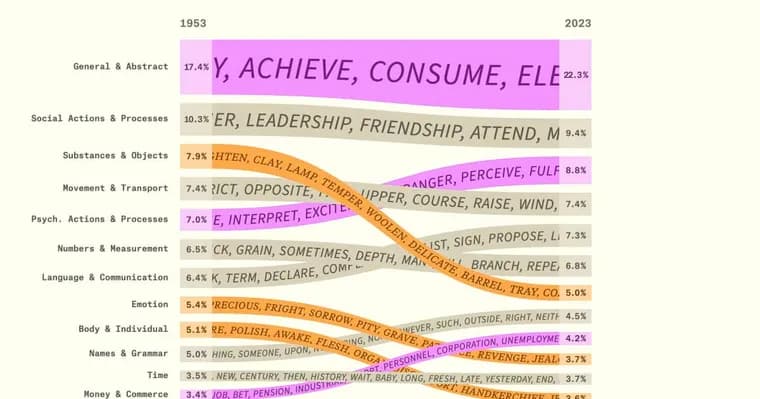
A data-journalism piece on pudding.cool compares two vocabulary lists built to teach English to language learners: the General Service List (GSL), published in 1953 with 2,284 words, and its update, the New General Service List (NGSL 1.2), first issued in 2013 and revised in 2023 with 2,809 words. The GSL is said to cover about 84% of everyday English use, the NGSL over 90%. Between the two lists, 1,656 words remained on both, 628 words present only in the 1953 list were dropped, and 1,153 words present only in the 2023 list were added.
Some drops and additions are unsurprising: telegraph and tobacco fell off; computer, website, blog and cigarette came in; motherhood was replaced by mom, and dad was added, though fatherhood was never on either list. But many everyday, physical words also fell away even though the things themselves did not disappear from daily life: apple, fork, soap, umbrella and leaf are gone from the new list, as are goat and donkey, though dog stayed, and flour and wheat, though bread stayed. Cook remained on the list; boil, bake and fry did not. In their place came abstract words such as mortgage, corporation, appropriate, analysis, fairly and despite.
The author ran all words in both lists through the UCREL Semantic Analysis System (USAS), sorting them into 21 semantic categories such as Food and Farming, the Body and the Self, Government and Public, and Language and Communication, then grouped those categories into five broader domains: the self, the immediate physical world, institutions, social and communicative life, and universal or abstract terms. Categories tied to the immediate physical world shrank as a share of the list, while categories further from direct experience grew. The author links this to a labor-market shift: by 1957, four years after the original GSL was published, white-collar workers outnumbered blue-collar workers in the US for the first time, and by 2000 fewer than one in four US workers did manual labor.
The piece also scored every word for concreteness on a 1-to-5 scale, where 5 means a word can be experienced directly through the senses, using the Brysbaert et al. (2014) concreteness-ratings dataset, which covered 99.8% of the words in both lists (6 words, including "as" and "dialog," were excluded from that chart for lack of coverage). The 2023 list skews measurably further toward abstract, low-concreteness words than the 1953 list. The author cites dual-coding theory: concrete words are processed through both a verbal and a sensory channel, which the piece argues makes them stickier and faster to recall, while abstract words rely on language alone.
A part-of-speech breakdown, measured by each category's share of its list rather than raw counts, found nouns still dominate both lists, verbs held roughly steady, adjectives grew modestly, and adverbs' share nearly doubled between 1953 and 2023. The author argues that abstract words such as "acceptable" or "adequate" need adverbs like "somewhat," "possibly," "absolutely" or "precisely" to qualify their degree, frequency or certainty, in a way concrete words such as "axe" do not.
The GSL word list is drawn from the Simple English Wiktionary GSL; the NGSL words come from the official NGSL 1.2 file. The author notes the NGSL uses lemmas, one entry per word family, while the GSL sometimes lists inflected forms separately, and says they did not personally re-run the underlying corpus coverage analyses, instead relying on the published figures from the list authors and a follow-up American-English coverage check by Stoeckel (2019). All source data, words tagged as remained, removed or added, with semantic tags, concreteness ratings and part-of-speech labels, is published in an accompanying spreadsheet alongside the interactive article.
Key facts
- The 1953 General Service List (2,284 words) and its 2023 update, the New General Service List (2,809 words), share 1,656 words; 628 were dropped and 1,153 were added.
- Concrete, hands-on words fell out (apple, fork, soap, umbrella, goat, flour) even where the objects remain common, while abstract words came in (mortgage, corporation, analysis, appropriate).
- Sorting both lists into 21 semantic categories via the UCREL Semantic Analysis System showed categories tied to the physical world shrank as a share of the list, while abstract and institutional categories grew.
- Using the Brysbaert et al. (2014) concreteness dataset, which covered 99.8% of the words in both lists, the analysis found the 2023 list skews measurably more abstract than the 1953 list.
- Adverbs' share of each list nearly doubled between 1953 and 2023, while nouns stayed dominant and verbs held roughly steady, reflecting more hedging and precision words like "somewhat" and "precisely."
Why it matters
The piece treats two practical teaching tools as an accidental record of how English-speaking daily life changed over 70 years. Its central finding, that vocabulary moved from concrete, hands-on words toward abstract, systemic ones, tracks a broader shift the author ties to the labor market: by 1957 white-collar workers had overtaken blue-collar workers in the US, and by 2000 fewer than one in four workers did manual labor. The piece also draws on dual-coding theory to argue this is not a cosmetic change: concrete and abstract words are processed differently by the brain, so a curriculum's shift toward abstraction changes what kind of cognitive work a learner has to do.
Who it affects
The direct audience is ESL learners, teachers and curriculum designers who rely on the GSL or NGSL as a guide to essential vocabulary. The analysis is also relevant to linguists and cognitive scientists working on concreteness effects and semantic change, and to general readers interested in how language mirrors shifts in work and daily life over decades.
How to use it
The article is a free, interactive piece on pudding.cool with browsable word-list panels and charts. The underlying dataset, every word tagged as remained, removed or added, with its semantic category, concreteness rating and part of speech, is published in an accompanying public spreadsheet, so curriculum designers or researchers can inspect or reuse the tagging directly rather than take the charts on faith.
How solid is it
The comparison rests on two established, tested vocabulary lists (the 1953 GSL and the 2023 NGSL 1.2) and two established external tools: the UCREL Semantic Analysis System for meaning categories and the Brysbaert et al. (2014) concreteness-ratings dataset, which covered 99.8% of the words in both lists. The author is explicit about method: category and part-of-speech changes are measured as each list's internal share, not raw counts, and they state they did not personally re-run the corpus coverage analyses behind the 84% and over-90% coverage figures, instead citing the list authors' published numbers and an independent American-English check by Stoeckel (2019).
Risks and caveats
The author states directly that neither list is a neutral census of culture: both were built as practical teaching tools, selected for frequency and coverage rather than as a deliberate portrait of society, so the sociological reading is the author's own interpretive layer on top of teaching data. The coverage percentages (about 84% for the 1953 list, over 90% for the 2023 list) come from the list authors and follow-up studies rather than from the author's own analysis. Category and part-of-speech shifts reflect proportional share of each list, not the number of words in absolute terms.
“The categories that shrank are mostly those that have to do with the immediate, physical world, while the gains are those furthest from it.”
— pudding.cool, "How the words we teach English language learners changed"