EnvHarness makes static AI agent training environments adaptive
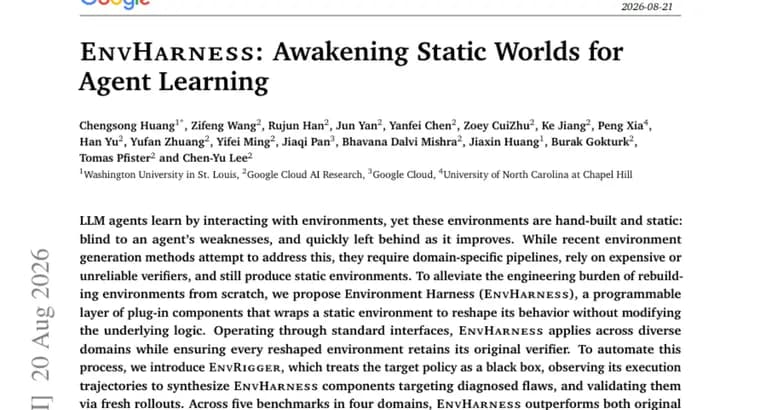
LLM agents learn by interacting with training environments, but according to a new paper, most such environments are hand-built and static: they cannot see an agent's specific weaknesses, and they get left behind as soon as the agent improves past them. Newer environment-generation methods that try to address this still fall short, the authors argue, because they require domain-specific pipelines, depend on verifiers that are either expensive or unreliable, and end up producing environments that are static all over again.
To fix this without forcing teams to rebuild environments from scratch, the paper proposes EnvHarness: a programmable layer of plug-in components that wraps around an existing static environment and reshapes how it behaves, without modifying the environment's underlying logic. EnvHarness works through standard interfaces, so it can be applied across different domains, and every environment it reshapes keeps its original verifier. To generate the plug-in components automatically, the authors introduce EnvRigger, which treats the agent's policy as a black box: it observes the policy's execution trajectories, synthesizes EnvHarness components aimed at the flaws it diagnoses, and checks each new component by running fresh rollouts.
Tested across five benchmarks spanning four domains, EnvHarness is reported to outperform both the original static environments and domain-specific environment-generation pipelines built for the same tasks. On held-out instances, it achieves up to a 9.0-point improvement while using 9.8% fewer execution steps. The authors also say EnvHarness gives reinforcement learning a better optimization signal than the alternatives, enabling continuous, targeted co-evolution of the policy and the environment it trains in.
Key facts
- Most LLM-agent training environments are hand-built and static, so they cannot target an agent's specific weaknesses and go stale as the agent improves; prior environment-generation fixes still need domain-specific pipelines and unreliable verifiers, the authors say.
- EnvHarness is a programmable layer of plug-in components that reshapes a static environment's behavior through standard interfaces, without changing its underlying logic, while keeping the environment's original verifier intact.
- EnvRigger automates building EnvHarness components by treating the target policy as a black box: it watches execution trajectories, synthesizes components aimed at diagnosed flaws, and validates each one with fresh rollouts.
- Across five benchmarks in four domains, EnvHarness is reported to outperform both the original environments and domain-specific environment-generation pipelines, with up to a 9.0-point improvement on held-out instances and 9.8% fewer execution steps.
- The authors say EnvHarness also gives reinforcement learning a better optimization signal, enabling continuous, targeted co-evolution between the policy and its training environment.
Why it matters
Training LLM agents well depends heavily on the environments they train in, and most of those environments are built once and never adapt: they cannot target the specific mistakes an agent keeps making, and they age out of relevance once the agent improves past them. Rebuilding an environment from scratch every time a new gap appears is expensive engineering work, and the paper argues that existing environment-generation methods do not really solve this, since they still need domain-specific pipelines and rely on verifiers that are expensive or unreliable. EnvHarness targets that gap directly: it adds plug-in components on top of an environment a team already has, changing how it behaves without anyone touching the underlying code, so the environment can keep adapting to what the agent actually struggles with.
Who it affects
This work speaks to researchers and engineering teams who train LLM agents through reinforcement learning or other interaction-based methods, and who currently rely on static, hand-built environments or benchmarks. It also speaks to teams already using domain-specific environment-generation pipelines, since the authors present EnvHarness and EnvRigger as an alternative that keeps the original verifier in place while avoiding the extra domain-specific engineering those pipelines require.
How to use it
EnvHarness is meant to be layered onto an environment a team already has rather than replace it: through standard interfaces, it wraps the existing static setup and reshapes how it behaves without touching the underlying logic, so the original verifier keeps working as before. Writing the actual plug-in components is automated by EnvRigger, which watches where the current policy fails, generates components aimed at those specific flaws, and checks each new component with fresh rollouts before it is used. The authors describe the approach as applying across diverse domains, provided the environment exposes the standard interfaces EnvHarness expects.
How solid is it
The claims rest on tests across five benchmarks in four domains, with EnvHarness compared directly against both the original static environments and domain-specific environment-generation pipelines built for the same tasks, which is a reasonably broad comparison for one paper. Several details that would let a reader judge the result more precisely are missing from the text: the benchmarks and domains are not named, no metric is specified behind the 'up to a 9.0-point improvement' figure, and it is not stated whether the 9.8% reduction in execution steps is measured against the original environments, the generation pipelines, or both. The source also carries no publication or submission date and does not specify which reinforcement learning algorithm or training setup was used. As with any single paper's self-reported results, these numbers describe what the authors measured in their own tests rather than an independently replicated finding.
Risks and caveats
Both headline figures, the up to 9.0-point improvement and the 9.8% cut in execution steps, are best-case results on held-out instances rather than typical or average outcomes, so real-world gains from adopting EnvHarness could be smaller. EnvRigger's automation works by observing a policy's execution trajectories and generating fixes for the flaws it diagnoses there, which means its plug-ins are shaped by whatever weaknesses happen to surface during observation; a problem the policy rarely triggers is less likely to get addressed. Because the five benchmarks, four domains and the metric behind the main improvement figure are not named, it is hard for an outside reader to judge how well the results would carry over to a different agent or task.