FACET grounds terminal-agent tasks in one shared execution environment
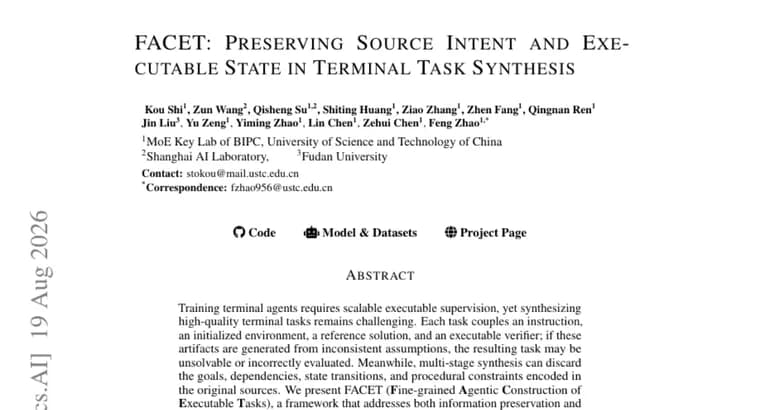
Training terminal agents, AI systems that operate inside a command-line environment, requires scalable executable supervision: large numbers of realistic practice tasks that come with a way to check whether an attempt succeeded. Synthesizing high-quality terminal tasks at that scale remains difficult, the paper argues, because each task couples four separate pieces that must agree with each other: an instruction describing the goal, an environment initialized to a starting state, a reference solution that solves the task, and an executable verifier that checks an attempt against it. If these four pieces are generated from inconsistent assumptions, the resulting task may turn out to be unsolvable, or it may be evaluated incorrectly. Ordinary multi-stage synthesis pipelines, the paper adds, can also discard the goals, dependencies, state transitions and procedural constraints that were encoded in whatever original sources the tasks were derived from.
The authors present FACET (Fine-grained Agentic Construction of Executable Tasks), a framework built to address both problems at once: keeping the four artifacts consistent with each other while preserving what made the original source material valuable. FACET first reconstructs related agent skills into a single coherent, information-rich scenario. It then builds and repairs the actual execution environment, a container, before generating the instruction, the reference solution and the verifier from that one already-validated state. Because all three downstream artifacts are produced after the environment itself has been checked and fixed, they share the same grounding. Execution-based validation can then catch a failure specific to just one artifact, for instance a broken verifier, and repair only that piece rather than regenerating the whole task.
The paper reports two lines of results. First, the tasks FACET produces are complex and carry dense executable checks, and the successful agent trajectories collected by running through them serve as data-efficient training supervision: fine-tuning models on this data, across multiple model scales, consistently improves their performance on Terminal-Bench 2.1, a benchmark for terminal-agent competence. Second, the authors compare FACET's environment-grounded construction against alternative task-generation schemes and report that grounding construction in a real, validated environment specifically supports task validity and keeps the solution and the verifier aligned with each other.
The paper does not attach a numeric score or percentage to the Terminal-Bench 2.1 improvement, beyond describing it as consistent; it does not name the baseline methods or prior benchmarks used for comparison; it does not specify which model families or parameter counts 'multiple scales' refers to; and it does not state whether FACET's code, data or the tasks it generates will be released.
Key facts
- FACET (Fine-grained Agentic Construction of Executable Tasks) generates terminal-agent training tasks by first building and repairing an execution environment, then generating the instruction, reference solution and verifier from that one validated container.
- The paper argues that generating a task's four parts, instruction, environment, solution and verifier, from inconsistent assumptions can leave tasks unsolvable or incorrectly evaluated, and that ordinary multi-stage synthesis tends to discard goals, dependencies, state transitions and procedural constraints from the original source material.
- Fine-tuning models across multiple scales on trajectories collected from FACET-generated tasks consistently improves performance on Terminal-Bench 2.1, though no specific score or percentage is given.
- Comparisons against alternative task-generation schemes support environment-grounded construction as important for task validity and for keeping the solution and verifier aligned with each other.
- The text does not name baseline methods, specify which model scales were tested, or say whether FACET's code, data or generated tasks will be released.
Why it matters
Any pipeline that trains a terminal agent depends on synthetic practice tasks, and a task is only as good as the agreement between its four parts: the instruction that states the goal, the environment it starts from, the reference solution, and the verifier that grades an attempt. The paper argues that when these four pieces are produced from inconsistent assumptions, rather than all checked against one real, working state, the resulting task can turn out unsolvable or be evaluated incorrectly, and that ordinary multi-stage synthesis pipelines tend to lose the goals, dependencies, state transitions and procedural constraints present in whatever source material the tasks were built from. FACET's answer is to build and repair the actual execution environment first, then generate the instruction, solution and verifier from that one validated state, so all three inherit the same grounding instead of drifting apart.
Who it affects
The direct audience is teams that build training or evaluation data for terminal and coding agents: anyone assembling a task set for fine-tuning, or anyone running an agent through automatically generated tasks and trusting the verifier's pass or fail result. The paper reports gains from fine-tuning on FACET-generated data across multiple model scales, so the result speaks to teams working at more than one model size, though the text does not say which model families or how many scales were tested. It also matters to anyone who treats Terminal-Bench 2.1 scores as a signal of an agent's competence, since that benchmark is where the paper reports its results.
How to use it
FACET is presented as a research method rather than a released product; the text does not say whether its code, data or the tasks it generates will be made available. The practical route the paper describes is to run its pipeline: reconstruct related agent skills into one scenario, realize and repair the execution container, generate the instruction, solution and verifier from that container, then collect successful agent trajectories against the resulting tasks to use as fine-tuning data.
How solid is it
The central empirical claim, that fine-tuning on FACET-generated trajectories improves performance on Terminal-Bench 2.1 across multiple model scales, is stated as a consistent result but without a numeric score or percentage attached. A second line of evidence comes from comparisons against alternative task-generation schemes, which the authors say support the case that grounding construction in a real, validated environment specifically helps task validity and keeps the solution and verifier aligned. Both findings are the authors' own reported results, drawn from their own experiments rather than an outside evaluation.
Risks and caveats
The claims are directional rather than quantified: 'consistently improves' and 'support the importance of' are not attached to numbers, so the size of FACET's advantage over other approaches cannot be judged from the text alone, and no baseline methods or prior benchmarks are named for comparison. The text also does not specify which model families or parameter counts 'multiple scales' covers, and it does not state whether the framework's code, data or generated tasks will be released, which matters for anyone hoping to reproduce or build on the result.