Environment evolution lifts Qwen3.6 terminal-agent scores by up to 18 percentage points
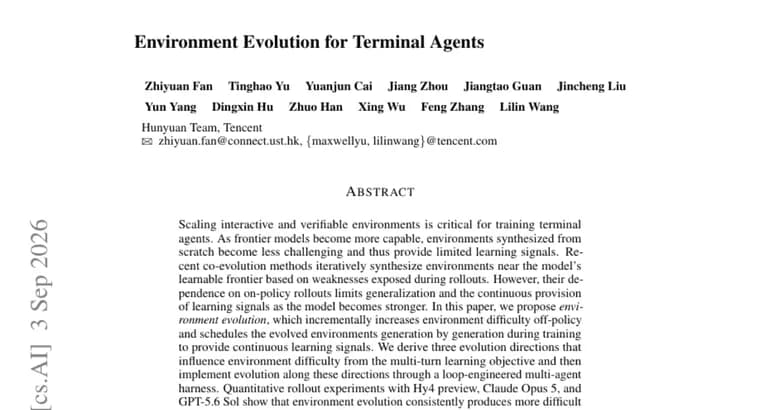
Researchers propose environment evolution, a method for training terminal agents (AI systems that operate a command line or similar interactive environment) through reinforcement learning. The starting problem: as frontier models get more capable, environments synthesized from scratch stop being challenging and give the model little to learn from. Recent co-evolution methods try to fix this by iteratively generating new environments near the model's learnable frontier, based on weaknesses the model exposes during its own rollouts. The authors argue this on-policy dependence backfires: it limits how well the resulting agent generalizes, and it runs out of useful signal as the model keeps improving, because the environments are tied to that one model's current weaknesses. Environment evolution instead increases environment difficulty off-policy, meaning independent of the specific model being trained, and schedules progressively harder environments generation by generation over the course of training. The authors derive three directions that drive environment difficulty from the multi-turn learning objective, then implement evolution along those directions with what they call a loop-engineered multi-agent harness; the abstract names this harness but does not explain its internal mechanics. To test whether the method actually produces harder environments, the team ran quantitative rollout experiments involving three different models: Hy4 preview, Claude Opus 5, and GPT-5.6 Sol. Across these, environment evolution consistently generated more difficult environments than the alternative. The authors then validated the practical payoff with simple long-horizon RL training on two Qwen models, Qwen3.6-27B and Qwen3.6-35B-A3B, measuring the result on the Terminal-Bench 2.1 benchmark. Training with environment evolution improved performance by 14.4 percentage points for the smaller Qwen3.6-27B model and by 18.0 percentage points for Qwen3.6-35B-A3B.
Key facts
- Environment evolution raises RL training-environment difficulty off-policy, independent of the model being trained, and schedules harder environments generation by generation during training.
- It targets a specific weakness in existing co-evolution methods: their reliance on on-policy rollouts limits generalization and stops giving useful learning signal once the model gets stronger.
- Three evolution directions, derived from the multi-turn learning objective, are implemented through a loop-engineered multi-agent harness.
- Quantitative rollout experiments with Hy4 preview, Claude Opus 5, and GPT-5.6 Sol show environment evolution consistently produces more difficult environments.
- Long-horizon RL training with the method raised Terminal-Bench 2.1 scores by 14.4 percentage points for Qwen3.6-27B and 18.0 percentage points for Qwen3.6-35B-A3B.
Why it matters
Training terminal agents with reinforcement learning needs environments that stay hard enough to teach the model something. Handwritten or from-scratch environments go stale as models get better, and the existing fix, co-evolution tied to a model's own on-policy rollouts, generalizes poorly and loses steam as the model improves, since the environments are shaped around that one model's current gaps. Environment evolution sidesteps both problems by evolving environments off-policy and scheduling harder versions across training generations, so the learning signal keeps flowing as the model gets stronger.
Who it affects
Teams building or training terminal and command-line agents through reinforcement learning. The method was validated on Qwen3.6-27B and Qwen3.6-35B-A3B, and its environment-difficulty effect was measured through rollout experiments involving Hy4 preview, Claude Opus 5, and GPT-5.6 Sol; the abstract does not say whether these three models generated the evolved environments, evaluated them, or both.
How to use it
This is a research training method, not a released product or tool, and the abstract gives no price, license, or access details. It works by deriving three evolution directions from the multi-turn learning objective and applying them through a loop-engineered multi-agent harness that incrementally increases environment difficulty and schedules the harder versions generation by generation during training; the abstract does not describe how the harness itself operates internally.
How solid is it
The claim that environment evolution produces harder environments rests on quantitative rollout experiments across three different models, Hy4 preview, Claude Opus 5, and GPT-5.6 Sol, which the authors say consistently show more difficult environments resulting from the method. Beyond that difficulty metric, the authors ran an end-to-end validation: simple long-horizon RL training on Qwen3.6-27B and Qwen3.6-35B-A3B produced measured gains of 14.4 and 18.0 percentage points respectively on the Terminal-Bench 2.1 benchmark, tying the method to a concrete downstream result rather than only a synthetic difficulty score.
Risks and caveats
The abstract names no authors, institutions, or affiliations, and gives no date or timeline for when the training or evaluation took place. It does not specify whether Hy4 preview, Claude Opus 5, and GPT-5.6 Sol were used to generate the evolved environments, to evaluate them, or both, only that they featured in the rollout experiments. The internal workings of the loop-engineered multi-agent harness and the specifics of the three evolution directions are not detailed.
“As frontier models become more capable, environments synthesized from scratch become less challenging and thus provide limited learning signals.”
— the paper's abstract