Escalating Claude or GPT models mid-task carries a 'handoff tax', study finds
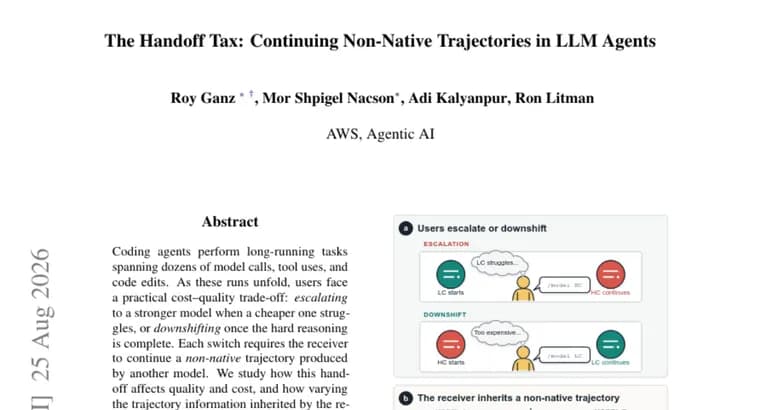
Coding agents now routinely run long tasks made up of dozens of model calls, tool uses and code edits. Partway through such a run, a practical question comes up: escalate to a stronger, pricier model when the cheap one is struggling, or downshift to a cheaper model once the hard reasoning is already done. A new study examines exactly this handoff and the cost-quality trade-off it creates.
The core difficulty is that whichever model takes over mid-task has to continue a trajectory (the sequence of calls, tool use and edits) that it did not produce itself: a non-native trajectory built by another model. The researchers tested how this handoff affects quality and cost, and how varying the amount of trajectory information passed to the receiving model changes the outcome. They used pairs of low-cost, low-capability (LC) and high-cost, high-capability (HC) models from the Claude and GPT families, and varied the handoff's direction (escalating from LC to HC, or downshifting from HC to LC), its timing within the task, and the interface: how much of the prior trajectory the new model receives, comparing full-trajectory transfer, a compacted version, and removing the trajectory entirely while keeping the repository state unchanged.
The headline result: across both model families, escalating with the full trajectory recovers less than half of the quality gap between the LC and HC model, while still incurring a substantial cost premium. The researchers name this cost-quality penalty the 'handoff tax'. Downshifting turned out to be the better deal: handing the task from the HC model to the LC model partway through lands at a favorable point on the cost-quality trade-off.
Which interface works best also flips with direction. When escalating from LC to HC, giving the stronger model less of the weaker model's trajectory information improves the outcome. When downshifting from HC to LC, the opposite holds: stripping out the HC model's trajectory hurts the downshifted result, so the cheaper model does better when it keeps more of the stronger model's prior work to build on.
Key facts
- Long coding-agent runs are increasingly handed off mid-task between a cheaper, weaker model and a pricier, stronger one, forcing the new model to continue a trajectory of calls and edits it did not produce.
- Testing pairs of low-cost/low-capability and high-cost/high-capability models from the Claude and GPT families, escalating to the stronger model with the full trajectory recovers less than half of the quality gap between the two, at a much higher cost: a penalty the study calls the 'handoff tax'.
- Downshifting to the cheaper model once the hard reasoning is finished lands at a favorable cost-quality point, unlike escalation.
- The best way to hand off trajectory information reverses by direction: giving the stronger model less of the weaker model's trajectory helps when escalating, but removing the stronger model's trajectory hurts the weaker model when downshifting.
- All the handoff methods tested (full transfer, a compacted version, and removal) keep the repository's file state unchanged; only the trajectory information passed along differs.
Why it matters
Teams running coding agents often assume that escalating to a stronger model mid-task will recover most of what that model could have delivered from the start, and that downshifting to save money is a straightforward win. This study complicates the first assumption and confirms the second: escalation only closes part of the gap while still costing much more, and downshift is the safer money-saver. That changes how a cost-conscious strategy for switching between cheap and expensive models should actually work inside a long agent run.
Who it affects
Anyone building or operating coding agents that mix model tiers: developers choosing between a cheap and an expensive Claude or GPT model mid-session, and whoever designs the orchestration layer that decides when to escalate or downshift within a single run.
How to use it
The practical takeaway sits in the interface choice. When escalating to a stronger model, do not hand it the full trajectory of the weaker model's work: a reduced or compacted version leads to better outcomes. When downshifting to a cheaper model, do the opposite and keep the stronger model's trajectory intact rather than stripping it out, since removing it hurts the cheaper model's follow-through. And do not expect escalation alone to match what the stronger model would have produced running the task from the start: the study finds it recovers less than half that gap.
How solid is it
The finding held across two separate model families, Claude and GPT, which strengthens it. But the text gives no specific model versions, no benchmark or task suite, and no numeric figures for the size of the quality gap or the cost premium, only the qualitative description of 'less than half' and 'a substantial cost premium'. No authors or institution are named in the material available, so the study's provenance cannot be verified beyond the text itself.
Risks and caveats
Without published numbers, the actual size of the handoff tax is unclear: 'substantial' and 'less than half' could describe a wide range of outcomes. The generic 'Claude and GPT families' framing means it is not clear which specific models were tested or whether the results generalize to other model pairs or to non-coding agent tasks. No venue or publication date appears in the material, so its review status is not established here.
“We term this cost-quality penalty the handoff tax.”
— the study's abstract