ExplorationBench tests 10 AI systems on rule discovery in verifiable 'Alien Worlds'
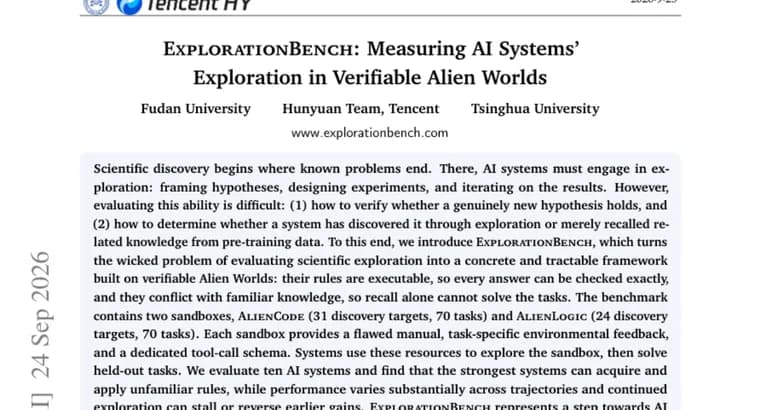
Researchers have introduced ExplorationBench, a benchmark designed to measure whether AI systems can genuinely explore unknown environments rather than simply recall facts from their training data. The problem the benchmark targets is a practical one for evaluating scientific discovery: it is hard to verify whether a new hypothesis actually holds, and it is hard to tell whether a system found an answer through real exploration or just remembered something similar from pre-training. ExplorationBench addresses both problems by building environments the authors call 'Alien Worlds,' whose rules are executable, so every answer can be checked exactly, and whose rules deliberately conflict with familiar, real-world knowledge, so recall alone cannot solve the tasks. The benchmark consists of two sandboxes. AlienCode contains 31 discovery targets across 70 tasks, and AlienLogic contains 24 discovery targets across 70 tasks. Each sandbox gives the AI system a manual that is deliberately flawed or incomplete, task-specific feedback from the environment as it acts, and its own dedicated tool-call schema for interacting with the sandbox. Systems are meant to use these resources to explore, form hypotheses about the actual rules, and test them, before being evaluated on a set of held-out tasks that require applying what they learned. The authors evaluated 10 AI systems on ExplorationBench, though the specific systems and their individual scores are not detailed in the available text. The overall finding is that the strongest systems are able to acquire and apply unfamiliar rules discovered through exploration, but performance is inconsistent: it varies substantially depending on the trajectory a system takes, and continued exploration does not reliably keep improving results. In some cases, further exploration causes a system's performance to stall or even reverse gains it had made earlier. The authors frame ExplorationBench as a step toward AI systems that can acquire and apply genuinely new knowledge in unknown environments, rather than ones that only perform well on tasks resembling their training data.
Key facts
- ExplorationBench evaluates AI exploration through two sandboxes: AlienCode (31 discovery targets, 70 tasks) and AlienLogic (24 discovery targets, 70 tasks)
- The sandboxes use executable rules that conflict with familiar real-world knowledge, so systems cannot solve tasks by recalling pre-training data
- Each sandbox provides a flawed manual, task-specific environmental feedback, and its own tool-call schema for exploration
- 10 AI systems were evaluated, though which systems and their individual scores are not specified in the available text
- The strongest systems can acquire and apply unfamiliar rules, but performance varies across trajectories, and continued exploration can stall or reverse earlier gains
Why it matters
Most benchmarks for AI systems can be gamed by recalling patterns absorbed during training, which makes it hard to tell whether a system is actually reasoning and exploring or just pattern-matching against familiar material. ExplorationBench tries to close that loophole by inventing rule sets that have never appeared anywhere before and that can be checked exactly, so success requires real hypothesis formation and testing rather than memory.
Who it affects
The benchmark is aimed at researchers building and evaluating AI systems for scientific discovery, reasoning, and agentic exploration tasks, who need a way to measure exploration ability separately from recall.
How to use it
ExplorationBench is presented as an evaluation framework with two ready-made sandboxes, AlienCode and AlienLogic, each with its own manual, feedback signals, and tool-call schema; the available text does not specify licensing, availability, or how to run it.
How solid is it
The account here is based on the paper's own description of the benchmark's design and its high-level findings; it does not name the authors, institutions, the specific 10 systems tested, or their individual scores, so those details cannot be reported.
Risks and caveats
The reported behavior itself is a caveat: even the strongest systems show performance that varies substantially depending on the exploration path taken, and continued exploration can stall progress or reverse gains already made, meaning the capability being measured is inconsistent rather than reliably improving with more effort.
“the strongest systems can acquire and apply unfamiliar rules, while performance varies substantially across trajectories and continued exploration can stall or reverse earlier gains”
— ExplorationBench paper