EmbodiedSWE turns coding-agent solutions into training data for robot policies
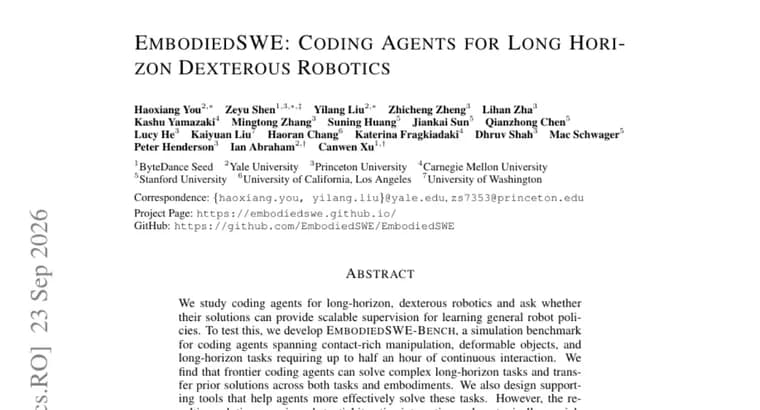
Researchers studying coding agents for long-horizon, dexterous robotics built EMBODIEDSWE-BENCH, a simulation benchmark covering contact-rich manipulation, deformable objects, and long-horizon tasks that can require up to half an hour of continuous interaction to complete. Testing frontier coding agents against this benchmark, the authors report that these agents can solve the complex long-horizon tasks and transfer prior solutions across both different tasks and different robot embodiments, aided by supporting tools the team built to help agents work through the tasks more effectively. The catch: the agents' solutions demand substantial iterative interaction and tend to be specialized to the specific task instance they were solved for, rather than generalizing on their own. To turn these narrow solutions into something broadly useful, the team introduces EMBODIEDSWE-GEN, a method that expands a single coding-agent solution into large, diverse sets of trajectories that can be used to train a vision-language-action (VLA) robot policy. According to the paper, VLA performance improves as more generated demonstrations are added, and diversifying the data with agent assistance improves how well the resulting policy generalizes to task variations it was not trained on. As a capstone result, the authors report that a VLA policy finetuned solely on coding-agent-generated simulation demonstrations, with no additional human demonstration data, was able to complete a long-horizon task on a real physical robot. The paper frames this as a general framework: use coding agents to solve hard robotics tasks once, verify the solutions, and then convert them into scalable training supervision for robot policies rather than relying purely on human-collected demonstrations.
Key facts
- EMBODIEDSWE-BENCH is a simulation benchmark spanning contact-rich manipulation, deformable objects, and long-horizon tasks requiring up to half an hour of continuous interaction.
- Frontier coding agents were found able to solve these complex long-horizon tasks and transfer solutions across tasks and embodiments, though their solutions need heavy iterative interaction and stay specialized to individual task instances.
- EMBODIEDSWE-GEN expands a single coding-agent solution into large, diverse trajectory sets for training a vision-language-action (VLA) robot policy.
- VLA performance improves with more generated demonstrations, and agent-aided diversification improves generalization to held-out task variations.
- A VLA finetuned only on coding-agent-generated simulation demonstrations completed a long-horizon task on a real robot.
Why it matters
Collecting human teleoperation demonstrations for training dexterous robot policies is slow and expensive, especially for long-horizon tasks. This work suggests coding agents can act as an automated substitute: solve a hard robotics task once in simulation, then turn that single verified solution into a large, diverse pool of training data for a robot policy, cutting the dependency on hand-collected demonstrations.
Who it affects
Researchers building vision-language-action (VLA) robot policies and anyone developing or evaluating coding agents for robotics tasks; the benchmark and generation method are aimed at the robot learning research community rather than end users or deployed products.
How to use it
The contribution is research infrastructure: EMBODIEDSWE-BENCH as a simulation benchmark for testing coding agents on contact-rich, deformable-object, and long-horizon manipulation tasks, and EMBODIEDSWE-GEN as a method for expanding one coding-agent solution into many training trajectories for a VLA. The source text does not give pricing, licensing, or release details for either artifact.
How solid is it
The account rests on the paper's own abstract-level description on Hugging Face Papers; it states the method, the benchmark's scope, and the qualitative findings, including the real-robot result, but gives no quantitative success rates or benchmark scores, no author or institution names, and no detail on which coding agents or which real robot were used.
Risks and caveats
The coding agents' raw solutions require substantial iterative interaction and are typically specialized to individual task instances rather than generalizing by themselves, which is precisely why the EMBODIEDSWE-GEN expansion step exists; without independently reported numbers, the size of the reported improvements in VLA performance and generalization cannot be judged from the source text alone.
“We find that frontier coding agents can solve complex long-horizon tasks and transfer prior solutions across both tasks and embodiments.”
— the authors