explosive drone found near Ukrainian cargo planes at German airport
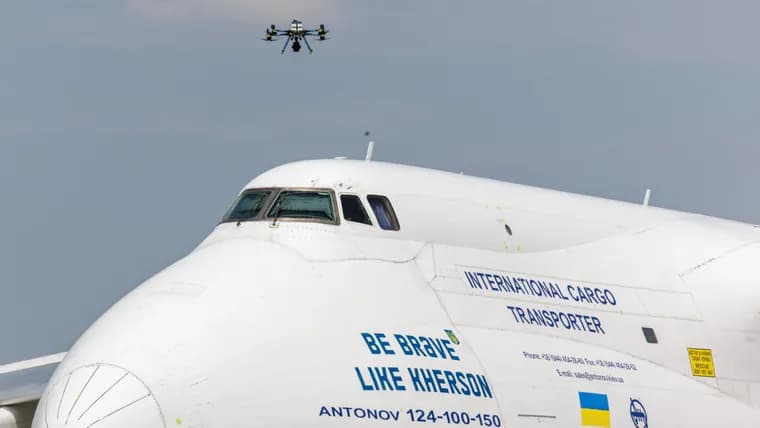
German police disarmed a drone found carrying explosives near Ukrainian cargo aircraft parked at Leipzig/Halle airport, and authorities are now checking whether a second drone was involved after an aircraft collided with something midair. An airport employee first spotted the drone hovering close to the ground between two parked Antonov Airlines An-124 cargo planes shortly before midnight on August 4, according to The Guardian. Germany's federal interior minister, Alexander Dobrindt, told a press conference the drone had apparently been modified to dodge the airport's drone defense sensors. He said it was carrying a fist-sized package of a substance believed to be the plastic explosive Semtex, and that only a failed detonator kept it from going off near the cargo planes. Police used a bomb disposal robot to help disarm the device, then carried out a controlled explosion, according to BBC News. Contrary to some media reports, the German Interior Ministry denied that the targeted Ukrainian aircraft were carrying weapons or other munitions bound for Ukraine, according to Deutsche Welle; officials said the planes were empty at the time. The incident shut Leipzig/Halle, one of Europe's largest air cargo hubs, to all traffic for several hours, forcing 19 flights to divert, according to Flightradar24. Among them was a DHL-operated Boeing 757 that had to abort its landing approach. As that aircraft climbed away, it collided with another flying object midair and diverted to Hanover airport, landing with minor damage, German police said in a statement; authorities are looking into whether that object was a second drone. No suspect has been officially named, but a counterterrorism investigation has been opened. Dobrindt described the episode as a "hybrid threat scenario," saying "we are dealing with a contest here that possibly involves foreign powers."
Key facts
- A drone carrying a fist-sized package of suspected Semtex was found hovering near two parked Ukrainian Antonov An-124 cargo planes at Leipzig/Halle airport shortly before midnight on August 4; a failed detonator prevented it from exploding.
- Interior minister Alexander Dobrindt said the drone had apparently been modified to avoid the airport's drone defense sensors.
- The closure forced 19 flights to divert; a DHL Boeing 757 that aborted landing collided with another flying object midair and diverted to Hanover with minor damage, and authorities are checking whether that was a second drone.
- The German Interior Ministry denied the targeted aircraft were carrying weapons or munitions for Ukraine, saying the planes were empty at the time.
- No suspect has been named; Dobrindt called the incident a "hybrid threat scenario" that may involve foreign powers, and a counterterrorism investigation is underway.
Why it matters
An armed drone reaching a parked Ukrainian cargo aircraft on European soil, despite an airport's drone defenses, is a direct test of how well Western infrastructure supporting Ukraine's war effort can be protected. Officials framing it as a "hybrid threat scenario" possibly involving a foreign power puts it in the same bracket as sabotage and disruption incidents that have targeted European logistics and infrastructure tied to Ukraine.
Who it affects
Ukraine's Antonov Airlines, whose cargo planes were the apparent target; Leipzig/Halle airport, one of Europe's largest air cargo hubs, which had to shut down for hours; DHL, whose Boeing 757 aborted landing and then hit a second object; the 19 flights forced to divert; and German security services, now running a counterterrorism investigation.
How to use it
There is no product or service here to adopt. The practical takeaway is for anyone tracking security around European cargo hubs handling Ukraine-related traffic: expect tighter drone-detection scrutiny at airports like Leipzig/Halle following a device that reportedly evaded existing sensors.
How solid is it
The account rests on an on-record press conference by Germany's federal interior minister and a police statement, cross-checked against reporting from The Guardian, BBC News, Deutsche Welle and flight-tracking data from Flightradar24. The German Interior Ministry has explicitly pushed back on other media reports claiming the targeted aircraft carried weapons.
Risks and caveats
No suspect has been officially named. Whether the object the DHL aircraft struck was actually a second drone is unconfirmed; authorities say only that they are investigating the possibility. How the first drone was modified to evade detection has not been detailed, and no timeline has been given for the counterterrorism investigation.
“we are dealing with a contest here that possibly involves foreign powers”
— Alexander Dobrindt, federal minister of the interior for Germany