GDPevo benchmark exposes gap in agents' self-evolution skills
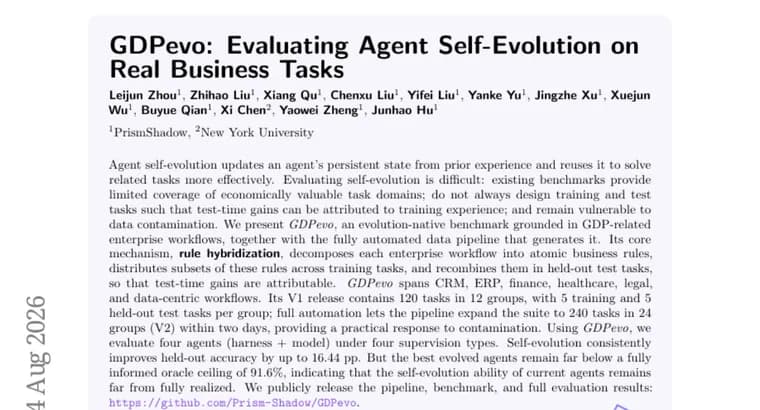
Researchers have released GDPevo, a benchmark built specifically to test agent self-evolution: the ability of an AI agent to update its own persistent state from past experience and reuse that state to handle related tasks better. The authors argue that existing self-evolution benchmarks fall short in three ways: they cover a limited range of economically valuable task domains, they don't always design training and test tasks so that any gain at test time can actually be traced back to the training experience, and they remain vulnerable to data contamination. GDPevo is built around GDP-related enterprise workflows spanning CRM, ERP, finance, healthcare, legal and data-centric tasks. Its core method is called rule hybridization: each enterprise workflow is broken down into atomic business rules, subsets of those rules are distributed across the training tasks, and the rules are recombined in a separate set of held-out test tasks. Because the test tasks are built from known rule combinations, any accuracy gain at test time can be attributed directly to what the agent learned during training, rather than to chance or overlap with the training set. The V1 release contains 120 tasks organized into 12 groups, with five training tasks and five held-out test tasks in each group. The whole pipeline is fully automated, which lets it expand the suite to a V2 release of 240 tasks across 24 groups within two days, a way to keep generating fresh, uncontaminated test material rather than reusing a fixed static set. Using GDPevo, the researchers evaluated four agents, each a combination of a harness and a model, under four different supervision types. Self-evolution consistently improved held-out accuracy, by up to 16.44 percentage points. But even the best evolved agents remained far below the fully informed oracle ceiling of 91.6% held-out accuracy, which the authors take as evidence that current agents' self-evolution ability is still far from fully realized. The team has publicly released the data generation pipeline, the benchmark itself, and the full evaluation results on GitHub, under the Prism-Shadow/GDPevo repository.
Key facts
- GDPevo is an evolution-native benchmark for testing whether AI agents can learn from prior experience on real enterprise tasks across CRM, ERP, finance, healthcare, legal and data-centric workflows.
- Its rule hybridization method splits each workflow into atomic business rules, distributing them across training tasks and recombining them in held-out test tasks so test-time gains can be attributed to training.
- V1 has 120 tasks in 12 groups (five training and five held-out test tasks per group); the fully automated pipeline can expand this to a 240-task, 24-group V2 within two days.
- Across four agents tested under four supervision types, self-evolution improved held-out accuracy by up to 16.44 percentage points.
- The best evolved agents still fall far short of the fully informed oracle ceiling of 91.6% accuracy, showing current self-evolution methods remain far from fully realized.
Why it matters
Agent self-evolution, an agent updating its own state from experience and reusing it on related tasks, is one of the more concrete paths toward agents that improve without retraining the underlying model. But testing whether it actually works has been hard: prior benchmarks skew toward domains with limited economic weight, often can't cleanly attribute a test-time gain to what was learned during training rather than to overlap or luck, and are prone to contamination once their fixed task sets circulate. GDPevo's rule hybridization approach is a direct answer to the attribution problem, and its fully automated pipeline is a direct answer to contamination, since a fresh, larger task set can be generated in days rather than requiring a slow manual redesign.
Who it affects
The benchmark targets researchers and teams building or evaluating self-improving AI agents intended for enterprise use, particularly in CRM, ERP, finance, healthcare, legal and other GDP-linked business workflows. It gives them a way to measure, with attribution, whether an agent's claimed self-evolution capability produces real gains rather than benchmark artifacts.
How to use it
The data generation pipeline, the GDPevo benchmark, and the full evaluation results have been made publicly available on GitHub under Prism-Shadow/GDPevo. Since the pipeline is fully automated, it can also be used to generate the larger V2 suite of 240 tasks across 24 groups within about two days, giving researchers a way to refresh the benchmark and reduce the risk of models having seen the exact test tasks before.
How solid is it
The evaluation covered four agents, each a specific harness-and-model combination, tested under four different supervision types, with the rule hybridization design meant to isolate genuine training-driven improvement from noise. The V1 release of 120 tasks across 12 groups gives a defined, structured test bed, and the demonstrated ability to expand it to 240 tasks within two days is offered as a practical, repeatable defense against contamination rather than a one-off claim.
Risks and caveats
The source text does not spell out what the four supervision types actually are, nor does it break results down agent by agent, only reporting the aggregate improvement of up to 16.44 percentage points. That aggregate figure also needs to be read against the ceiling: even the best evolved agents remain far below the 91.6% oracle accuracy, which the authors themselves read as showing that current agents' self-evolution ability is still far from fully realized. In other words, self-evolution measurably helps, but on this benchmark it closes only part of the gap to what a fully informed agent could achieve.