Feyospace-s1 hits 63.24% success rate, ranks 10th on CyberGym leaderboard
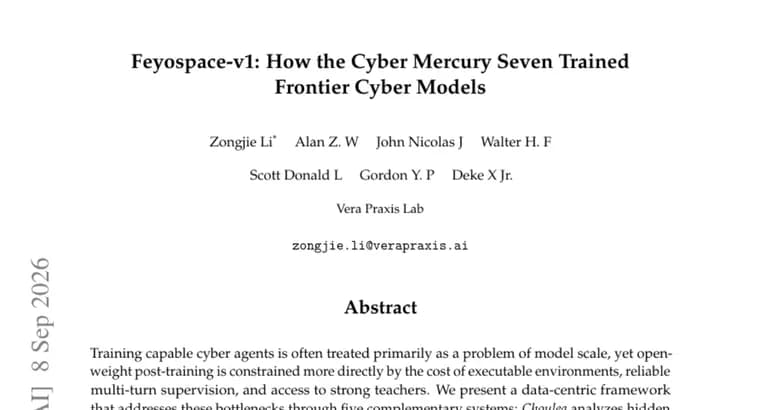
A seven-person independent team argues that training capable AI agents for cybersecurity work is usually treated as a matter of model scale, when the real bottleneck for open-weight post-training lies elsewhere: the cost of building executable environments, the difficulty of reliable multi-turn supervision, and limited access to strong teacher models. Their response is a data-centric framework built from five complementary systems. Choulea analyzes hidden reasoning signatures. SkyReal reduces the cost of sampling from teacher models. Hongzwang bypasses API restrictions on teacher execution. PSBreakup restores capabilities that get weakened when models are merged. Kreator converts expert interventions into trainable reasoning data.
Alongside those five systems, the team built a data engine that constructs resettable coding, vulnerability, capture-the-flag (CTF), kernel-history, full-exploit, firmware, and device-backed environments for agents to work in. Candidate training trajectories generated in these environments are kept only after they pass execution verification and evidence auditing; that filtering produced 164,269 verified trajectories used for long-context supervised fine-tuning.
The three resulting model checkpoints, part of the Feyospace family, improve over their starting models by an average of 23.76% on the full CyberGym benchmark suite and 10.49% across the pooled CTF suites; the passage does not say what those starting models were. As of September 1, 2026, one of the three, Feyospace-s1, reaches a verified success rate of 63.24% and ranks 10th on the official CyberGym leaderboard, while all three checkpoints rank first among models of comparable parameter scale. The team calls this, to its own knowledge, the first end-to-end demonstration that a seven-person independent group can train open-weight models with leading agentic cyber capability; the paper's title also nicknames the group the 'Cyber Mercury Seven,' though the passage does not explain where that name comes from.
Key facts
- A seven-person independent team built a data-centric framework, five complementary systems plus a data engine, to post-train open-weight models for agentic cybersecurity work rather than relying on raw model scale.
- The data engine builds resettable coding, vulnerability, CTF, kernel-history, full-exploit, firmware, and device-backed environments; only trajectories that pass execution verification and evidence auditing are kept, yielding 164,269 verified trajectories for fine-tuning.
- The three resulting Feyospace checkpoints improve over their starting models by an average of 23.76% on the full CyberGym suite and 10.49% across the pooled CTF suites.
- As of September 1, 2026, Feyospace-s1 reaches a verified 63.24% success rate and ranks 10th on the official CyberGym leaderboard; all three checkpoints rank first among models of comparable parameter scale.
- The team calls the project the first end-to-end demonstration that a seven-person independent group can train open-weight models with leading agentic cyber capability.
Why it matters
The paper challenges a common assumption that training capable AI agents for cybersecurity work is mainly a matter of model scale. Its authors argue the real bottleneck for open-weight post-training is elsewhere: the cost of building executable environments, the difficulty of reliable multi-turn supervision, and limited access to strong teacher models. Their answer is a data-centric framework of five named systems, Choulea, SkyReal, Hongzwang, PSBreakup, and Kreator, each addressing one of those bottlenecks, on top of a data engine that generates the training environments themselves. The paper's own title calls this seven-person group the 'Cyber Mercury Seven,' without explaining the name in the passage, and frames the result as the first end-to-end demonstration that a seven-person independent team can train open-weight models with leading agentic cyber capability.
Who it affects
The immediate audience is researchers and engineers working on open-weight agentic models for cybersecurity, in particular anyone weighing raw model scale against this kind of data engineering and verified-trajectory pipeline. The CyberGym and CTF benchmark communities are a direct audience too, since the paper measures itself against the official CyberGym leaderboard and the pooled CTF suites. More broadly, the result is relevant to anyone tracking how much offensive-security capability a small, unaffiliated team can now reach.
How to use it
The passage describes a training methodology, five component systems plus a data engine, rather than a released product. It does not say whether the model weights, the code behind the five systems, or the 164,269 verified fine-tuning trajectories have been or will be released publicly.
How solid is it
The reported numbers rest on more than self-report: candidate trajectories were kept only after execution verification and evidence auditing, and the headline results are checked against a public leaderboard, CyberGym, and pooled CTF suites, giving a rank position, 10th overall and 1st among comparably sized models, that others can in principle verify independently. That said, the passage gives only the improvement deltas, 23.76% and 10.49%, and Feyospace-s1's own 63.24% figure: it does not state what the starting scores were, nor what base models the three checkpoints were built from, and it carries no submission or publication date for the paper itself, only the September 1, 2026 snapshot of the leaderboard standing.
Risks and caveats
The framework is built around coding, vulnerability, CTF, kernel-history, full-exploit, firmware, and device-backed environments. One of its five systems is described only as bypassing API restrictions on teacher execution. That leaves the usual dual-use question open for any agent trained to be good at exploitation, and the passage gives no information on whether the resulting models, code, or training data will be publicly released.
“Training capable cyber agents is often treated primarily as a problem of model scale, yet open-weight post-training is constrained more directly by the cost of executable environments, reliable multi-turn supervision, and access to strong teachers.”
— the authors