FilmFlow uses a Director agent and three helpers to plan 3D camera moves
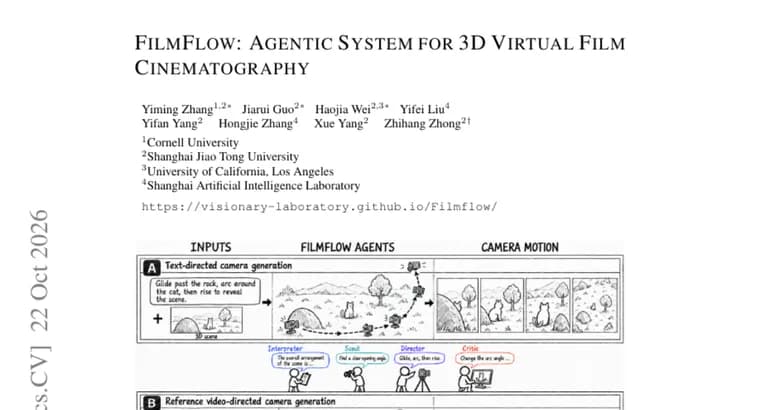
The paper introduces FilmFlow, an agentic framework that converts natural-language instructions or reference videos into explicit camera trajectories for dynamic 3D environments. The starting problem, as the authors frame it, is that complex camera motion is central to visual storytelling, yet turning cinematographic intent into controllable, executable camera trajectories remains hard.
The system is built around a Director agent. The Director constructs executable camera plans by composing high-level motions from concurrent atomic operations that jointly control translation, rotation and framing. Three specialized agents support it. An Interpreter extracts scene-grounded cinematographic intent. A Scout selects initial viewpoints. A Critic evaluates rendered results and gives visual feedback, so the plan can be refined over several iterations.
The paper also introduces CinemaBench, a benchmark of 150 Blender scenes drawn from self-created and licensed sources. Each scene comes with five camera instructions, which gives 750 text-directed tasks. In addition, 60 reference videos are associated with a subset of the scenes. The benchmark is meant to evaluate both text-directed camera generation and video reference-directed camera generation.
The authors report that, across a diverse set of evaluated baselines, FilmFlow achieves the strongest benchmark performance and the highest user preference. They say this demonstrates effective spatial reasoning, temporal coordination and visual composition for executable 3D cinematography. The abstract gives no benchmark scores or margins over the baselines.
Key facts
- FilmFlow turns natural-language instructions or reference videos into explicit camera trajectories for dynamic 3D environments.
- A Director agent composes camera plans from concurrent atomic operations controlling translation, rotation and framing; an Interpreter, a Scout and a Critic support it.
- The Critic evaluates rendered results and gives visual feedback for iterative plan refinement.
- CinemaBench has 150 Blender scenes, five camera instructions per scene (750 text-directed tasks) and 60 reference videos tied to a subset of scenes.
- The authors say FilmFlow achieves the strongest benchmark performance and highest user preference across the evaluated baselines.
Why it matters
Camera movement is a core part of visual storytelling, and turning a director's intent into a trajectory a 3D engine can execute is still hard. FilmFlow tackles this with a division of labour among agents: one reads intent, one picks starting viewpoints, one plans the motion and one checks the rendered result. CinemaBench adds a shared test bed with both text and video-reference tasks, which gives later work something common to compare against.
Who it affects
The work is aimed at people who need controllable camera paths in 3D scenes, such as those building or evaluating camera generation methods. The benchmark is built from Blender scenes, so it is most directly relevant to workflows in that environment.
How to use it
The abstract describes the method and the benchmark but does not mention a code, model or dataset release, so there is nothing here to download or run. A practical reading is as a design pattern: separate agents for interpreting intent, choosing a starting viewpoint, planning motion and critiquing rendered output.
How solid is it
The claims come from the authors' own abstract. They say FilmFlow beats a diverse set of baselines and wins on user preference. The abstract does not name the baselines, give any scores or margins, or describe the user study. The abstract also does not name the models behind the agents. Treat the headline result as a claim until the full paper's numbers are checked.
Risks and caveats
CinemaBench is modest in size: 150 scenes, 750 text tasks and 60 reference videos linked to only some of the scenes. The scenes come from self-created and licensed sources. Results on a benchmark introduced alongside the method, with baselines chosen by the authors, may not carry over to other scenes or production pipelines.