BrickWright lets coding agents build LEGO models that are physically valid
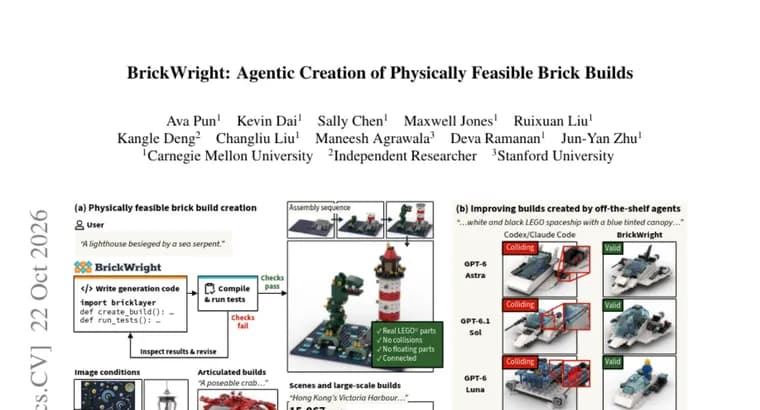
Frontier coding agents are getting better at 3D modeling, but the paper says they still struggle with objects meant to be assembled in the physical world. They often produce invalid assemblies with floating, colliding or disconnected parts.
The authors argue that giving agents tools for assembling builds and for checking physical feasibility is enough for them to produce physically valid assemblies that still follow the input prompt. To test this on LEGO bricks, they present BrickWright, a framework that generates physically feasible brick builds from text or image prompts using pre-trained agents. A build counts as physically feasible if it uses only real parts, has no colliding or floating parts, and forms a connected structure if possible.
BrickWright has agents create builds by writing code with BrickLayer, a Python toolkit with two main components. The first is a brick assembly API that, according to the authors, halves inference cost compared to working in raw LDraw. The second is a validator that gives the agent feedback on physical feasibility.
The reported results: baseline agents reach physical validity rates ranging from 9% (GPT-6 Luna) to 69% (GPT-6 Astra). BrickWright-guided agents reach 100% validity on a sample of 512 prompts. The authors also say prompt adherence improves for lightweight agents and is maintained for stronger agents, and that the guided agents outperform specialized models on the text-to-brick task. Code is available on the project page at avalovelace1.github.io/brickwright.
Key facts
- BrickWright is a framework that has pre-trained coding agents generate physically feasible LEGO builds from text or image prompts.
- Agents write code with BrickLayer, a Python toolkit with a brick assembly API and a validator that gives feedback on physical feasibility.
- Baseline agents reach physical validity of 9% (GPT-6 Luna) to 69% (GPT-6 Astra); BrickWright-guided agents reach 100% on a sample of 512 prompts.
- The assembly API halves inference cost compared to working in raw LDraw.
- The authors report better prompt adherence for lightweight agents, maintained for stronger ones, and better results than specialized models on text-to-brick.
Why it matters
The paper's central claim is that agents do not need new training to build physically valid objects: tools for assembly and for checking feasibility are, in the authors' words, sufficient. Baseline frontier agents often leave parts floating, colliding or disconnected, and the jump from 9% to 69% for baselines up to 100% for guided agents is the evidence offered. The authors also say the guided agents beat specialized models on the text-to-brick task.
Who it affects
The work targets people building agent systems that output things meant to exist physically, with LEGO bricks as the test domain. It is also relevant to anyone generating brick designs from text or image prompts. Code is public on the project page.
How to use it
Code is available on the project page, avalovelace1.github.io/brickwright. The method has agents write code against BrickLayer, a Python toolkit, using its brick assembly API to build and its validator to check feasibility and get feedback. The authors say the API halves inference cost compared to raw LDraw.
How solid is it
This is a preprint listed on Hugging Face Papers, and the figures are the authors' own. The 100% validity is measured on a sample of 512 prompts and judged by the validator's definition of feasibility: real parts only, no colliding or floating parts, a connected structure if possible. Baseline results are given only as a range, 9% to 69%.
Risks and caveats
The text does not say which agents were used in the BrickWright runs, or whether 100% holds for each agent individually. It does not name the specialized models used for comparison, and prompt adherence is described only by direction, with no numbers. The halved inference cost has no absolute figures. No physical assembly of the generated builds with real bricks is reported.