Finland orders Google to halt work on two datacentre sites over missing impact assessment
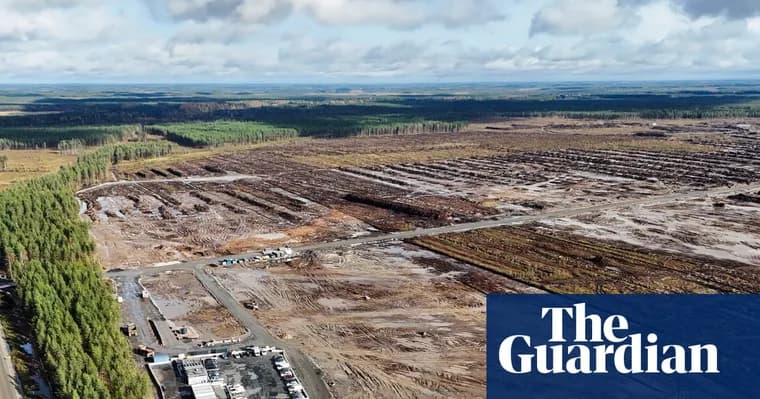
Finland's Licensing and Supervision Authority (LVV) has ordered Google to temporarily stop work on two datacentre sites in northern Finland, in Muhos and Kajaani, after the company failed to complete the necessary environmental impact assessments (EIA) on its construction sites. The two sites are part of a €13bn (£11bn) Google project across multiple sites in northern Finland, built amid huge demand for space to house online infrastructure.
On Tuesday LVV said it had issued a notice to the company to 'immediately suspend', by 23 October at the latest, 'preparatory measures that significantly change the environment' at the two sites until the EIA is complete. The EIA is ongoing and expected to finish later this year. But Google went ahead with 'extensive preparatory measures', LVV said, including removing trees, stripping topsoil and constructing site roads. Google has until next Wednesday to submit a written explanation. If it does not comply, LVV said it would consider enforcement proceedings and a fine.
The scale of the clearing is large. Tuike Finland Oy, the company representing Google, felled 330 hectares (815 acres) of forest in Muhos without completing an EIA. In Kajaani, the company has reportedly been logging across just under 200 hectares (494 acres) of land.
Tommi Muilu, head of the environmental department at LVV, put the regulator's reasoning plainly: the measures in question will change the environment and cause impacts, and identifying and assessing those impacts is among the key objectives of the EIA procedure.
Google responded in a statement that 'we understand the concerns' and that it had 'fallen short of our own high standards'. It said it will study LVV's findings and follow its guidance, and added that it acted in good faith under the Forestry Act, ran nature surveys and put in place measures to protect high-value areas. As part of landscaping and biodiversity plans, it pointed to tree planting across 130 hectares (321 acres) at Muhos.
The Finnish Association for Nature Conservation said the sites had been reduced to 'sand'. Its chief operating officer, Tapani Veistola, called the malpractice across the two sites a 'systemic problem' and said Muhos is 'not a forest any more. It is a sand area.' He blamed the 'overheated' market for new datacentres, which pushes companies to work as fast as possible, together with a lack of expertise in small municipalities that are overwhelmed by the demand.
Key facts
- LVV, Finland's Licensing and Supervision Authority, ordered Google to suspend preparatory work at two datacentre sites in Muhos and Kajaani by 23 October at the latest, until the environmental impact assessment is complete.
- Tuike Finland Oy, the company representing Google, felled 330 hectares of forest in Muhos without a completed EIA; in Kajaani, just under 200 hectares are reportedly being logged.
- Google has until next Wednesday to submit a written explanation; if it does not comply, LVV said it would consider enforcement proceedings and a fine.
- Google said it had 'fallen short of our own high standards' and will follow LVV's guidance, while stating it acted in good faith under the Forestry Act.
- The sites are part of a €13bn (£11bn) Google project across multiple sites in northern Finland.
Why it matters
A national regulator has stepped in during the build phase of a €13bn project by one of the largest technology companies. The core of the case is sequence: trees were removed, topsoil stripped and site roads built before the assessment that exists to identify the environmental impacts of exactly those measures had been completed. LVV's head of environmental matters said as much. The conservation association argues the problem is systemic and driven by an overheated datacentre market, which makes this a test of how fast datacentre construction can move under Finnish permitting rules.
Who it affects
Google and Tuike Finland Oy, the company representing it, face a suspension at the Muhos and Kajaani sites and a possible enforcement proceeding and fine. The municipalities involved are affected too: Veistola says small municipalities lack expertise and are overwhelmed by the demand to build datacentres in Finland. Anyone else building datacentres in the country operates in the same market that the conservation association describes as overheated.
How to use it
This is a regulatory story rather than a product, so there is nothing to adopt. For readers following datacentre siting in Finland, the dates to watch are the following: Google's written explanation, due next Wednesday; the 23 October deadline by which preparatory measures must be suspended; and completion of the EIA, expected later this year. Whether LVV moves to enforcement proceedings and a fine depends on Google's compliance.
How solid is it
The account is a news report that rests on LVV's notice, with named officials quoted: Tommi Muilu of LVV and Tapani Veistola of the Finnish Association for Nature Conservation. Google's own statement is quoted directly. The Muhos figure of 330 hectares is stated as fact, while the Kajaani figure of just under 200 hectares is reported as 'reportedly', with no LVV figure given for it. The report does not say any authority or court found the tree felling illegal; LVV's notice concerns preparatory work carried out before the EIA was completed. The second site is spelled both 'Kajanni' and 'Kajaani' in the report; Kajaani is used here.
Risks and caveats
The suspension is described as temporary, pending completion of the EIA, not as a permanent halt. No fine amount is given; LVV said only that it would consider enforcement proceedings and a fine if Google does not comply. Google says it acted in good faith under the Forestry Act, so the question of responsibility is not settled by the notice. The 'sand' and 'not a forest any more' descriptions come from the conservation association, not from LVV. The report gives no information about the datacentres' size, power use or purpose beyond their being part of the €13bn project.
“In our opinion, the measures in question will change the environment and cause impacts, the identification and assessment of which are among the key objectives of the EIA procedure.”
— Tommi Muilu, head of the environmental department at LVV