FlyTrex remote pilots work like air traffic controllers for delivery drones
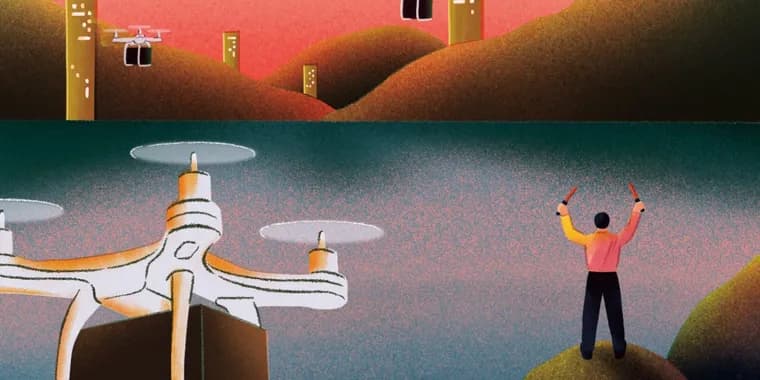
MIT Technology Review's "Job titles of the future" series profiles Trevor Wischnewsky, a remote pilot in command (RPIC) at the drone-delivery company FlyTrex. He decided to pursue the work the moment he heard that drones were delivering pizza and sushi around his Texas neighborhood. "It was super fascinating," he says. "I just immediately wanted to be a part of it."
The article describes an RPIC as something like an air traffic controller: instead of airplanes, the job is tending fleets of hexacopter drones that carry cargo to homes and businesses within a three-mile radius. Wischnewsky makes sure FlyTrex's parcels travel safely, and he also coordinates traffic with a growing swarm of delivery drones over Dallas from competitors including Zipline, Amazon and Alphabet's Wing.
The piece is organised around what it takes to get the job. The first requirement is aviation experience. When he applied, Wischnewsky was training to become a commercial pilot and flight instructor, and he already held a Federal Aviation Administration certification as a drone pilot. FlyTrex requires that credential, plus a weeks-long FAA-approved training course, so that a pilot is ready to take over a drone if needed. He does not pilot the craft day to day. He monitors the delivery process from FlyTrex's operations center, using inputs from GPS, lasers and a range of sensors.
The second is a collaborative mindset. At first, the biggest challenge was trusting the technology. "On the manned-aircraft side, they tell you 'Don't trust the automation,'" Wischnewsky says. But the Dallas-Fort Worth area is a testing ground for unmanned aircraft systems traffic management (UTM), a network that lets autonomous drones from FlyTrex and its competitors share their coordinates in real time to help avoid collisions, even beyond the pilot's line of sight. Once he confirms that a drone is flight-ready, its path is unimpeded and the weather is clear, UTM takes care of the rest.
The third is staying calm under pressure. At his busiest, Wischnewsky has up to 10 drones on his watch at the same time. "You're there as a safety net," he says. Even with automation, keen situational awareness is required, and the most common hazard is the weather. He recalls one stressful day when a drone had been in the air for only seconds and the wind picked up so suddenly that he had to intervene. He returned it safely, which kept an errant ice cream cake from hitting the sidewalk.
Key facts
- Trevor Wischnewsky is a remote pilot in command (RPIC) at drone-delivery company FlyTrex; the article likens the role to an air traffic controller for hexacopter drones that serve a three-mile radius.
- He coordinates traffic with competing delivery drones over Dallas from Zipline, Amazon and Alphabet's Wing, and at his busiest watches up to 10 drones at once.
- FlyTrex requires an FAA drone-pilot credential plus a weeks-long FAA-approved training course so a pilot can take over a drone if needed.
- The Dallas-Fort Worth area is a testing ground for unmanned aircraft systems traffic management (UTM), a network where drones from different companies share coordinates in real time.
- Even with automation, the job demands situational awareness; the most common hazard is the weather, and Wischnewsky describes himself as a safety net.
Why it matters
Delivery drones from several companies now share the same sky over the Dallas area, and the article shows what keeps that orderly. A UTM network lets autonomous drones from FlyTrex and its competitors trade coordinates in real time, and a human RPIC sits above it as a supervisor rather than a pilot. The profile is a small, concrete look at a job that exists because drone delivery has become routine enough to need people watching it.
Who it affects
The most direct audience is people weighing a career in aviation or drone operations. Wischnewsky arrived with commercial-pilot and flight-instructor training and an FAA drone-pilot certification. The piece also touches the delivery companies named in it, FlyTrex, Zipline, Amazon and Wing, whose drones share airspace and coordinates in the Dallas-Fort Worth area, and the homes and businesses within a three-mile radius that receive parcels.
How to use it
Treat it as a checklist for the role as the article presents it. FlyTrex requires an FAA drone-pilot credential and a weeks-long FAA-approved training course. The article lists three qualities: aviation experience, a collaborative mindset, and the ability to stay calm under pressure. Day to day, the work is monitoring deliveries from an operations center using GPS, laser and sensor inputs, confirming each drone is flight-ready, its path clear and the weather acceptable, and being ready to take over.
How solid is it
This is a short first-person-sourced profile in MIT Technology Review's "Job titles of the future" series, written by Eamon Whalen, a reporter and researcher based in San Francisco. It rests on one worker's account and the author's description of the role. It gives no figures for FlyTrex's fleet, number of RPICs or deliveries, and no pay information. The label "air traffic controller" is the headline's shorthand; the article itself says an RPIC is "like" one.
Risks and caveats
The article names the weather as the most common hazard, and its anecdote shows how fast it can turn: wind picked up seconds after a drone took off and Wischnewsky had to step in. He also says trusting the automation was the hardest part at first, which sits against the manned-aviation habit of not trusting it. The piece offers no accident or incident statistics and no regulatory detail on UTM beyond its description, so it cannot be read as a measure of how safe drone delivery is overall.
“You’re there as a safety net,”
— Trevor Wischnewsky, remote pilot in command at FlyTrex